
Patones Climbing Guide
Steep, Pocketed Limestone & Winter Sun at Pontón de la Oliva — Sierra Norte de Madrid, Spain
Patones is one of the busiest crags in central Spain, and for good reason — more than 900 single-pitch sport routes packed around an old dam less than an hour north of Madrid. It’s steep, pockety and sun-soaked through the winter, with parking close to the rock and van-friendly spots a short hop away. This guide covers everything you need to plan a trip: the climbing and the style, the seasonal closures to watch out for, getting there, where to park and sleep, and which topo to use.
Rock type
Limestone (calcarenite)
Discipline
Single-pitch sport
Grades
~4c to 9a+, bulk 6a–7c
Routes
900+ across the area
Approach
5–15 min, partly downhill
Best season
Oct–Mar (sunny, sheltered)
From Madrid
~50 min by car
Rope
60m + 14 quickdraws
Why climb at Patones?
If you’re rolling through central Spain in the cooler months, Patones is hard to skip. It’s widely considered the second most important sport-climbing area around Madrid after La Pedriza, and it’s the busiest limestone venue in the whole central region — for good reason. You get a huge concentration of routes packed around an old, disused dam, a forgiving approach, and walls that catch sun and shade at different times of day so there’s almost always somewhere comfortable to climb.
The headline crag is Pontón de la Oliva, which on its own holds well over half of the area’s routes. It sits on the old dam of the same name on the Río Lozoya, straddling the border between the Comunidad de Madrid and the province of Guadalajara. Around it sit four smaller satellite crags — Peñarrubia, Los Alcores, Patones Pueblo and Cañón de Uceda — which together push the total well past 900 routes.
It’s also just one piece of a brilliant climbing region — if you’re basing yourself near the capital, it pairs naturally with the granite of La Pedriza, La Cabrera and Valdemanco (see our complete guide to climbing around Madrid). For van lifers it’s a genuinely easy stop: tarmac most of the way in, parking right by the rock, and the postcard village of Patones de Arriba a short hop away when you need a rest day, a coffee or a phone signal.
The rock & the style
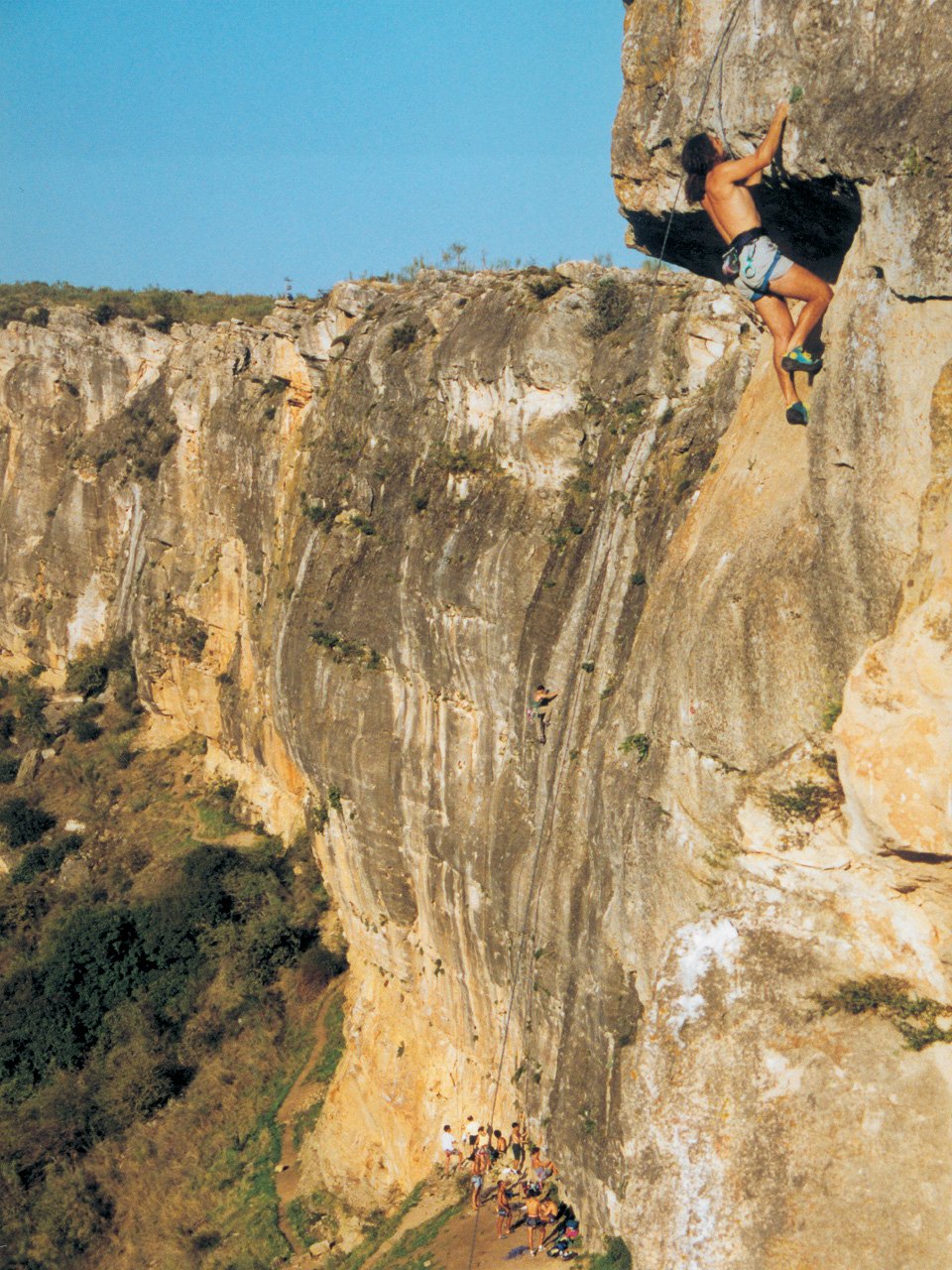
Patones is steep, athletic single-pitch climbing on limestone — technically a calcarenite, which gives it that characteristic pockety, holey texture. Expect vertical walls and bulging overhangs covered in pockets, jugs and crimps, with routes that tend to be sustained and powerful rather than balance-dependent. Several sources describe the climbing as “explosive” — short, intense and reachy in places. Average route length is around 25m.
The grade spread runs from around 4c right up to the area’s hardest test pieces, but the real sweet spot is the 6a to 7c band, where the volume of quality routes is enormous. At the top end, Pontón de la Oliva is home to genuinely hard modern lines — the standout being Panorama / Panodrama at 9a+, a powerful, mostly-traversing route first done by Kymy de la Peña.
Bolting is generally good — many routes have been re-equipped in recent years with stainless or titanium hardware, and spacing is reasonable rather than run-out (steeper terrain aside). A 60m rope and around 14 quickdraws covers the vast majority of single-pitch routes; lower-offs are the norm. One known quirk: some of the easier routes closest to the car parks are a bit polished, so the area rewards climbers operating in the 6s and above.
⚠ Seasonal closures — read this before you plan dates
Patones has bird-nesting restrictions that close a big chunk of the main wall for roughly half the year. According to Montaña Regulada (listing updated January 2026), climbing is banned from 15 January to 15 June in nine of the upper sectors on the Guadalajara side: Parking, Maracaibo, Quebrantahuesos, Sangre, Púrpura, Grajo Free, Poyero, Desmond and Placas del Sol.
On top of that, the Pasarela and Muro Erótico sectors are closed year-round — they sit on private land belonging to the Canal de Isabel II water company. Note that older guidebooks and some forum posts quote different dates (you’ll see “1 Jan – 1 Jul” floating around), so dates and affected sectors do shift year to year.
Always check the current on-site signage and Montaña Regulada before you travel. The practical upshot: the prime, restriction-free window is autumn into early winter (Oct–Dec), when conditions are good and the upper wall is open.
The crags & sectors
“Patones” is an umbrella name for several crags. Here’s how they break down so you know where to point the van.
⚠️ May 2026 update: The approach on the east side of the dam no longer exists following earthworks. Routes on Muro de los Lamentos beyond Baracalofy may be inaccessible — check the UKClimbing logbook for current conditions before heading there.
Pontón de la Oliva
The reason most people come. A long sweep of sectors strung along the old dam, with everything from gentle warm-ups to 9a+. Big sectors include Stradivarius, Maracaibo, Poyero, Grajo Free, Luna and the popular Muro de los Lamentos — a common first stop with high-quality routes.
Patones Pueblo
Reached on the way in, near the turn-off toward Patones de Arriba. A handy smaller sector if the main wall is busy or partly closed.
Cañón de Uceda
About a kilometre on from Patones Pueblo. Note: driving on the Canal de Isabel II service tracks here is prohibited — check access on arrival.
Peñarrubia & Los Alcores
The two further outlying crags that round out the 900+ route total. Quieter, and more useful when you want to escape the Pontón crowds.
Heads-up: route and sector layouts here are detailed and frequently updated by locals. We’d strongly recommend cross-checking sector names and current access against an up-to-date topo (see the resources section) rather than relying on any single printed source.
Topos, apps & guidebooks
Patones is well documented, but layouts and access change often here, so a current digital topo usually beats an ageing printed one. Here’s which resource is best for what:
| Resource | Format | Best for |
|---|---|---|
| Rockfax — “Madrid” | App-only (paid) | English-speaking visitors who want clean, curated topos with parking and access info. Covers ~300 routes across four Madrid crags (Patones, La Pedriza, La Cabrera, Valdemanco), so for Patones it’s a selection of the classics rather than the full tally. |
| 27Crags | Free, app/web | The full route database and logbook for Pontón de la Oliva — every sector listed with route counts, grades and ascent logging. Premium recommended for the full experience. |
| theCrag | Free, web/app | The other big crowd-sourced listing (900+ routes), with recent ascents and useful access notes. Good for cross-checking what’s been re-bolted and what’s currently open. |
| enlavertical.com | Free, web | Detailed Spanish-language sector breakdowns and topos, especially good on Pontón de la Oliva. |
| “Patones y Alrededores” or “Patones Guidebook” 📘 THE GUIDEBOOK | Print book | The definitive comprehensive guide — 900+ routes with photo topos and French grades. Spanish-only, 3rd edition (2015), so thorough on routes but partly dated on access. Buy from Climbing-guide-eu ↗ |
| Montaña Regulada | Free, web | Not a topo — the authority for current restrictions and seasonal closures. Check it before every trip. |
New to topo apps? See our walkthrough on getting the most from 27Crags & Rockfax and our full review of the Rockfax app.
Parking & van life logistics
This is the bit that’s changed and where people get caught out, so pay attention here.
Historically you could drive right up to a couple of lots beyond the lower bridge. That’s no longer allowed and is actively being fined. The only legal parking now is the designated lot toward El Atazar; anything past the dam turn-off risks a ticket. From the legal lot it’s a short, easy walk to the rock.
🏨 Places to Stay Nearby
Accommodation in Patones & the Sierra Norte
Rural hotels, apartments and campsites on one map — filter by price, dates and type. Patones de Arriba is tiny and books out at weekends.
Booking through this map supports the blog at no extra cost to you.
Sleeping in the van
Free wild camping is officially prohibited, but overnight van parking is tolerated at a couple of spots, and climbers’ vans are a common sight in the lots:
- Pontón de la Oliva car park — quiet at night (empties out after ~6pm), gravel/dirt surface, no services, bins only. Zero light pollution makes for great stargazing. Restaurant near the dam.
- Patones de Abajo car park — flat, free, with a fountain and picnic area next to the lot; 10-minute walk up to Patones de Arriba via the ecological path. Lovely for visiting the village, but it can get rowdy on Saturday nights.
Always verify current overnight rules on Park4Night before you settle in, as enforcement around the dam has been tightening.
Water, food & supplies
- Water: there’s a fountain on the left as you leave Torrelaguna toward Patones — Google Maps ↗ — and a fountain in Patones de Abajo next to the frontón (handball court), handy for topping up van tanks.
- Food & beer: Bar Manolo in Patones de Abajo is the local climbers’ hangout and a solid spot for a post-session beer or a bite.
- Resupply: Torrelaguna (20 min) has the basics — shops, places to eat and a drink. It’s quiet midweek, busier at weekends.
- Rest day: Patones de Arriba is a beautifully preserved slate-built village and a genuinely nice wander when your skin needs a break.
Quick practical tips
- Go midweek if you can — weekends bring crowds, parking restrictions and the shuttle bus.
- Chase the shade or sun. Most routes get sun after about 3pm, and you can usually find a shaded sector — useful given the area’s reputation for getting busy and warm.
- Best window is Oct–Dec: good conditions and the nesting closures haven’t kicked in yet.
- Bring a 60m rope and stick-clip-friendly draws — some first bolts on the steeper lines are worth protecting.
- Double-check closures on the day. Signage at the foot-of-crag trail marks the current restricted sectors.
- Kids: belay bases are mostly flat and shady, but the ground underfoot can be uneven for little ones.