
Van Life Electrical Setup 2026 — Our Exact Power System
How we power the van full-time across Europe — Liontron LiFePO4, Victron components, 450W solar, DC-DC charging, and what it all actually costs.
A note on our recommendations: some links in this guide are affiliate links for products we personally run in our van. If you buy through them we earn a small commission at no extra cost to you — that’s what keeps Rock Van Life and our free climbing guides running. We bought all of this kit ourselves.
Power is the infrastructure of van life. Everything runs off it — the fridge, the lights, the phones, the laptop, and for us, a Starlink dish that draws a meaningful load every time we work. Get the van life electrical setup wrong and you’re either constantly anxious about the battery level or you wake up somewhere remote with nothing left. Get it right and you don’t think about it at all.
📋 What this is
Our exact system after two years of full-time van life across Europe — shared as a reference point, not a blueprint. Every van and every lifestyle is different.
📋 In This Guide
Why your van life electrical setup matters
Most van conversion guides treat the electrics as an afterthought — slap in a leisure battery, wire a solar panel, done. That works until you actually live in it. A weekend in good weather is easy. Full-time across Europe in winter, parked for days at a time in a valley with no solar gain, running a fridge, a laptop, and a satellite dish — that can be a different situation entirely.
We built this system because we needed it to be reliable, not clever. We wanted to know exactly how much power we had, charge it reliably from two sources, and not think about it again. After two years, we don’t anymore.
What we’re actually powering
Before choosing a battery size or solar setup, it’s worth being honest about the loads. Here’s roughly what runs off our 12V system:
| Device | Draw | Usage | Daily total (Wh) |
|---|---|---|---|
| Compressor fridge | ~35W | 24/7 (~40% duty cycle) | ~336Wh |
| Starlink dish (12V kit) | ~30W | 6–8h when working | ~210Wh |
| GL.iNet router | ~5W | When Starlink is on | ~40Wh |
| LED lighting | ~15W | Evenings (~3h) | ~45Wh |
| 2× phone + 2× laptop | ~50W | Daily charging | ~80Wh |
| Water pump | ~60W | Brief bursts | ~10Wh |
| Working day total | ~700–800Wh | ||
| Rest day (Starlink off) | ~400–500Wh |
Running Starlink through an inverter on AC instead of a 12V kit would add ~40W of conversion loss on top. That’s the single biggest efficiency gain we made.
The goal from there was simple: cover that with solar while stationary, and top it up from the alternator on driving days. We move every few days anyway — that combination of 450W on the roof and a DC-DC charger while moving means we’ve never run out, and never once needed a hook-up. No time spent looking for Campsite or Wifi when we need from anywhere.
LiFePO4 vs AGM — why we chose lithium
This is the decision that shapes everything else — and honestly, in 2026, it’s not much of a debate anymore. Lithium (LiFePO4) has won. We’re not here to argue the ethics of lithium mining or compare battery chemistries in exhaustive detail, but we can tell you from direct experience: before the van, we lived on a boat with four sealed lead-acid batteries. The comparison is stark.
With AGM you can only safely use about 50% of rated capacity before damaging the cells — so a 200Ah AGM actually gives you ~100Ah of usable power. To get the equivalent of one 200Ah lithium battery you’d need two, three, sometimes four lead batteries taking up space, adding weight, and still delivering less. Lithium you can take down to zero, charge back up, and lose nothing. It lasts longer, takes up less space, weighs significantly less overall, and for the same usable power it’s simply a fraction of the footprint. Once you’ve used it, going back feels absurd.
LiFePO4 (lithium iron phosphate) changes that completely.
✓ LiFePO4 advantages
- Use 80–100% of rated capacity — almost double the usable power
- 2,000–5,000 charge cycles vs 400–600 for AGM
- Significantly lighter for the same capacity
- No off-gassing — safe to install inside the van
- Better performance in partial state of charge (key for solar)
- Built-in BMS protects against overcharge and over-discharge
✗ Worth knowing
- Higher upfront cost — roughly 3–4x the price of equivalent AGM
- Cannot be charged below 0°C without a heated battery or low-temp protection
- Requires a compatible charger (not all older DC-DC or solar controllers work, do your research first)
- BMS can cut out if pushed hard — rare, but worth knowing
Over a 5-year lifespan the maths almost always favours Lithium — for full-time van life specifically, the usable capacity advantage is the clincher.
Our battery: Liontron LiFePO4
We run a Liontron LX 12.8V 150Ah LiFePO4 — a German-brand lithium battery with a built-in BMS. We chose it because it’s a properly engineered European product (not a rebranded generic cell), the BMS handles the protection logic so we don’t have to, and it integrates cleanly with the Victron monitoring system.
🔋 What the BMS does for you
The built-in Battery Management System automatically protects against over-charge, over-discharge, short circuit, and excessive temperature. In practice this means you can connect solar, a DC-DC charger, and a load simultaneously without worrying about managing it manually — the BMS sorts it.
After two years of daily use — including winter months in northern Europe where solar gain is minimal — the battery has been completely reliable. No swelling, no issues, performs exactly as rated.
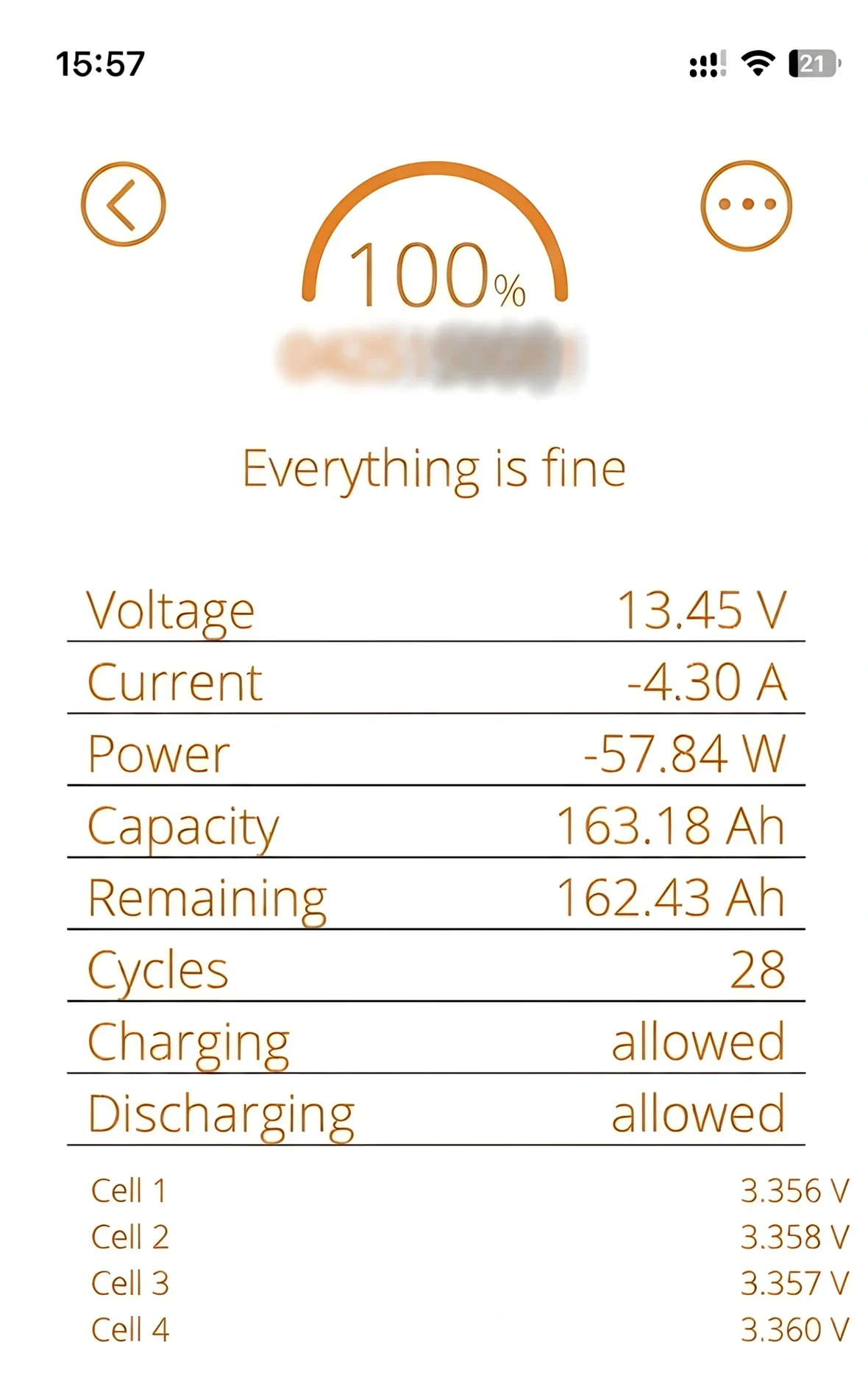
One thing worth mentioning: Liontron batteries come with their own app which connects over Bluetooth and shows you exactly what’s happening in real time — state of charge as a percentage, current draw, charge rate coming in, temperature. It’s genuinely useful day to day, especially early on when you’re still learning your consumption patterns. You open it in the morning, see 78%, notice the fridge drew 12Ah overnight, watch the solar start pushing it back up — it makes the whole system feel transparent rather than mysterious.
💡 Where to buy Liontron in Europe
Liontron is a German brand and doesn’t sell direct to consumers. The best sources we’ve found in Europe are AKKUman.de (ships across Europe) and Camping Wagner (German market). Both stock the full Liontron range. Once our affiliate links are live we’ll update these.
Solar: 450W on the roof
We have a 450W JAM54D40 N-type bifacial panel permanently mounted on the roof — and one thing worth flagging upfront: this is a large panel. At 1,762 × 1,134mm and 22kg, it’s a residential/commercial-grade module, not a compact campervan unit. It fits our roof (we run a long-wheelbase, high-roof van) but it would not fit on a short-wheelbase Transit, or anything with a smaller roof footprint, especially alongside a roof fan. If you’re on a smaller van, you’d either need two smaller panels or a different module entirely — worth checking your roof dimensions carefully before buying. This feeds into a Victron SmartSolar MPPT controller. On a good summer day in southern Europe this comfortably covers everything we use, with charge to spare. In winter in northern Europe it’s less — sometimes much less — which is why the DC-DC charger below matters.
Summer (south Europe)
450W in full sun generates roughly 120–160Ah per day (around 1,600–2,000Wh). On a solid summer day in southern Europe that covers our full consumption and the battery is typically full by early afternoon.
Overcast / north Europe
Diffuse light still generates 20–60Ah depending on cloud density. Not enough alone — this is when driving becomes important.
Winter
Short days and low sun angle reduce output significantly. LiFePO4 handles partial state of charge better than AGM, which helps — but plan your driving accordingly.
📐 Why we went from 240W to 450W — and why it matters
We started with 240W of solar. On paper that sounds reasonable — in practice, on a full working day with Starlink running, we were barely breaking even in good sun and going backwards in anything less. Every slightly overcast day meant a stressed battery by evening. We upgraded to 450W and the difference was immediate: the battery hits full by midday on a decent day, and we haven’t genuinely run low since — unless it’s been solidly overcast for several days in a row with no driving. The maths is simple: 240W in real conditions generates roughly 700–800Wh on a good day, which is almost exactly what a working day consumes. There’s no margin for anything less than perfect sun. 450W generates around 1,200–1,300Wh on the same day — enough to cover consumption and top the battery back up. If you’re planning a serious full-time setup, don’t undersize the solar to save money upfront. It’s the one thing we’d do differently from day one.
The Victron Energy SmartSolar MPPT 100/50 controller is the device between the panels and the battery. MPPT (Maximum Power Point Tracking) extracts significantly more power than older PWM controllers — typically 20–30% more. It’s also Victron, which means it integrates with the monitoring system and talks over Bluetooth. Always choose your MPPT according to your battery type.
💡 Panel brand — a note
We’re not going to pretend the panel brand matters enormously — solar cells are commoditised. What matters is getting enough wattage on the roof, installed securely with the right cable gauge and fusing. If you want a one-brand solar kit (panels + controller + cabling), Renogy makes solid, well-documented kits that are easy to buy in Europe and come with decent support.
Charging while driving: Victron Orion DC-DC
Solar is great when the sun is out. But in winter, parked for three days in a cloudy valley in the Alps, you need another charging source. That’s the DC-DC charger — it charges your leisure battery from your van’s alternator while you drive.
We use the Victron Orion DC-DC charger. The key reason to use a proper DC-DC charger rather than a split-charge relay (the older, simpler alternative) is that LiFePO4 batteries have a specific charging profile that a relay doesn’t respect. The Orion charges correctly, protects your starter battery, and can be set to only engage above a threshold voltage — so it doesn’t drain your starter battery if the engine is off. Check your alternator type, this will give you your numbers.
⚡ How much does driving actually charge?
On a typical motorway drive of 1.5–2 hours, the Orion adds roughly 30–50Ah back into the battery depending on the charger spec and alternator output. Combined with whatever solar generates that day, an hour or two of driving keeps the system topped up through cloudy stretches.
This combination — solar for static days, DC-DC for driving days — means we’ve rarely dipped below 20% state of charge in two years, even through the worst winter weeks. The system is genuinely self-sustaining for the way we travel.
💡 Where to buy Victron components in Europe
For UK buyers: Butler Technik — authorised Victron dealer, ships worldwide. For Germany and wider Europe: Camping Wagner stocks both Victron and Liontron so one order covers both. Fritz Berger is another solid German option. Affiliate links coming once approved.
Monitoring: knowing what’s in the bank
The last piece is knowing what’s happening. Without monitoring you’re flying blind — you don’t know how much is left, whether the solar is doing its job, or whether something is drawing more than expected.
Because we run three Victron Smart devices — the SmartSolar MPPT 100/50, the Orion XS 12V/12V-50A DC-DC charger, and the BlueSmart IP22 AC charger— they all connect directly to our phones over Bluetooth via the Victron Connect app. No separate monitor needed. From one app you can see each device in real time: what the solar is generating, what the DC-DC is putting in while driving, what the AC charger is doing when plugged in, and the overall state of the system. It takes about 30 seconds each morning to know exactly where things stand.
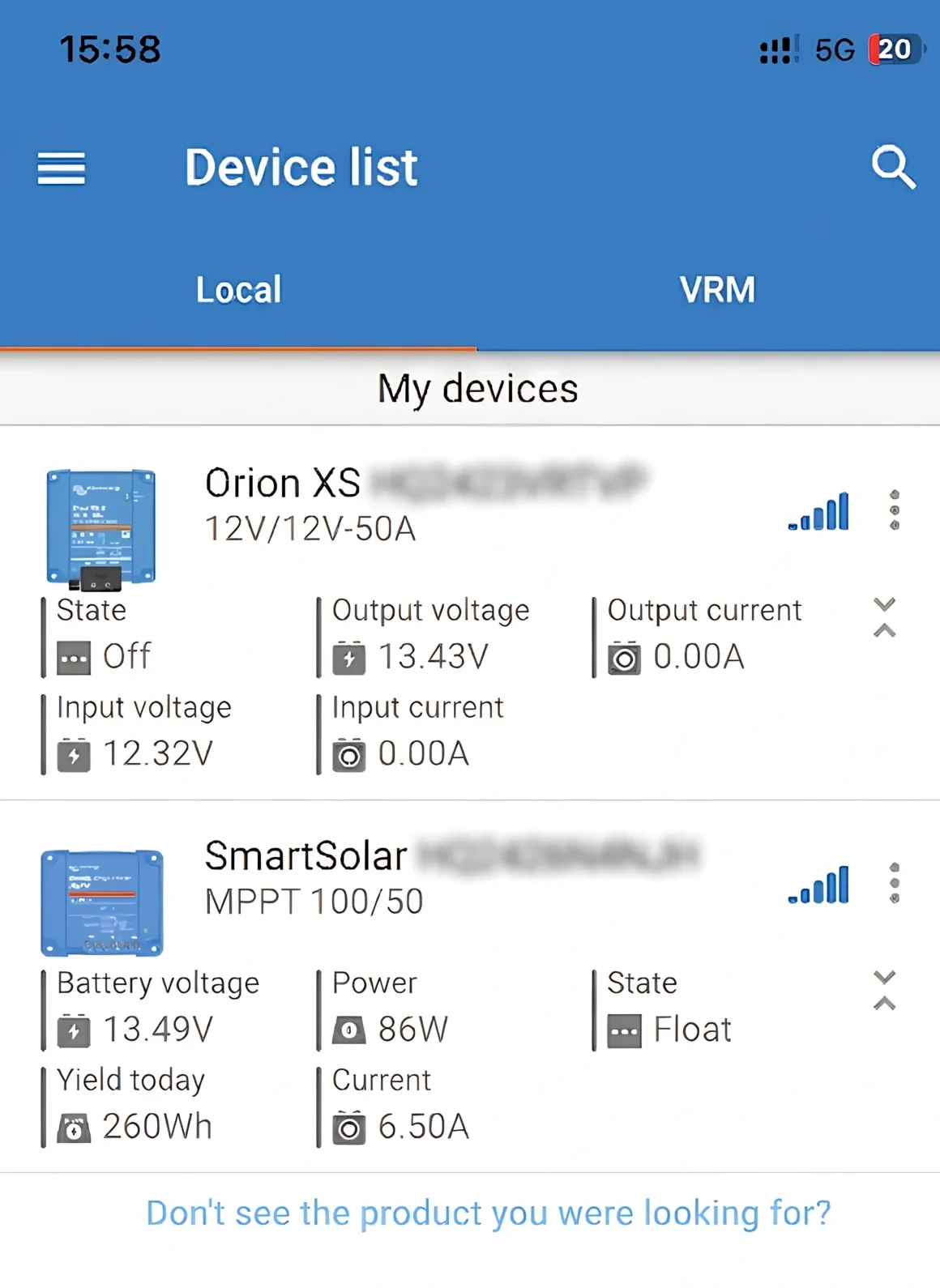 Adding the Liontron native app to it and we know exactly what is happening in our Van.
Our full setup at a glance
Where to buy — our recommended sources
Battery — Liontron LiFePO4
Liontron LiFePO4 — what we use
German-brand lithium battery with built-in BMS. Available in multiple capacities. The one in our van. Buy via AKKUman (ships across Europe, on Awin) or Camping Wagner (Germany).
Victron components
Butler Technik (UK)
UK-based authorised Victron dealer, ships worldwide. Good for UK buyers or international orders. Stocks the full Victron range including MPPT controllers, Orion DC-DC.
Camping Wagner (DE)
German retailer stocking both Victron and Liontron — so one order can cover both your battery and your Victron components. On Awin. Ships within Germany.
What about a full solar kit?
Renogy — one brand, full system
We went the Victron + Liontron route because we wanted the best components individually. But we did look at Renogy as a full-system option — they do panels, MPPT controllers, batteries and cabling all in one place, with decent documentation and European availability. If you’d rather not mix brands and source everything separately, it’s a solid starting point worth exploring.
Eco Worthy — budget-friendly with EU warehouses
A more affordable one-brand option covering solar panels, LiFePO4 batteries, MPPT controllers and inverters. Not the premium route we took, but a legitimate brand with 500k+ customers and warehouses in Germany and the UK — so no customs headaches for European buyers. Worth exploring if budget is the priority and you want everything from one place.
💶 What the whole system cost us
Rough ballpark for our exact setup (June 2026 prices): Liontron 150Ah ~€1300 · Victron MPPT ~€180 · Victron Orion XS ~€320 · Victron BlueSmart ~€80 · StarWifi 12V kit ~€200 · Panel ~€200. Total ~€2,300 before cabling, fusing and installation. Expensive upfront — but two years in with zero issues, it’s earned it.
Making it work day to day
After two years the routine is completely automatic. But when we were setting up, the honest practical picture was this:
Morning — Liontron app first
First thing, open the Liontron app. It shows battery percentage instantly over Bluetooth — you know in five seconds whether you’re sitting at 85% or 55% after the overnight fridge draw and your Netflix evening session. That single number sets the tone for the day.
Once the sun or engine is on
Once we’re driving or the sun hits the panels, a quick check on Victron Connect confirms the solar or Orion is doing its job — you can see the charge rate coming in in real time. If it’s pushing 15–20A in, you relax. If it’s a grey day and the panels are barely contributing, you plan accordingly.
Starlink discipline
We added a physical on/off switch for the dish. Off when we’re not working or watching something — it’s a 30W draw that adds up over a full day.
Drive if needed
1.5–2 hours on the motorway puts 30–50Ah back in via the Orion. In winter we plan route days to coincide with low battery. In summer we rarely think about it.
The verdict: build it once, forget about it
The upfront cost of a proper van life electrical setup — battery, MPPT controller, DC-DC charger, monitor — is real. It’s not a cheap weekend project. But for full-time van life, it’s the investment that makes everything else possible. We don’t think about power. We park where the climbing is, we work when we need to, and the system keeps up without any anxiety.
If you’re doing occasional weekend trips, a good AGM and a modest solar panel will serve you fine. If you live in the van, build it properly from the start — you’ll spend less over time and you’ll never regret it.
This is our exact system after two years of full-time van life across Europe — and before anything else, one thing needs to be said clearly: every van is different, and every person’s needs are different. Our setup is ours. We’re sharing it because we know how useful it is to read what someone with a similar lifestyle actually runs, not what a salesperson recommends or a YouTube channel monetises.
If you’ve spent any time researching van electrics, you’ll have noticed that everyone has an opinion — self-proclaimed experts, garage mechanics, boat engineers, solar installers, forum veterans — and they often contradict each other completely. We found the most useful advice came from people who had actually lived in a van long-term. We also came to this with some background in boat life, which gave us a practical grounding in 12V DIY that helped a lot.
Take this post as a reference point, not a blueprint. It might confirm a direction you’re already heading, help you ask better questions, or flag something you hadn’t considered. It is not expert advice, it is not the only way to do it, and it almost certainly isn’t a perfect match for your van, your budget, or your lifestyle. Use it as support — and always verify current prices with retailers before buying, as everything below is a June 2026 snapshot.
Frequently asked questions
How big a battery do I need for full-time van life?
It depends on your loads, but as a starting point: 100Ah LiFePO4 suits light users (fridge, lights, phones). 150–200Ah covers heavier setups including a laptop and Starlink. We’d always say size up rather than down — a larger battery charges to full and stays there; a smaller one is always fighting to keep up.
Can I run Starlink off solar alone without driving?
Yes, in summer in southern Europe with 300W+ of solar and a decent battery. All is based on how much solar you can actually put on your roof. In winter or overcast conditions you’ll want the DC-DC charger top-up from driving too. The 12V conversion kit is essential either way — it halves the Starlink draw and makes it much more solar-friendly.
Do I need a DC-DC charger or can I use a split-charge relay?
For a LiFePO4 battery, use a DC-DC charger. A split-charge relay doesn’t respect the lithium charging profile and can cause issues long-term. The Victron Orion is the most reliable option we’ve found and integrates with the rest of the Victron ecosystem. If you run through “regular” battery, a split charge works fine.
Is Liontron worth it over cheaper lithium brands?
In our experience, yes. Liontron is a proper German-engineered product with a real BMS and proper customer support. The cheap generic lithium batteries on marketplace sites vary enormously in cell quality and BMS reliability. For something you’re betting your van’s electrical system on, we wouldn’t cut corners here.
Can I install this myself?
The components themselves are straightforward — it’s DC wiring, not rocket science. The things to get right: correct cable gauge for the run length and current, properly rated fusing on every circuit, and a solid earth. If you’re not confident, have a qualified auto-electrician at least check the work before you rely on it. Mistakes in 12V DC wiring with a LiFePO4 battery can cause fires.
Does LiFePO4 work in cold climates?
Most LiFePO4 batteries (including Liontron) cannot be charged below 0°C without a low-temperature protection feature — charging in sub-zero conditions damages the cells. Discharging is fine at low temperatures. If you’re wintering in genuinely cold conditions, check your battery’s low-temp spec, and the Victron MPPT and Orion can both be configured to stop charging below a threshold. Our battery sits inside the Van which has also no reason to go below 0°C anyway. Worth thinking about your battery placement as well.
How long does the battery last?
Liontron rates its batteries at 2,000+ cycles to 80% capacity. At one full cycle per day (which is more than most van lifers do), that’s over 5 years. In practice, most van lifers do partial cycles, which extends the lifespan further. We’re two years in with zero degradation we can measure.
Primary: van life electrical setup · van life battery setup · LiFePO4 van life · Victron van life · van solar setup 2026 | Secondary: Liontron LiFePO4 review · Victron Orion DC-DC van · Victron SmartSolar MPPT van · van life power system Europe · 12V van electrical setup · best battery for van life · van life solar panel setup | Long-tail: how to set up electrics in a campervan · LiFePO4 vs AGM van life · do I need a DC-DC charger for van life · how much solar do I need for van life · how to power Starlink in a van · best van life battery Europe