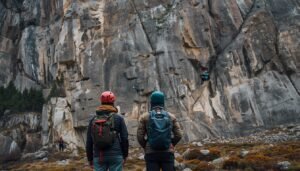
Pietra di Bismantova Climbing Guide — Emilia-Romagna’s Sandstone Monolith
800+ routes on Dante’s mountain of Purgatory, and how to climb it from a van
| Location | Pietra di Bismantova, Castelnovo ne’ Monti, province of Reggio Emilia, Emilia-Romagna, Italy. Inside the Tuscan-Emilian Apennine National Park – Google map |
|---|---|
| Parking | 44.4174, 10.4116 — Piazzale Dante, 881 m, at the foot of the south-east wall. Free roadside parking on the access road below, plus a free West car park |
| Climbing Style | Sport, trad and bouldering. Technical, endurance-based climbing on vertical walls, plus modern overhanging lines. Multi-pitch of 4–5 pitches to the summit |
| Rock Type | Fossil-rich sandstone (biocalcarenite) — quality improves the closer you get to the summit. Sloping holds demand precise footwork |
| Wall Size | The monolith is 300 m tall, 240 m wide and 1 km long, with a 12-hectare grassy summit plateau at 1,041 m. Sectors sit between 860 and 960 m |
| Grade Range | 2 to 8c — 547 sport, 140 trad and 126 boulder problems catalogued across roughly thirty sectors |
| Best Season | Winter is prime — most sectors face south. Spring and autumn excellent. Summer workable in shaded sectors (Sasso dei Reggiani, Palestra CAI, north-facing Placca Freezer) |
| Approach | 1–30 minutes; most sectors under 20. Sasso dei Reggiani and Placca Freezer are the long ones at 30 min. Summit via CAI 697 in roughly 20–45 min |
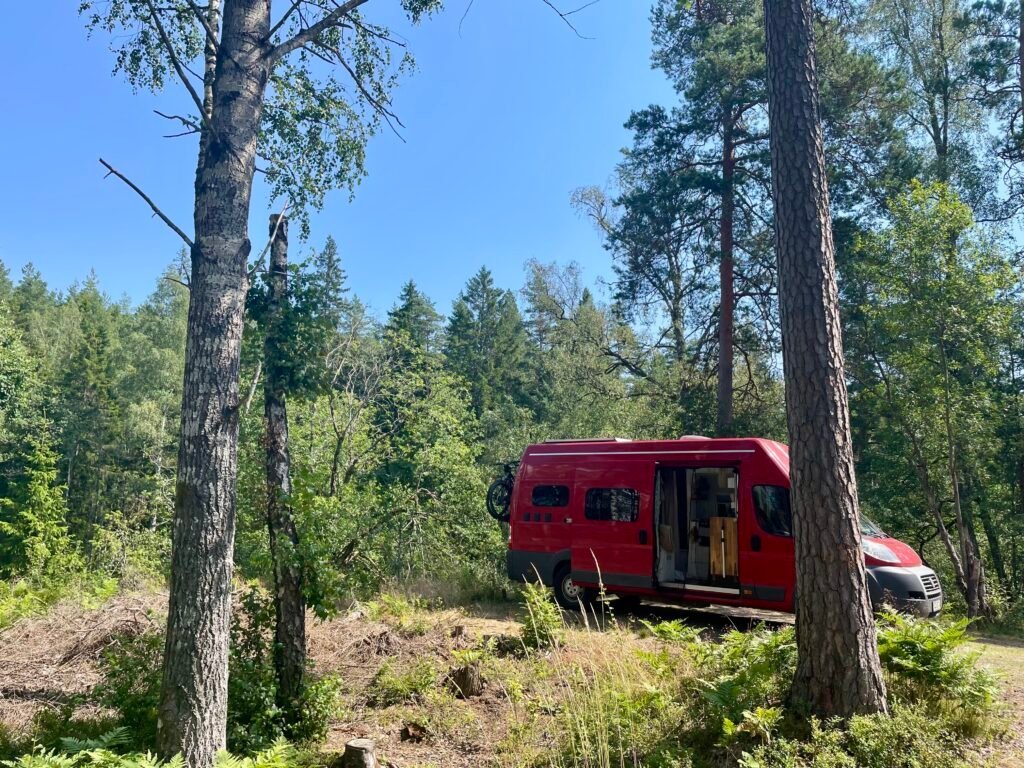
| Van Parking | Dedicated camper spaces at Piazzale Dante here , and plenty of vans stay by the crag itself, we had no problem at all and a peaceful night. Google map by the crag with plenty space. See the van section below for more info. |
| Mobile Coverage | Good overall, depending where — download topos offline before you go regardless |
| Topos | Versante Sud guidebook (€35, Italian) · The Topo — Bismantova · theCrag |
| Also Here | Two via ferratas (Alpini, 1971; Ovest / dell’Ultimo Sole, 2017), a small dry tooling sector, hundreds of boulder problems and highlining on the summit plateau |
We’ve had a few days on the Pietra — August 2026 — and we’re going back for a proper time in September. So take this as a first look rather than the last word: the practical beta, access and van logistics below are ours, but with 800-plus routes across 30-odd sectors we’ve barely scratched the surface. Everything we haven’t climbed comes from the Versante Sud guidebook and The Topo, and it’s flagged as such. We’ll expand this guide after the return trip.
In This Guide
What Is the Pietra di Bismantova?
Drive into the Reggiano Apennines and the Pietra announces itself long before you reach it: a sheer-sided sandstone monolith standing 300 metres tall, 240 metres wide and a kilometre long, rising out of gentle green hills like something dropped there by mistake. The summit at 1,041 m is a flat grassy plateau of 12 hectares with a 360-degree view — locals say it feels like standing in the middle of the sky, and they’re not wrong.
It sits above Castelnovo ne’ Monti in the province of Reggio Emilia, inside the Tuscan-Emilian Apennine National Park, and it comes with proper literary credentials. The Pietra matches Dante’s description of the Mount of Purgatory in the Divine Comedy — an island-like mountain with rugged rocky flanks and a flat top — and he’s believed to have visited in 1306. The rock itself formed around 20 million years ago; many of the boulders scattered around its base broke off far more recently.
For climbers, it’s the most complete crag in Emilia-Romagna: 547 sport routes, 140 trad lines and 126 boulder problems catalogued on The Topo alone, spread across some thirty sectors and boulders, from grade 2 slabs for children to an 8c. Add four- and five-pitch routes running to the summit, two via ferratas, a dry tooling sector and highlining on the plateau, and you have somewhere you could return to for years.

The Rock & Climbing Style
The rock is fossil-rich sandstone — biocalcarenite, to be precise — and by all accounts it gets better the closer you climb to the summit. What defines the climbing here is the hold shape: lots of sloping, rounded features that reward technical footwork and punish anyone trying to muscle through. Routes tend towards technical and endurance-based on vertical walls, though modern lines on steep overhangs are well represented too.
The consensus from the local topo is that most climbers need a short acclimatisation period before they properly enjoy Bismantova sandstone. If your first few routes feel harder than the grade suggests, that’s normal — it’s a footwork crag, and it takes a session or two to trust the smears.
One safety note worth taking seriously: wear a helmet even on single-pitch routes. Many multi-pitch lines run directly above the sport sectors, so there’s real potential for rockfall from parties above.
The local topo explicitly recommends a helmet even for single pitches, because multi-pitch routes sit above many of the sport sectors. If you’ve been getting away without one at roadside crags, this is the place to change that habit. Best Climbing Helmets 2026: Reviews & Buying Guide
Sectors & Grades
There are around thirty named sectors and boulders ringing the Pietra, which is a lot to take in on a first visit. These are the ones worth knowing about, grouped by what you’re after. Grades and route counts come mainly from The Topo’s sector descriptions — cross-check against the guidebook before you commit to an approach.
| Sector | Character | Routes | Grades |
|---|---|---|---|
| Sasso Coccinella | Shortest approach of all; beginners’ spot, some lines top-rope only | 8 | 3–4 |
| Sassolungo | Big boulder/pillar, mostly slabs — the ideal starting point at the Pietra | 20 | 3–6b |
| Sasso Smeraldo | Slabs and steep overhangs, short approach, very popular | 20 | 3–7a |
| Sasso dei Reggiani / Palestra CAI | Slabs for first-timers and children; bearable even in summer (30 min approach) | 12 | 2–5b |
| Gare Vecchie | Historic, busy, technical grey walls on slopers | 16 | ~6th grade |
| Gare Vecchie Baby | Easier slabs on pillars, good safe bolting | 6 | 3–5+ |
| Placche di Albertino & Capibara | Beautiful grey slab, technical and adherence-dependent | 14 | 6a–7a |
| Sasso della Bettola | Short lines on steep and vertical walls | 16 | 4–8a |
| Sirotti | Huge detached pillar, endurance climbing | ~20 | 6a–8a |
| Banana / Nino Marchi | The main event — includes the famous Fiorirosa (8b) | 31 | 5–8b |
| Pilone Giallo | The historic wall: cracks, dihedrals, overhangs, multi-pitches to the summit | 32 | 6a–8b |
| Gare Nuove | Overhanging technical walls, the hard concentration | 21 | 7a–8c |
| Sasso Moby Dick | Largest boulder at the Pietra, some of the hardest lines, new safe bolts | 35 | 5+–8c |
Beyond these there’s Verbum, Illusioni, Zona Gabri, Anfiteatro, Pornografie, Estasi, Le Terrazze, Sasso Diamante, Sasso Rubino, Sasso sul Sentiero, Sasso Batman, Cocoa and a cluster of smaller boulders — plus multi-pitch sectors including Eremo, Parete Est, Parete Ovest, Dente della Vecchia and Orto dei Mandorli. There’s even a small dry tooling sector on the western via ferrata.
One access rule to note: the multi-pitch routes in the Eremo sector can’t be climbed on holidays or the days before them, because of the numbers of people gathered below at the hermitage.
Our First Day on the Pietra
We had just a very few days, which at a crag this size means picking a corner and accepting you’ll miss the rest. We went for the easy-access sport sectors on the hermitage side — the ones you can reach in minutes from Piazzale Dante and warm up on without committing to a long approach in the heat. Gare Nuove, Illusioni, Zona Gabri, Anfiteatro.
The entrance and the path around the rock get very busy at weekends — worth knowing before you go. The Pietra is big enough to absorb it, though: even with plenty of climbers around, there’s space for everyone.

Guidebooks & Resources
Essential: Pietra di Bismantova by Versante Sud

Pietra di Bismantova — Vie e Falesie
Authors: Diego Filippi & Matteo Bertolotti
Publisher: Versante Sud (series LV 91), 2nd edition 2021
ISBN: 9788855470346 · Language: Italian
Price: €35
This is the reference guide for the Pietra — multi-pitch routes and crags, up-to-date sector information, clear line drawings and, new to the second edition, a set of drone images that make orienting yourself around the monolith enormously easier. It was written with contributions from local climbers across several generations, so it carries the history of the place alongside the topos. Diego Filippi is an IFMGA guide and CAI academic member who also wrote the Valle del Sarca multi-pitch guide; Matteo Bertolotti is a climbing instructor and president of the board of the CAI alpinism school in Lombardy, with 800-plus routes behind him.
A heads-up for non-Italian speakers: the text is in Italian only. In practice the topos, grades and drawings are perfectly usable regardless, and the language barrier is far less of an obstacle than you’d think.
Buy from Versante Sud →For Bouldering & Sport: The Local Guides
The Versante Sud book is a vie e falesie guide — multi-pitch routes and sport crags. If bouldering is what brings you here, and with hundreds of problems scattered around the base of the Pietra it might well be, the self-published guides by Alexandro Stecchezzini and Umberto Fontanesi are the ones to look for. They’re written by climbers who developed much of this rock themselves, and there are two editions in circulation that are genuinely different books — not just a reprint.

Pietra di Bismantova — Boulder e Arrampicata (2024)
Authors: Alexandro Stecchezzini & Umberto Fontanesi
Edition: 2024, the “più snella” (slimmed-down) version · Language: Italian
Covers: bouldering areas and single-pitch sport routes (monotiri)
The current edition, deliberately cut back to the core climbing sectors. Everything that wasn’t boulder or single-pitch sport was stripped out to make it thinner and easier to carry — which is exactly what you want if you’re heading out for a day among the boulders rather than planning a week of mixed activity. This is the one to buy if bouldering and clip-ups are your reason for coming.
See it on the authors’ site →
Boulder e Arrampicata alla Pietra di Bismantova (2022)
Authors: Alexandro Stecchezzini & Umberto Fontanesi
Edition: 2022, the original and more exhaustive version · Language: Italian
Covers: bouldering, sport climbing, long multi-pitch routes (vie lunghe), both via ferratas and the trekking trails
Don’t dismiss this as simply the old edition. It’s the broader book: the 2024 revision got thinner by removing material, and a good deal of what went is here. If you want one volume that handles the boulders, the sport, the long routes, the ferratas and the walking all at once — a proper all-round Bismantova book rather than a climbing-only one — this is the more useful purchase, and it’s still available.
See it on the authors’ site →Stecchezzini also publishes free sector pages on his own website, which are a good way to see the quality of the topos before you buy. Fair warning: both books are self-published and sold through Amazon Italy only — no climbing shop or mountain bookshop stocks them. If that bothers you as much as it bothers us, ask at the Rifugio della Pietra by Piazzale Dante or in the shops in Castelnovo ne’ Monti; local guidebooks often turn up on the counter where the climbers actually are.
There’s a third title worth knowing about: Bismantova Climbing & Bouldering by Andrea Gennari Daneri and Lamberto Camurri (Pareti e Montagne Edizioni, 2005, 94 pages, €15). Camurri is a name from the crag’s own history — the climber who brought Yosemite crack technique to the Pietra in the 1980s — and the book’s distinguishing feature is his American-style topo notation for the multi-pitch routes, which describes the climbing move by move in a way the other guides don’t. It’s the fifth guidebook in the Pietra’s history. Libreria Monti in Città in Milan lists it, though it’s currently out of stock — treat this one as a nice find rather than a plan.
So Which Guidebook Should You Buy?
| If you’re here for… | Buy this |
|---|---|
| Multi-pitch routes and sport crags, with the full history and drone imagery | Versante Sud — Filippi & Bertolotti, 2021 (€35) |
| Bouldering and single-pitch sport, travelling light | Stecchezzini & Fontanesi 2024 — the slimmed-down edition |
| Everything: boulders, sport, long routes, via ferratas and trekking | Stecchezzini & Fontanesi 2022 — the exhaustive edition |
For a week or more, buy two: the Versante Sud for the walls and one of the Stecchezzini editions for the boulders. Between them they cost less than a couple of nights in a campsite, and guidebook sales are what pays for the bolts in the rock.
The Versante Sud book is a vie e falesie guide — multi-pitch routes and sport crags. If bouldering is what brings you here, and with hundreds of problems scattered around the base of the Pietra it might well be, the local self-published guides by Alexandro Stecchezzini and Umberto Fontanesi are the ones to look for. They cover the boulder zones alongside the sport sectors, they’re written by climbers who developed much of this rock themselves, and they’ve been revised more recently than the Versante Sud edition.
They’ve appeared under a few titles over the years — Arrampicata Sportiva e Boulder alla Pietra di Bismantova and Boulder e Arrampicata alla Pietra di Bismantova: … un amore verticale! among them — with the most recent revision covering all the boulder zones and sport sectors updated. They’re sold through Amazon Italy rather than a climbing distributor, and Stecchezzini also publishes free sector pages on his own site, which are a useful way to see what you’re buying before you commit.
There’s a third book worth knowing about too: Bismantova Climbing & Bouldering by Andrea Gennari Daneri and Lamberto Camurri (Pareti e Montagne Edizioni). Camurri is a name from the crag’s own history — he’s the climber who brought Yosemite crack technique to the Pietra in the 1980s. Availability seems patchy, so treat it as a nice find rather than a plan.
Our take: if you’re here to clip bolts and do multi-pitches, buy the Versante Sud. If you’re here to boulder, buy Stecchezzini. If you’re here for a week, buy both — between them they cost less than a night in a campsite, and they’re what funds the bolting.
Digital Topos: The Topo App

We ran The Topo’s Pietra di Bismantova crag page alongside the book — it’s a premium topo by the Arco not normal team, with excellent sector-by-sector descriptions in English and Italian, plus detailed approach notes for all seven routes into the sectors. Book first, app for quick orientation on the wall, which is the combination we cover in our climbing apps guide.
Also useful: the Pietra di Bismantova webcam for checking conditions before you drive up, and the Rifugio della Pietra by Piazzale Dante, which serves food and hands out route information. A group of mountain guides operating as “La Pietra Guide Alpine” run courses and maintain the routes locally.
When to Go
This is a winter crag. Most sectors face south and soak up sun, so the cold months are prime — crisp air, good friction, warm rock. Spring and autumn are excellent too. Summer is the awkward one: it’s climbable, but you’ll be chasing shade, and that means knowing which sectors work. Sasso dei Reggiani and Palestra CAI stay acceptable through summer, and Placca Freezer faces north and stays permanently shady (its name is not subtle). Various boulders on the flanks fall into shade at different hours of the day.
The crag sits at 860–960 m for the sectors, with the summit at 1,041 m, so it’s meaningfully cooler than the valley floor — worth remembering when the Po plain is baking.
Getting There & Approaches
From Castelnovo ne’ Monti, follow signs for the Pietra from the roundabout by the hospital; the road climbs to Piazzale Dante at 881 m, directly beneath the south-east wall. Parking there costs €1 an hour, €3 for six hours or €5 for the day, charged 8am–8pm daily from 1 June to 30 September and at weekends only the rest of the year. The roadside parking on the access road below and the West car park roughly 900 m before Piazzale Dante are both free.
Approaches are mercifully short by mountain standards — generally under 20 minutes, some as little as one. The exceptions are Sasso dei Reggiani and Placca Freezer at around 30 minutes. From Piazzale Dante, the staircase up to the hermitage is the gateway to most of the popular sport sectors, while a separate path to the right heads towards the via ferrata degli Alpini and the big walls: Sasso sul Sentiero, Anfiteatro, Banana, Pilone Giallo.
An easy 30-minute walk from Piazzale Dante takes you to the summit plateau — worth doing on its own merits, and it doubles as the descent for the multi-pitch routes.
What to Bring
Rope: a 60 m covers the sport sectors comfortably; bring a 70 m if you’re heading for the longer lines, and doubles for the multi-pitches to the summit. Draws: 12–14 for single pitches. Helmet: not negotiable here — see above. Also: the south-facing aspect that makes this a winter crag makes it a suntrap the rest of the year, so water, a hat and a shady lunch spot matter. A head torch if the Camino del Diavolo chimney is on your list — it genuinely needs one.
Van Life, Where to Stay & Rest Days
Where We Slept
We parked right here, and it worked out about as well as van parking near a busy crag ever does. It’s silent at night, there’s room for something like fifteen vans, and the walk to the sectors is short enough that you can roll out of bed and be climbing. Just about every climber staying at the Pietra for a few days ends up in this car park.
On being there overnight: the Carabinieri drove past us and said nothing. That’s not the same as it being officially permitted, and we’d never tell you a spot is legal on the strength of one quiet night — but the local reality is that vans stay here, and nobody seems to mind. Behave accordingly: no awnings out, no chairs, no noise, leave nothing behind.
The Timing Trick
Here’s the thing that actually matters in summer. This car park and the whole road up to it are heaving during the day — hikers, day trippers, weekenders, families walking to the hermitage. Turn up at eleven on a Saturday in August and you will not park.
So arrive at dawn. Get there while it’s still dark and the place is empty, sleep the last hour if you need to, and you’ll have both a space and the cool part of the day for climbing. Out of season the pressure drops away — winter and weekdays are far more relaxed, and the parking charges ease off too (weekends only from October).
The Alternatives
There are a handful of other spots on Park4Night within a five to ten minute drive, which is fine as a fallback — though the same problem applies in reverse: if you leave to climb and come back mid-afternoon, you may struggle to find a space anywhere near the crag.
The other option is the dedicated camper area in Castelnovo ne’ Monti itself. It’s pleasant and straightforward, with none of the uncertainty of sleeping in a car park — the trade-off is a ten-minute drive to the rock and back every single day. If you’re here for a week and want facilities, it’s a reasonable swap. If you’re here to climb from dawn, the car park wins.
Rest Days
The surroundings make the rest days easy. The “al gir d’la Preda” is a 16 km paved loop right around the Pietra, taking in Carnola, Ginepreto, Vologno, Maro Casale and Campolungo — brilliant for walking, cycling or running, with the monolith rotating past you from every angle. This is also mountain Parmigiano Reggiano country: the local dairies produce what many consider the finest expression of the cheese, and visiting one is a genuinely good rest-day plan.
Where to Stay — Castelnovo ne’ Monti & Around
Not everyone arrives with a bed in the back. Castelnovo ne’ Monti sits right at the foot of the Pietra and has the most options; the villages on the “gir d’la Preda” loop offer quieter agriturismo-style stays in among the pastures. The map below shows live prices for your dates:
🏨 Places to Stay Nearby
Accommodation in Castelnovo ne’ Monti & Around the Pietra
Hotels, agriturismi and campsites on one map — filter by price, dates and type. The villages on the gir d’la Preda loop are the quiet option.
Booking through this map supports the blog at no extra cost to you.
On the Pietra itself there’s the hermitage, two via ferratas (the historic Alpini route from 1971 and the easier Via Ferrata Ovest, added in 2017), and highlining on the summit plateau if that’s your thing. The Rifugio della Pietra near Piazzale Dante handles refreshments.
Planning a European Climbing Trip?
Bismantova is exactly the kind of crag that never makes the top-ten lists but absolutely should. We collected more of them — places across Europe that deliver far more than their reputation suggests.
10 Underrated Climbing Destinations in Europe →Verdict — Is the Pietra Worth the Detour?
On one day’s evidence: yes, and we’re going back to prove it properly. The scale of it is the thing — 800-plus routes and 30-odd sectors on a single monolith, running from grade 2 children’s slabs to 8c, with multi-pitches to a summit plateau you can walk down from in half an hour. Add short approaches, a winter-friendly aspect, cheap and easy logistics, and Parmigiano Reggiano country all around it, and Bismantova makes a strong case as a base rather than a stopover. If you’re routing through northern Italy — it pairs neatly with a trip to Muzzerone and the Golfo dei Poeti, about two hours south-west — build in more than a day. We didn’t, and we regretted it.
Pietra di Bismantova Climbing FAQ
Where is the Pietra di Bismantova?
The Pietra di Bismantova is a sandstone monolith above Castelnovo ne’ Monti in the province of Reggio Emilia, Emilia-Romagna, Italy, within the Tuscan-Emilian Apennine National Park. The main parking is Piazzale Dante, reached via the roundabout by the hospital in Castelnovo ne’ Monti.
How many climbing routes are there at Bismantova?
The Topo catalogues 547 sport routes, 140 trad routes and 126 boulder problems across roughly thirty sectors and boulders, with grades running from 2 to 8c. There are also numerous four- and five-pitch multi-pitch routes to the summit.
What kind of rock is the Pietra di Bismantova?
Fossil-rich sandstone — biocalcarenite — which reportedly improves in quality the closer you get to the summit. Holds are frequently sloping, so the climbing is technical and footwork-dependent, rewarding precision over power.
When is the best time to climb at Bismantova?
Winter is the best season, as most sectors face south and get plenty of sun. Spring and autumn are also excellent. Summer climbing is possible in shaded sectors such as Sasso dei Reggiani, Palestra CAI and the north-facing Placca Freezer.
Is Bismantova good for beginners?
Yes. Sasso Coccinella (grades 3–4), Gare Vecchie Baby (3–5+), Sassolungo (3–6b) and Sasso dei Reggiani / Palestra CAI (2–5b) all offer easy, well-protected slabs, and the technical nature of the rock makes it a good learning ground. A helmet is recommended even on single pitches, as multi-pitch routes run above many sport sectors.
Which guidebook covers Pietra di Bismantova?
There are three. For sport routes and multi-pitches, Pietra di Bismantova — Vie e Falesie by Diego Filippi and Matteo Bertolotti (Versante Sud, 2nd edition 2021, ISBN 9788855470346, €35). For bouldering, the local guides by Alexandro Stecchezzini and Umberto Fontanesi, sold via Amazon Italy. There is also Bismantova Climbing & Bouldering by Andrea Gennari Daneri and Lamberto Camurri. All are in Italian, but the topos work in any language. The Topo app has a detailed premium topo for the crag as well.
Do you have to pay to park at Piazzale Dante?
Yes. Piazzale Dante costs €1 per hour, €3 for six hours or €5 for the day. Charges apply daily from 8am to 8pm between 1 June and 30 September, and at weekends only during the rest of the year. Free alternatives are the roadside parking on the access road below and the West car park about 900 m before Piazzale Dante.
Keep Reading

📚 Helpful Climbing Resources
Essential guides, tips, and advice for your climbing adventures
🔧 Gear Lab
View all →
DMM Renegade Review: Four Years on My Trad Harness
Read more →
Black Diamond Solution Review — The All-Rounder, Updated for 2026
Read more →🚐 Road Trip Essentials
View all →
10 Underrated European Sport Climbing Destinations (That We Actually Drove To)
Read more →
Van Life Electrical Setup 2026 — Our Exact Power System
Read more →📖 Climber's Handbook
View all →
Beginner Climbing Gear List 2026 – Everything You Need to Start Climbing Outdoors
Read more →