
Mammut 9.5 Alpine Core Protect Dry Review — The Cut-Resistant Alpine Rope
View the 2026 Starter Pack →
How It Rates
Six ropes reviewed and scored
One rope’s rarely the whole story. See the Alpine Core Protect ranked against five rivals — sport, trad, alpine and everyday cragging — and find your perfect match.
Read the ropes guide → ⛰In This Review
Where to Buy the Alpine Core Protect
Support your local climbing shop first. If it’s out of stock, these retailers ship across Europe — or buy direct from Mammut:
Prices correct at time of writing — tap through for current pricing, lengths and stock.
Why This Rope Matters for Van Life Climbers
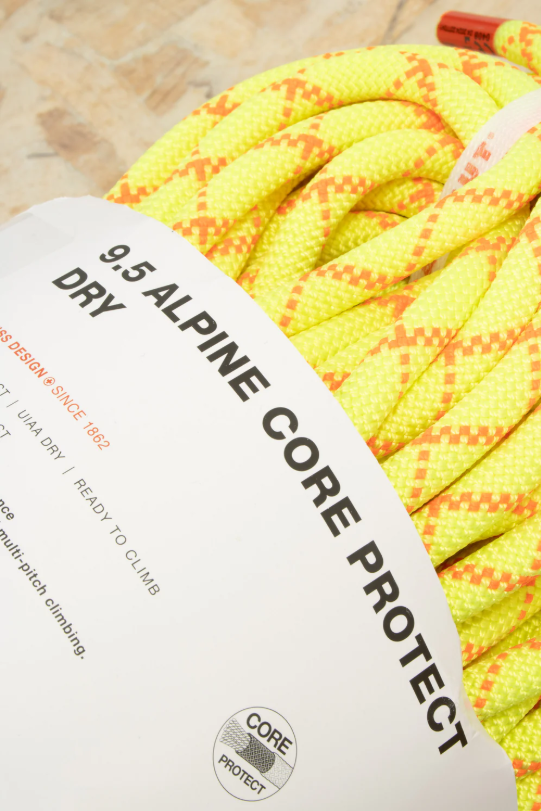
The short version of this Mammut 9.5 Alpine Core Protect Dry review: it’s a single rope built to solve one specific, serious problem — a rope cut over a sharp edge.
The Problem It Solves
On committing alpine, multi-pitch and ice routes, the scariest failure isn’t the rope stretching or wearing out — it’s the sheath being sliced over a sharp rock or metal edge in a fall. It’s rare, but it’s catastrophic. The Alpine Core Protect is Mammut’s answer: an extra aramid layer woven into the rope to resist exactly that.
Where It Sits
This is a 9.5mm single rope, so it handles like a normal all-round rope day to day — but with a genuine safety margin built in for when the terrain turns sharp. It won an ISPO Award, and it’s aimed squarely at climbers heading somewhere the consequences of a core-shot are real.
How Core Protect Works
Aramid Where It Counts
An aramid climbing rope in the traditional sense would be too static to catch a fall safely. Ordinary ropes use polyamide (nylon) — great for dynamic stretch, but cuttable. Aramid (the Kevlar family) is far more cut-resistant but too static to make a safe climbing rope on its own. Mammut’s solution is to weave a small proportion of aramid fibres (around 4%) into the polyamide sheath, adding an extra protective layer between the outer sheath and the core.
Why It Still Falls Dynamically
The clever part: the aramid layer is built with extra length, so in a fall it unfolds rather than snapping taut. That means the rope still stretches and catches a fall as dynamically as any other Mammut rope — you get the cut resistance without turning it into a dangerous static line. Handling and abrasion resistance stay the same as a standard 9.5mm; only the cut resistance goes up.
Does the cut protection actually work?
Independent testers at Climbing put it through hard whippers — including a gear-ripping fall in Patagonia — and reported the rope came through core-shot-free. Reassuringly, most owners never stress-test the aramid layer at all; it’s there as insurance.
Handling & Build
Feels Like a Normal Rope
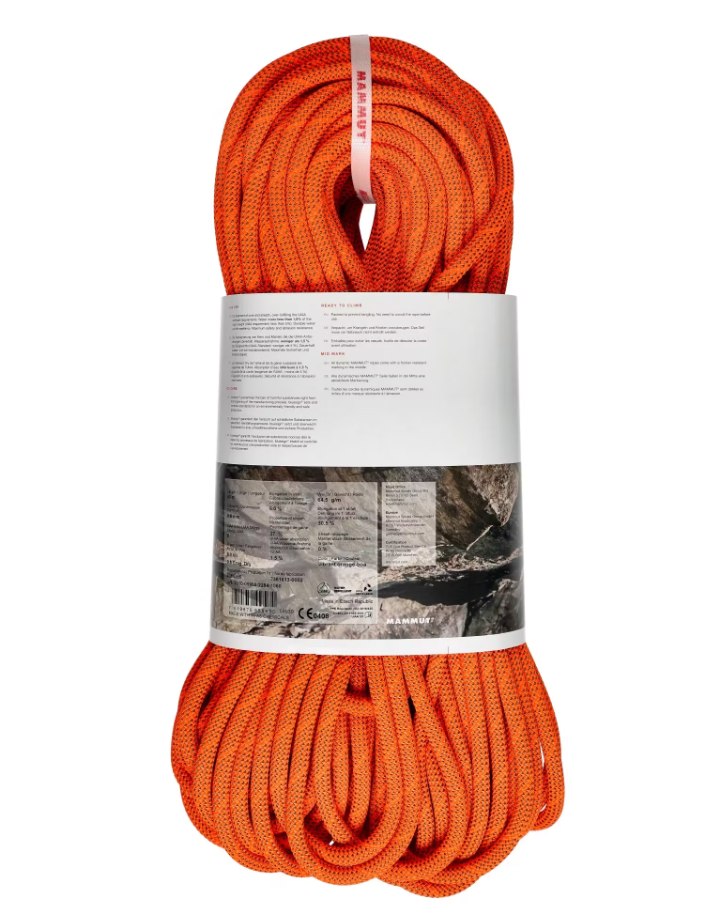
The point of the design is that the aramid should be invisible in the hand. The outer layer is standard polyamide, which keeps handling familiar and protects belay devices and carabiners from the rougher aramid fibres. Reviewers consistently report it feeds, knots and catches just like any other quality 9.5mm — the cut resistance is invisible until you need it. It ships ready to climb, tangle-free out of the packaging.
🔗 Pairing tip: at 9.5mm it works with every belay device. See our best belay devices for 2026 →
Dry Treatment
Built for the Mountains
A cut-protection rope is squarely aimed at alpine and ice, so a proper dry treatment isn’t optional. The Alpine Core Protect carries Mammut’s full UIAA-certified dry treatment, keeping water absorption under 1.5% — comfortably beyond the UIAA’s 5% standard. On soaking wet ice and mixed routes, that means the rope stays light and doesn’t freeze into a stiff cable.
Dirt and Longevity
As with all dry ropes, the finish also resists dirt working into the core, extending the rope’s life. Water repellency fades gradually with use and washing, so treat it as a feature that degrades slowly rather than one that lasts forever.
Van Life Considerations
When It Earns Its Place in a Van
This isn’t the rope for everyone, and it’s not pretending to be. Climbing that’s mostly bolted sport at friendly crags won’t tax the cut protection, and a cheaper all-rounder like the standard Crag Dry does that job better. Van trips built around alpine faces, sharp mountain rock or ice are where a cut-resistant rope justifies itself — the category exists for exactly that risk profile.
Storage & Heat
Rope storage principles apply the same way here as with any van rope: keep it in a bag, low and out of direct sunlight rather than on a shelf against the glass. A thicker 9.5mm is fairly forgiving of the odd storage slip, though UV and heat still age nylon over time.
The Weight and Cost Trade-Off
The cut protection isn’t free — the aramid adds a little weight over a plain 9.5mm, and this is the most expensive rope in our guide. The honest question is whether the climbing you actually do exposes a rope to sharp edges often enough for the insurance to earn its place.
Pros & Cons
Pros
- Genuine aramid cut protection over sharp edges
- Still falls fully dynamically — the aramid unfolds under load
- Handles like a normal 9.5mm — cut resistance is invisible
- Full UIAA-certified dry treatment (<1.5% absorption)
- Independently tested core-shot-free on hard whippers
- ISPO Award-winning technology
Cons
- Most expensive rope in this guide
- Heavier than a plain 9.5mm — the aramid adds weight
- Overkill for pure bolted sport climbing
- Single-rated only — not a half or twin rope
- Cut resistance is improved, not a guarantee — no rope is uncuttable
How It Compares
vs Mammut 9.5 Crag Dry
Same diameter, different mission. The standard Crag Dry is the cheaper, lighter everyday all-rounder for sport, trad and cragging. The Core Protect adds the aramid cut layer for sharp alpine terrain, at a weight and price premium. If you’re not regularly on sharp edges, save the money. See our Crag Dry review.
vs Mammut 9.0 Crag Sender Dry
Cut protection versus versatility. The 9.0 Crag Sender is a lighter, triple-rated do-everything rope for weight-conscious climbers. The Core Protect is heavier and single-rated, but adds cut resistance the Sender doesn’t have. Choose on priority: minimum weight and flexibility, or maximum edge safety. See our Crag Sender review.
vs Beal Opera 8.5mm
Two safety philosophies. The Opera uses Unicore bonding so its sheath won’t slide off the core if damaged — a different way to add security, at a much lighter 8.5mm. The Core Protect goes heavier and thicker for outright cut resistance. Ultralight alpine, or armoured against sharp rock — pick your risk.
Mammut 9.5 Alpine Core Protect Dry Review: Final Verdict
For climbing where a rope cut over a sharp edge is a real risk, the Alpine Core Protect offers a safety margin no standard rope can match.
The engineering is the story here: an aramid layer that reviewers and independent testers report adds real cut resistance while still unfolding to catch a fall dynamically, wrapped in a normal polyamide sheath. Add a full UIAA dry treatment and it’s a serious specialist tool for alpine, multi-pitch and ice. The caveats are consistent — heaviest and priciest rope in our guide, and single-rated only.
For climbers regularly on sharp mountain rock or committing ice, the peace of mind justifies the premium. For pure sport cragging, it’s more rope than the terrain needs — the standard 9.5 Crag Dry will serve you better for less, and the 9.0 Crag Sender is our lighter triple-rated pick for versatility.
Frequently Asked Questions
Is the Alpine Core Protect actually cut-proof?
Does the aramid make it fall like a static rope?
Is it worth the extra cost over the standard Crag Dry?
Can I use it as a double (half) rope?
Six ropes reviewed and scored
The Core Protect is our pick for sharp rock — but is it right for you? See it ranked against five rivals across sport, trad, alpine and everyday cragging.
Read the ropes guide → ⛰Related Climbing Guides
🧗 Explore Our Climbing Guides
Detailed crag guides from our van life climbing adventures across Europe