Patagonia Ascensionist 35 Review — Alpine Capacity Without the Weight Penalty
35 litres at 771 grams, Fair Trade sewn — the ethical alpine all-rounder examined
Don’t waste money on gear you don’t need. Check out our full 2026 breakdown of the essentials for every new climber.
View the 2026 Starter Pack →| Capacity | 35 litres |
|---|---|
| Weight (empty) | 771 g |
| Material | 210D 100% recycled nylon ripstop (159 g/m²) with recycled TPU backer and PFAS-free DWR · 200D recycled polyester PU-coated lining · straps and hip belt in 92% recycled nylon / 8% elastane, also PFAS-free DWR |
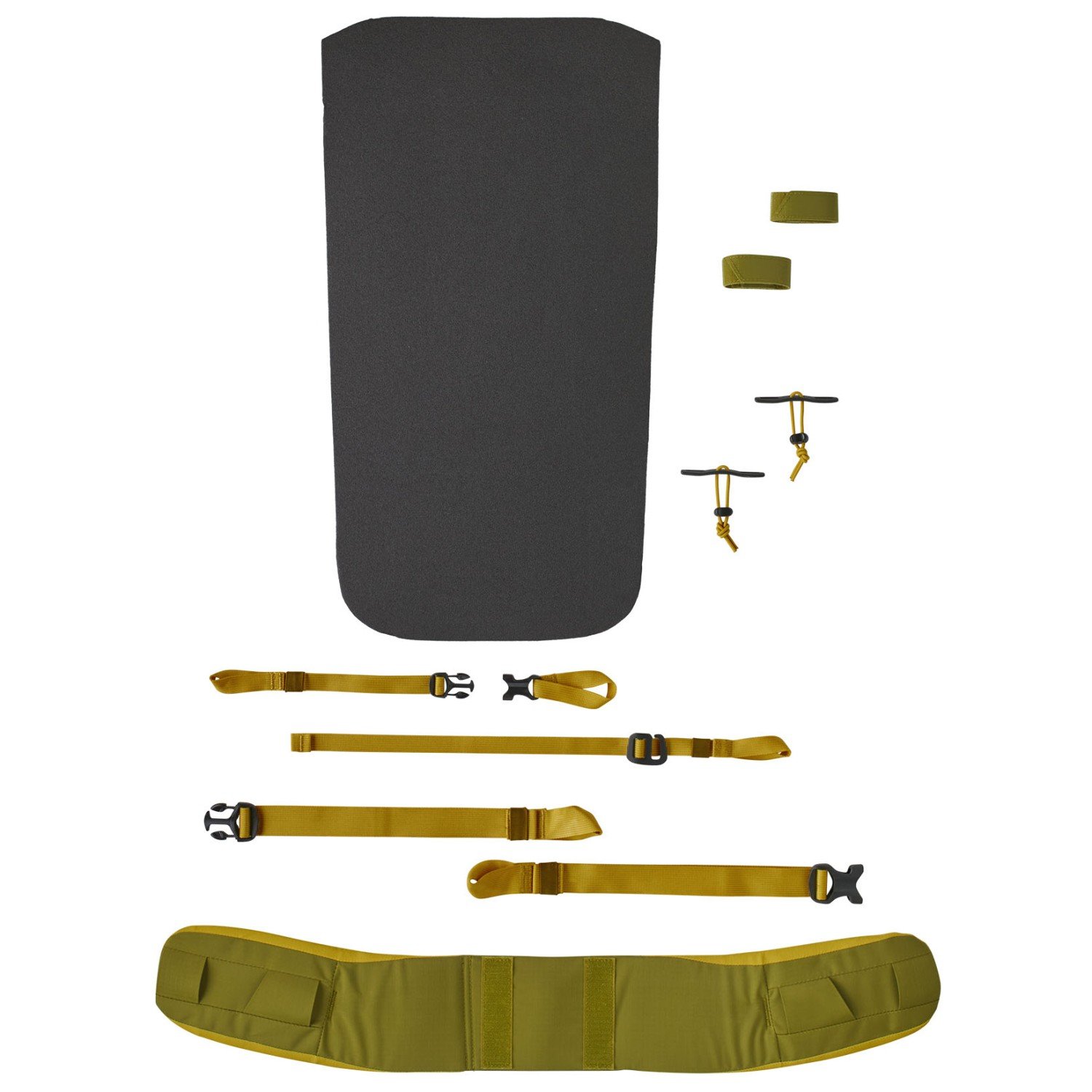
| Frame / Back System | Removable internal support structure and removable padded hip belt — strips to a frameless summit bag |
| Access | Top-load with glove-friendly drawcord and lid pocket |
| Rain Cover / Waterproofing | No cover included — highly water-repellent (DWR + TPU backing), not waterproof |
| Sizes | S / M / L (53 / 57 / 61 × 28 × 24 cm) |
| Warranty | Patagonia Ironclad Guarantee — repair, replacement or refund |
| Best For | Alpine climbing · Multi-pitch · Winter routes |
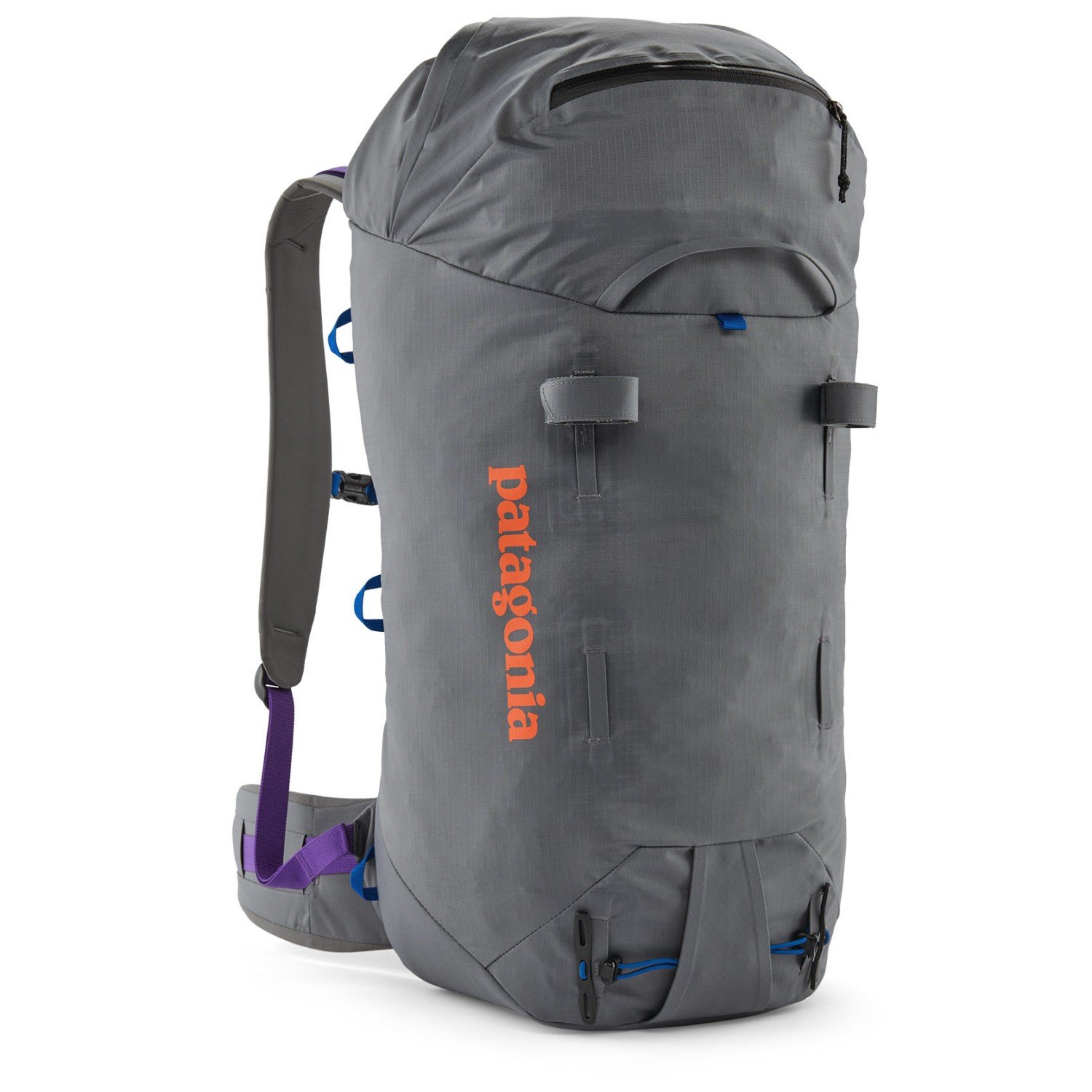
Front view — the current 35 L, 771 g model
Our Score
Five packs reviewed and scored
One pack’s rarely the whole story. See the Patagonia Ascensionist 35 ranked against four rivals — crag, alpine, winter and hauling — and find your perfect match.
Read the backpacks guide →In This Review
Where to Buy the Patagonia Ascensionist 35
Support your local climbing shop first. If it’s out of stock, these two trusted retailers ship across Europe:
Bergfreunde
Germany-based, EU shipping
€229.95
free DE shipping — check live price
Check price at Bergfreunde →Prices shown are approximate — tap through for current pricing and stock.
Why This Pack Matters for Van Life Climbers
The short version of this Patagonia Ascensionist 35 review: it carries a full alpine day — rope, rack, layers, food — at 771 g, and it’s the rare pack you can buy without checking the ethics footnotes first. That combination is why it holds the highest all-round score of the load-carriers in our 2026 backpacks comparison.
The Capacity Trap
Most 35-litre alpine packs solve capacity with weight: burlier fabric, bigger frames, more straps, and suddenly the empty pack costs you a kilo and a half before breakfast. Patagonia’s answer is lighter fabric engineered harder — and a design where everything non-essential comes off.
Which Generation This Covers
One buying note: this review covers the current Patagonia Ascensionist 35L (model 47986) — 210-denier recycled ripstop, 771 g. An older, heavier generation (850 g, different fabric) still appears on outlet sites and old listings, so check the weight when comparing prices.
Build & Materials
How It’s Made
The body is 210-denier 100% recycled nylon ripstop (159 g/m²) with a recycled TPU backing and a PFAS-free DWR finish — light for an alpine pack, but tough for its weight and highly water-repellent. The lining is 200D recycled polyester with a PU coating, and the lining and strap fabrics are bluesign approved. The whole pack is sewn in a Fair Trade Certified™ factory in Vietnam — workers received premium payments for making it, which remains rare in the pack market at any price.
Fittings & Features
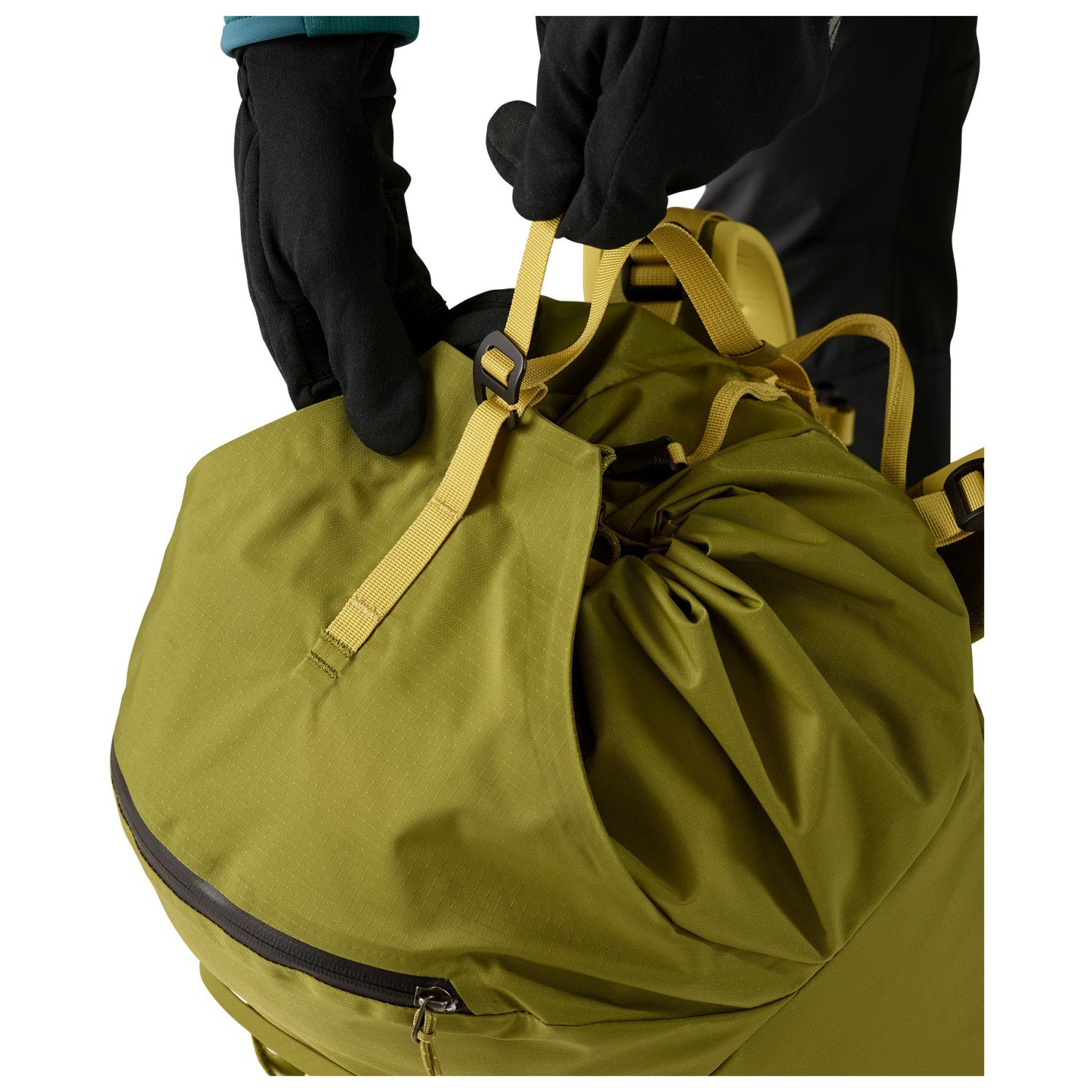
The feature set is alpine-focused and repair-minded: a glove-friendly drawcord closure under a large lid pocket that stays usable even when the pack is stuffed, mmultiple lash points across the face, side panels and top, and ice tool carry straps that are adjustable, removable and repairable in the field. The padded hip belt, the belt padding and the frame all come out entirely — more on why that matters below. Behind it sits Patagonia’s Ironclad Guarantee and their repair programme, which on a £200 pack is part of the value calculation rather than a footnote.
Capacity & Organisation
What 35 Litres Actually Holds
This is genuine, usable volume: a 60–70 m rope, alpine rack, crampons, belay jacket, food and water for a full mountain day go in without strategic packing. For summer multi-pitch cragging it’s roomy enough to carry kit for two. It comes in three back lengths (S/M/L) — a real fit advantage over the one-size packs in this class.
Lid and Lash Points, Not Zips
Organisation follows the alpine playbook: one big top-loading compartment, a lid pocket for the headlamp-sunglasses-gloves layer, and lash points for everything that won’t fit inside. There are no side zips or panel access — deliberate, for weather resistance and durability, but slower than a zip pack at a sport crag.
Strip It Down
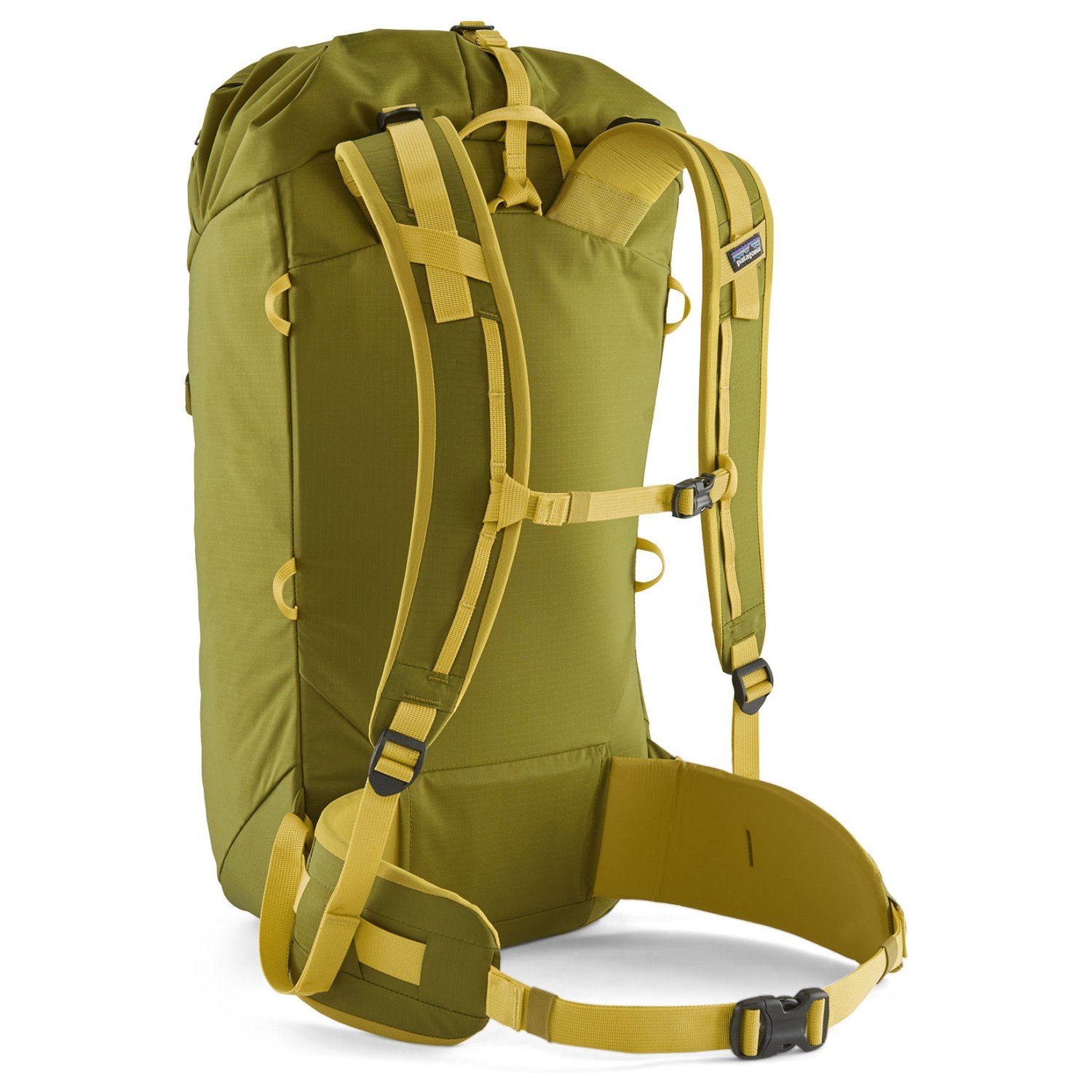
Hip belt off, internal support out, and the Patagonia Ascensionist 35 becomes a light, frameless summit bag for the route itself. It won’t drop to Blitz-28 weights, but for a 35-litre load-carrier the stripped weight is impressively low.
Comfort & Carry
On the Approach
This is where the Patagonia Ascensionist 35 justifies its place over smaller packs: the internal support structure and padded hip belt transfer a real alpine load properly, and the three sizes mean the hip belt actually sits on your hips. Patagonia’s own verified owner reviews average 4.3 out of 5 across 19 ratings, with the carry under load a recurring theme. With 12 kg+ aboard it remains a climbing pack, not a trekking pack — but that’s the honest ceiling of anything at 771 g.
On the Route
Stripped down, it climbs well for its size: the profile is slim for 35 litres, the drawcord closure works with gloves and frozen fingers, and the lid doesn’t flop into your helmet. It’s bigger on the back than a dedicated summit pack — if most of your climbing is with the pack on, the Blitz 28 is the sharper tool.
Van Life Considerations
Living in a Gear Cupboard
The honest caveat for van storage: this is the biggest-footprint pack in our lineup short of the Creek, and with its support structure in, it doesn’t stuff flat the way frameless packs do. Pull the framesheet and hip belt for storage and it behaves much better. The TPU-backed fabric wipes clean and shrugs off van grime.
One Pack for the Mountains
Where the Patagonia Ascensionist 35 earns its van space is trip flexibility: the same pack does winter routes in Scotland, summer alpine in Chamonix, and heavy crag days with kit for two. If van storage forces you to own fewer, more capable things — the vanlife condition — a 35-litre pack that strips down is a rational single choice.
The Wet-Kit Caveat
Highly water-repellent is not waterproof: no rain cover, no sealed seams. The DWR + TPU combination handles alpine weather and snow well; for sustained valley rain, add a liner bag.
Pros & Cons
Pros
- Genuine 35 L capacity at 771 g
- Fair Trade Certified™ sewn — rare in this market
- Recycled fabrics, PFAS-free DWR, bluesign-approved components
- Removable hip belt and internal support — strips for the route
- Glove-friendly drawcord and lid pocket usable when full
- Three back lengths (S/M/L) for a real fit
- Field-repairable, removable ice axe straps
Cons
- Premium price at £199.95 / €229.95
- Toploader only — no side or panel access
- Overkill for single-pitch sport cragging
- Larger footprint needs proper storage in a van
- No rain cover — water-repellent, not waterproof
- No hydration sleeve — Patagonia don’t list one and reviewers report none
How It Compares
Ascensionist 35 vs Black Diamond Blitz 28
The two lightweight alpine choices. The Blitz undercuts it by over 350 g and climbs better with the pack on; the Ascensionist gives you 7 more litres, tougher TPU-backed fabric, a proper load-bearing carry and three sizes. Big days with heavier loads? Ascensionist. Fast single-day missions? Blitz.
Read our Blitz 28 review →Patagonia Ascensionist 35 vs Blue Ice Warthog 30
Summer capacity versus winter specialism. The Warthog is lighter (630 g), burlier-fabriced and built around ice tools and winter conditions; the Ascensionist carries more, fits better across body sizes, and wins on ethics credentials. Mostly winter and mixed? Warthog. All-season alpine with bigger loads? Ascensionist.
Read our Warthog 30 review →Ascensionist 35 vs Petzl Bug
Mountain tool versus everyday crag pack. The Bug is 18 litres at 665 g, less than half the price, and perfect for single-pitch sport days near the van; the Ascensionist exists for the days the Bug can’t do — full racks, winter kit, routes with real approaches. Many climbers sensibly own both.
Read our Petzl Bug review →Ascensionist 35 vs Black Diamond Creek 35
Same volume, opposite jobs. The Creek is a 1,660 g haul bag that stays at the base; the Ascensionist is a climbing pack that swallows the same 35 litres at nearly 900 g less. Haul with the Creek, climb with the Ascensionist.
Read our Creek 35 review →Patagonia Ascensionist 35 Review: Final Verdict
The Patagonia Ascensionist 35 is the most convincing answer on the market to the alpine capacity trap: full-day volume at a weight that doesn’t punish the approach.
The strengths: 35 real litres at 771 g, a strippable carry system, three back lengths, glove-friendly closures, and manufacturing credentials — Fair Trade sewn, recycled fabrics, PFAS-free DWR — that nothing else in this lineup matches. The trade-offs: a premium price, toploader-only access, a footprint that demands proper van storage, and no stated hydration compatibility.
For climbers whose season spans summer alpine, winter routes and heavy multi-pitch days — and who’d rather own one capable pack than three partial ones — it’s the strongest all-round load-carrier in our comparison, and the cost-per-use maths improves every season it survives. If your climbing is mostly single-pitch sport, save the money and take the Bug.
Frequently Asked Questions
Is the Patagonia Ascensionist 35 too big for day cragging?
For single-pitch sport days, yes — it’s more pack than the job needs, and a 16–18 L pack like the Petzl Bug does it lighter and cheaper. Where the 35 L earns its keep is full alpine days, winter routes, and carrying kit for two on multi-pitch objectives.
Which size Patagonia Ascensionist 35 should I choose?
The three sizes differ in back length: S (53 cm), M (57 cm) and L (61 cm) — width and depth are identical at 28 × 24 cm. Measure your torso from the C7 vertebra to the iliac crest and match it to Patagonia’s size guide; a correct back length matters more for carrying comfort than any feature on the pack.
Is the Patagonia Ascensionist 35 waterproof?
No — it’s highly water-repellent thanks to the PFAS-free DWR and TPU-backed fabric, which handles snow and alpine showers well, but there’s no rain cover and the seams aren’t sealed. For sustained rain, use a liner bag inside.
Is this the new or old version of the Ascensionist?
This review covers the current generation (Patagonia model 47986): 210D recycled nylon ripstop, 771 g, PFAS-free DWR, Fair Trade sewn. An older 850 g generation with different fabric still shows up on outlet listings — check the weight and model number when buying discounted stock.
Not sure it’s the right pack?
See the Patagonia Ascensionist 35 scored against four rivals — crag, alpine, winter and hauling — in our full 2026 comparison.
Read the backpacks guide →Related Climbing Guides

🧗 Explore Our Climbing Guides
Detailed crag guides from our van life climbing adventures across Europe