Best Climbing Harness 2026 – Sport, Trad & Beginner Picks
Six harnesses tested for sport, trad, and everything in between — chosen for climbers who spend full days on the rock across Europe.
Best Climbing Harnesses 2026 climbing harness for all-day comfort, this is not about the thickest padding. It is about how your weight is distributed across the waist belt and leg loops when you are hanging at a belay, resting on a sport route, or sorting gear at the base of a long trad pitch. The wrong harness — even a comfortable one in the shop — can make a full day on rock genuinely miserable. The right one disappears completely.
This guide compares five of the best climbing harnesses available to European climbers in 2026, across sport and trad disciplines. We’ve included a note on the best harness for beginners, the best for trad, and the best for sport — plus a section on exactly what to look for when buying your first harness.
Whilst it’s easy to click buy online, your local climbing shop funds bolt replacement programmes, maintains access agreements, and keeps the local climbing community alive. Always try your harness on in person and buy locally where you can. These links are for reference — your local specialist deserves your business first.
View the 2026 Starter Pack →
📊 Climbing Harness Price Comparison — All Six Side by Side
| Harness | Price | Weight | Gear Loops | Best For | Score |
|---|---|---|---|---|---|
| Mammut Ophir 3 Slide 2.0 Our Choice |
€60.16 −10% | 385g | 4 loops | All-round sport & trad | 9.0/10 |
| Black Diamond Solution Best Sport |
€74.96 −25% | 315g | 4 loops | Sport projecting, gym | 9.0/10 |
| DMM Renegade Best Trad |
€77.04 −18% | 395g | 7 loops | Trad, multi-pitch, all-day | 9.2/10 |
| Petzl Corax Best Beginner |
€60.16 −10% | 470g | 4 loops | Beginners, gym, first outdoor | 8.7/10 |
| Arc’teryx Skaha Premium |
€161.96 −10% | ~300g | 7 loops | Sport, multi-pitch, warm-weather | 9.0/10 |
| Edelrid Jay / Jayne Best Sustainable |
€55.21 −15% | 380g | 4 loops | Beginners, eco-conscious climbers | 8.8/10 |
1. Mammut Ophir 3 Slide 2.0
Mammut Ophir 3 Slide 2.0
⚡ On sale now: Alpinetrek UK £51.56 (was £59.95) or Bergfreunde DE €62.96 (was €69.95) — also available direct from Mammut (€70)
Score Breakdown
Key Specs
Detailed Review
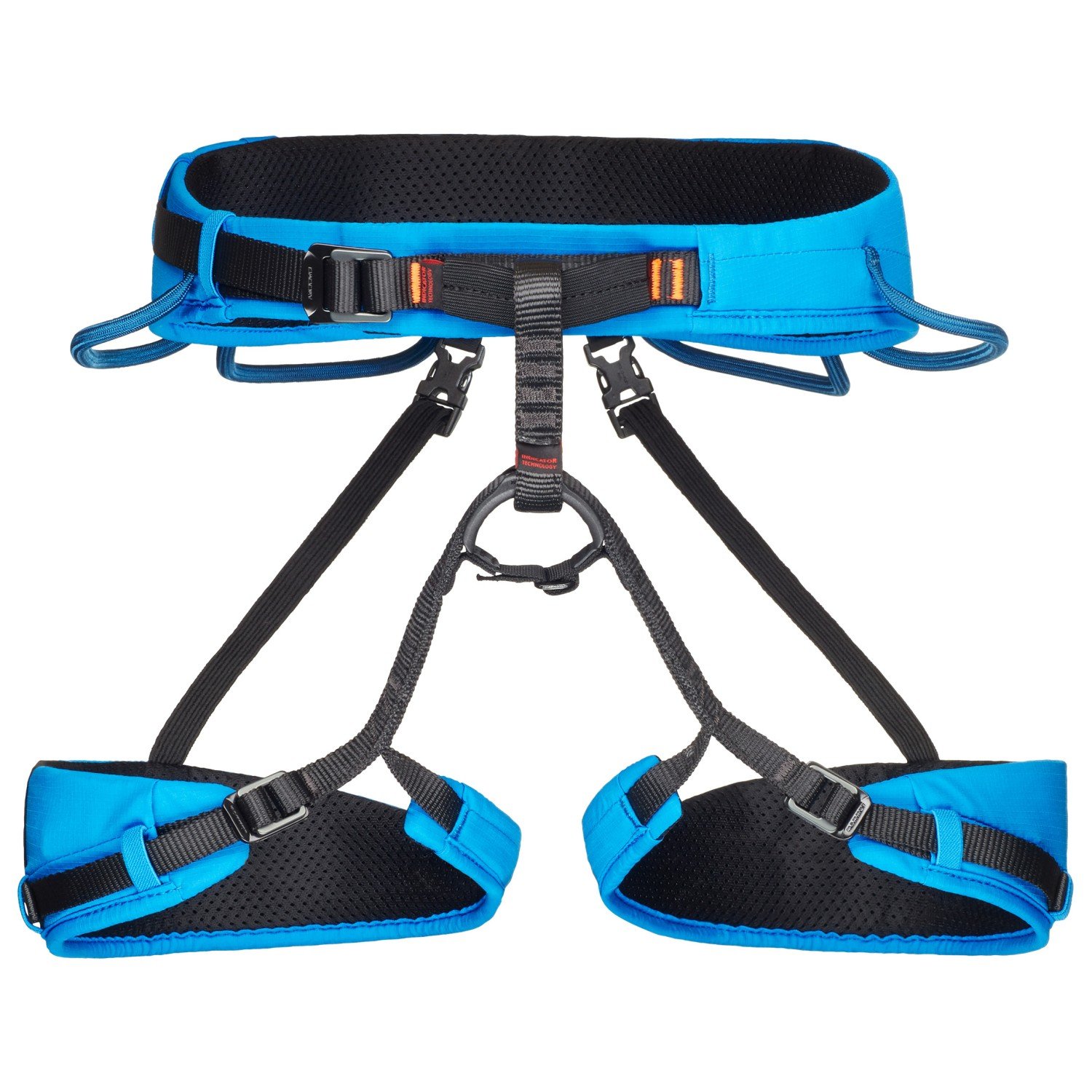
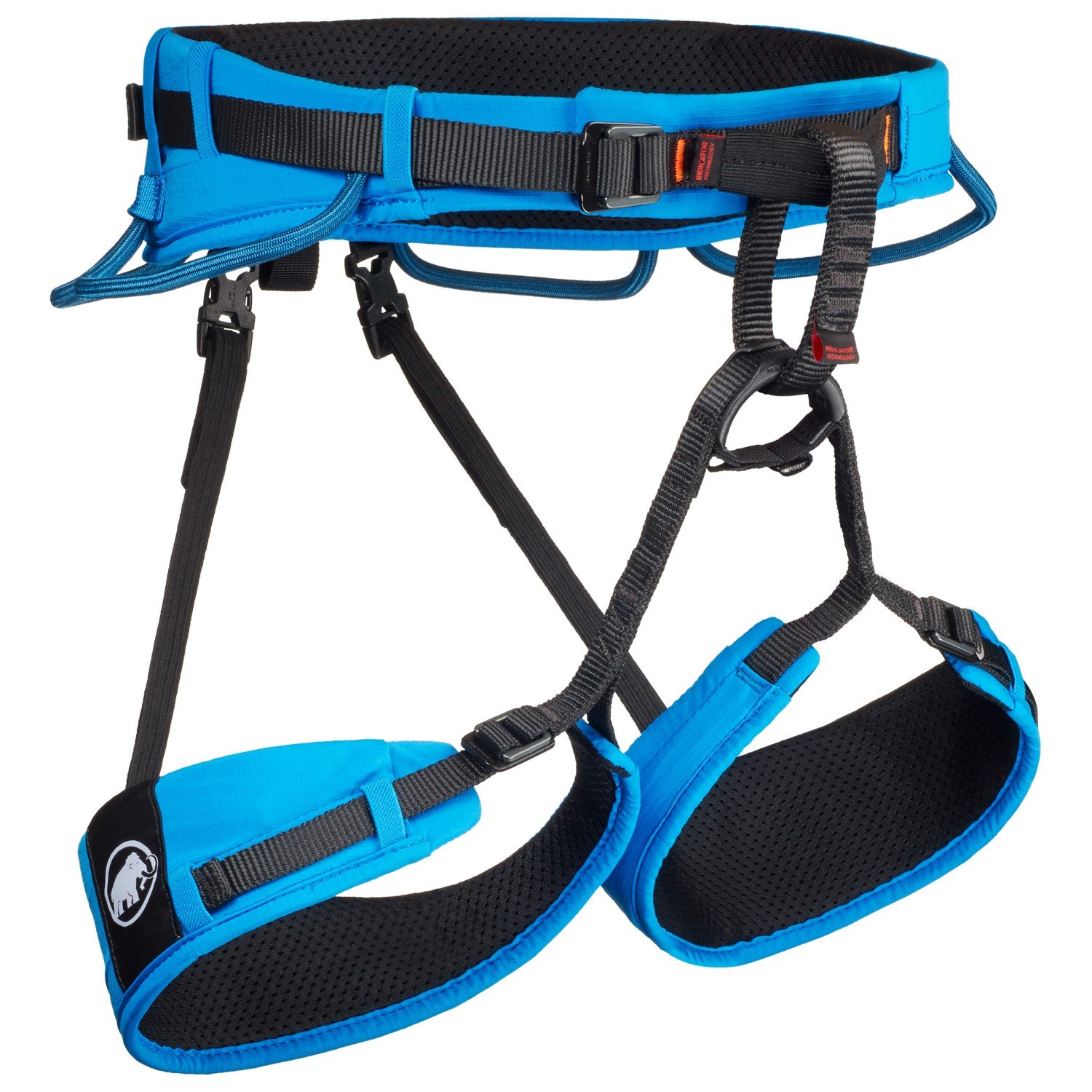
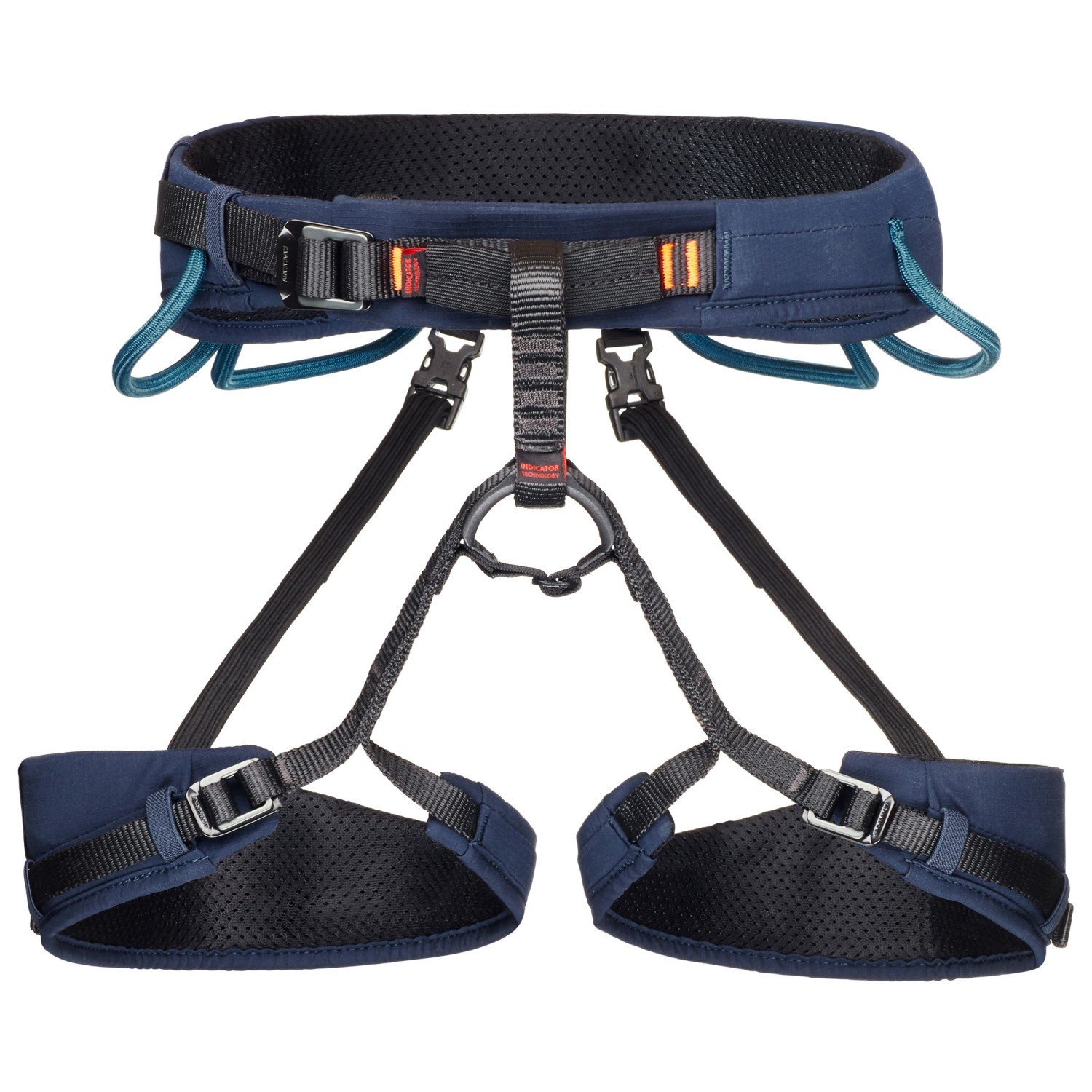
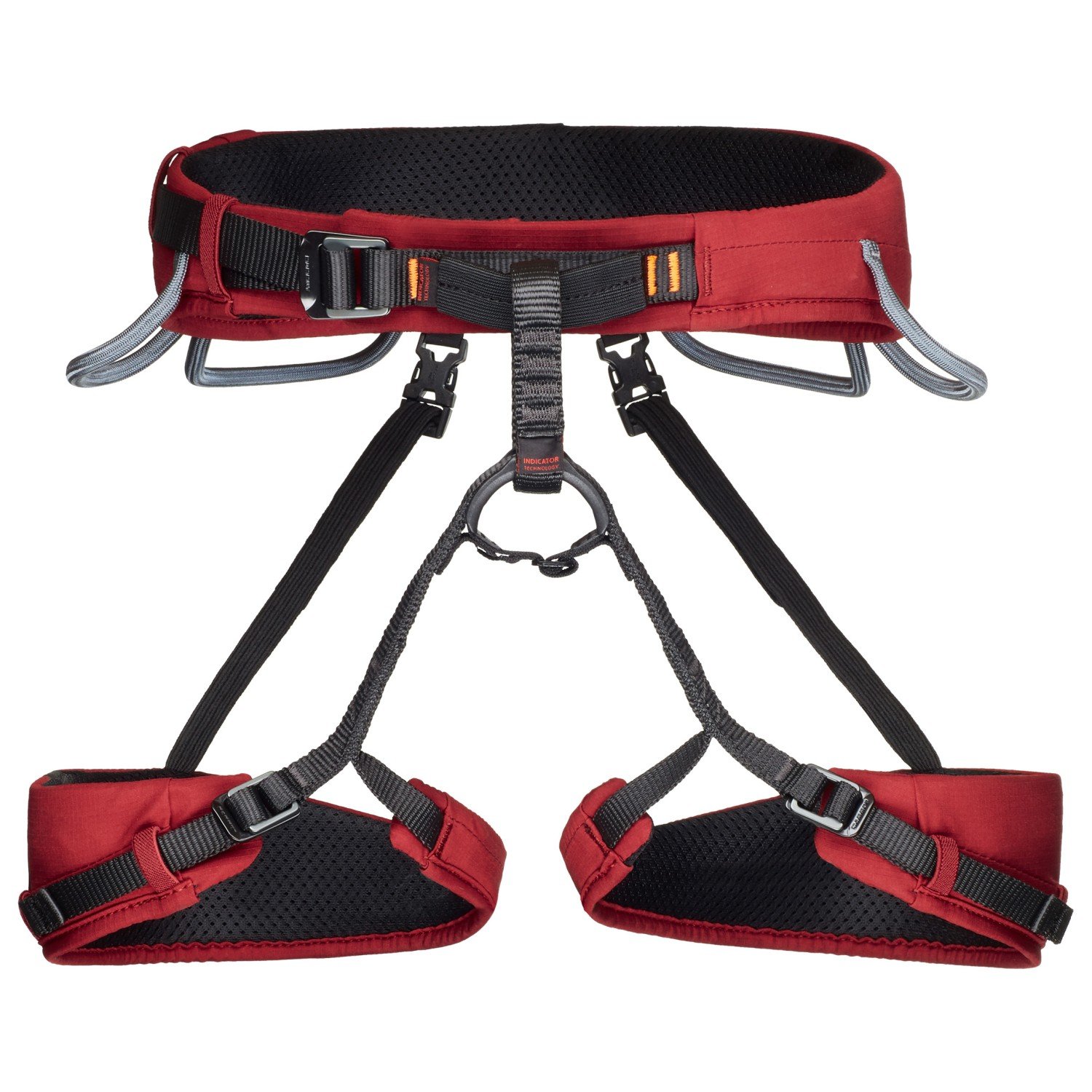
The Mammut Ophir 3 Slide 2.0 earns its top spot by covering everything an all-round climber needs. Mammut describes it as an all-rounder for indoors or out, on rock or ice, single or multi-pitch, and its adjustable leg loops let you fit it precisely over shorts or thick trousers. Treeline Review named the Ophir 3 Slide its best overall harness, and its testers found it one of the most adjustable harnesses they tried, second only to the Petzl Corax.
For the European climbing vanlifer, this adjustability is the killer feature. One harness that fits when you’re sport climbing in Kalymnos in July and layered up for a Snowdon trad route in October is a rare and genuinely useful thing. Drop-seat buckles also mean you can stay tied in when nature calls.
Mammut uses split webbing at the waist and leg loops to spread your weight, reduce pressure points and add comfort on long hanging belays. Testers rated its padding the most comfortable of every harness in their test, and liked the mesh windows in the waist and legs for ventilation.
For racking, you get four large rigid textile gear loops, each tested to 20 kg, plus one small soft loop, which Mammut says is enough for the longest trad routes. There are also two ice clipper slots and a 1 kN haul loop.
One honest note: at 385 g in size M, the Ophir 3 Slide 2.0 isn’t built to save weight, and testers found it a little bulky and heavy for experienced sport climbers. But for the vanlifer who wants one harness that does everything without a second thought about layers, weather or discipline, the Ophir 3 Slide 2.0 is the answer.
What It Does Well
- Adjustable leg loops with drop-seat buckles
- Fits over shorts or thick trousers
- Split webbing spreads load at waist and leg loops
- Replacement indicator in the tie-in points and belay loop
- Outstanding value — currently on sale at both retailers
- Widely stocked across Europe
Where It Falls Short
- A little bulky and heavy for experienced sport climbers
- Only four full-size gear loops; the fifth is a small soft loop
- Mammut rates it only 3/6 for alpine climbing and mountaineering
2. Black Diamond Solution
Black Diamond Solution
The sport climbing benchmark — minimal weight, outstanding hanging comfort, Fusion Comfort technology that punches far above its price.
⚡ On sale now: Alpinetrek UK £65.66 (was £72.95) or Bergfreunde DE €74.96 (was €99.95, −25%) TrekExperts UK £72.56
Score Breakdown
Key Specs
Detailed Review
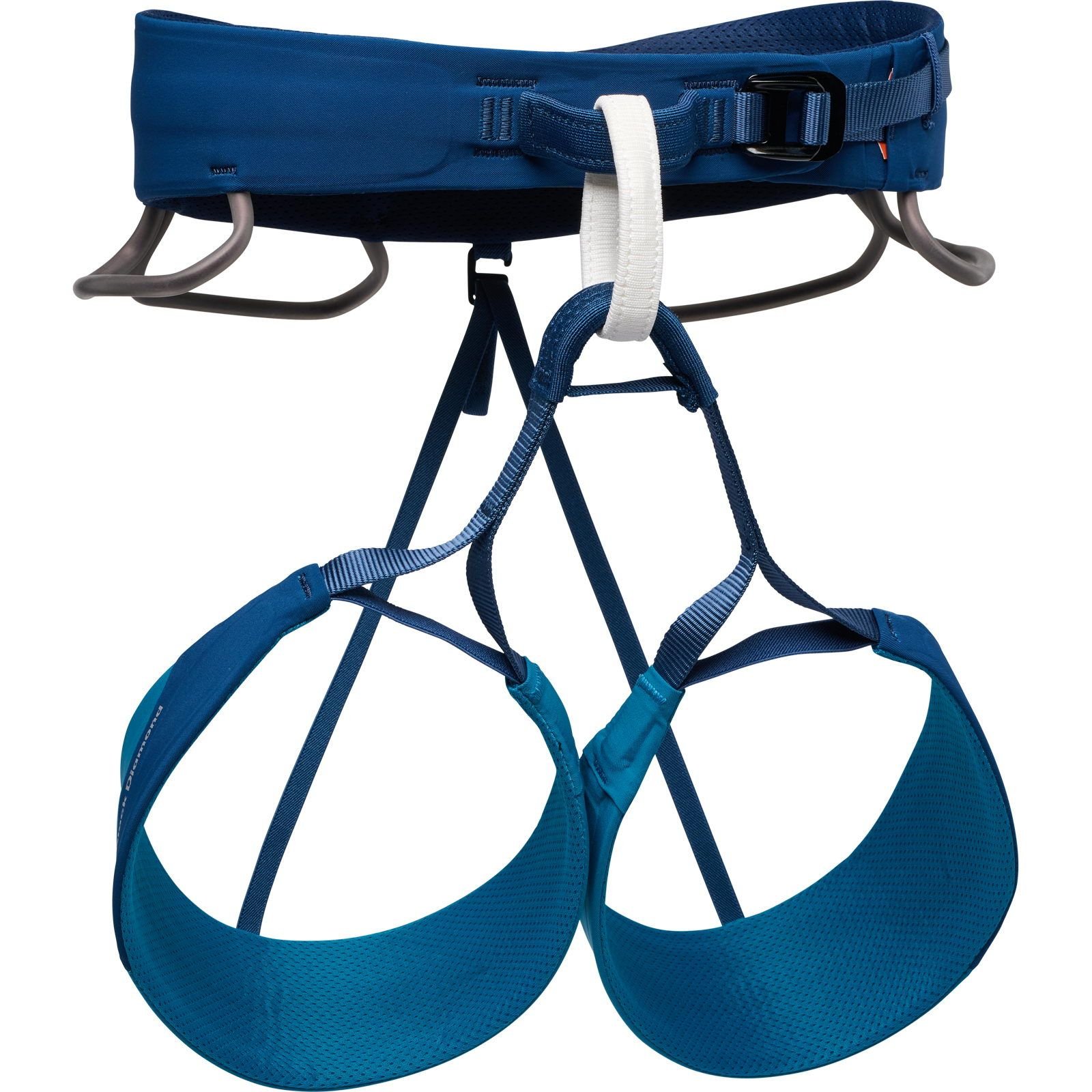
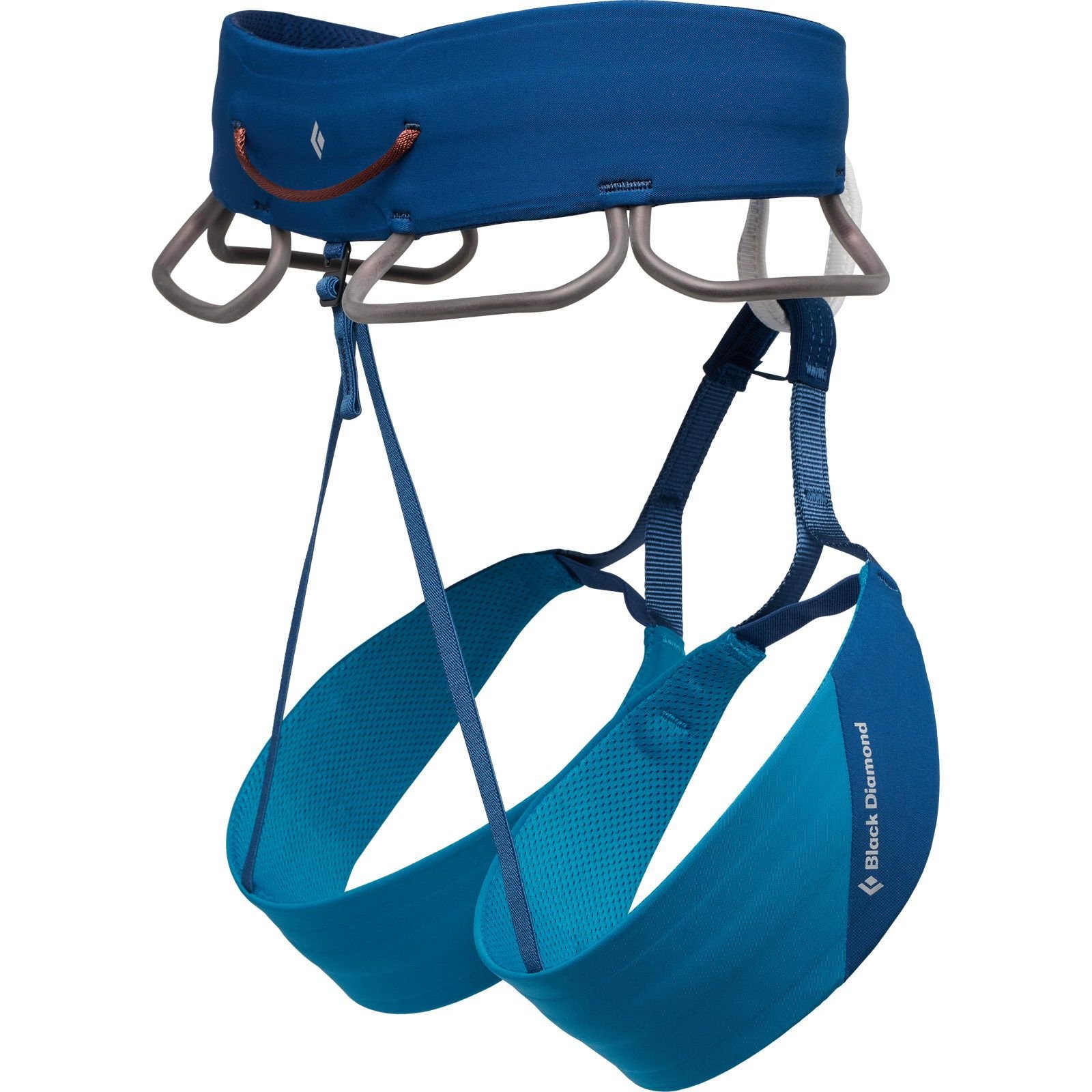
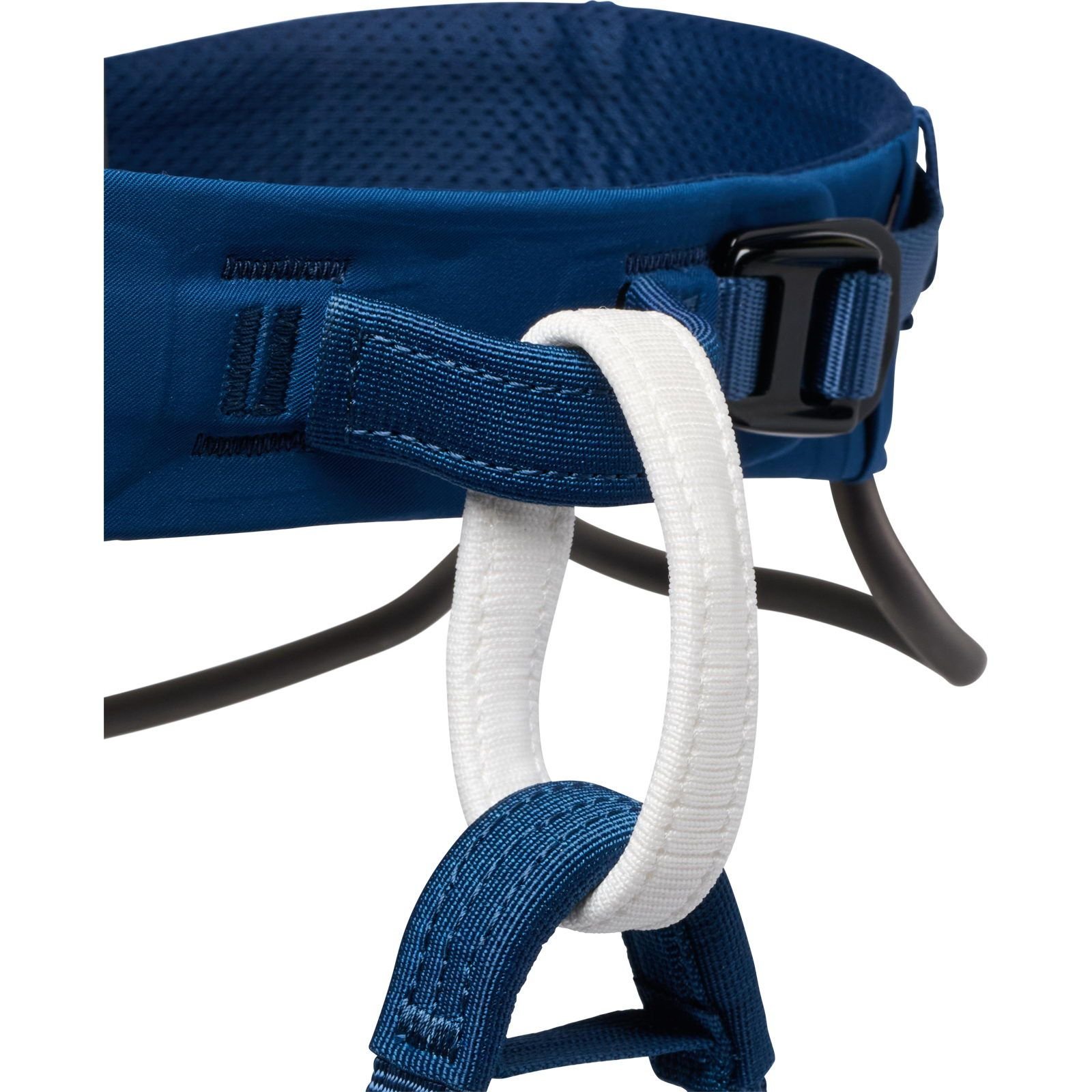
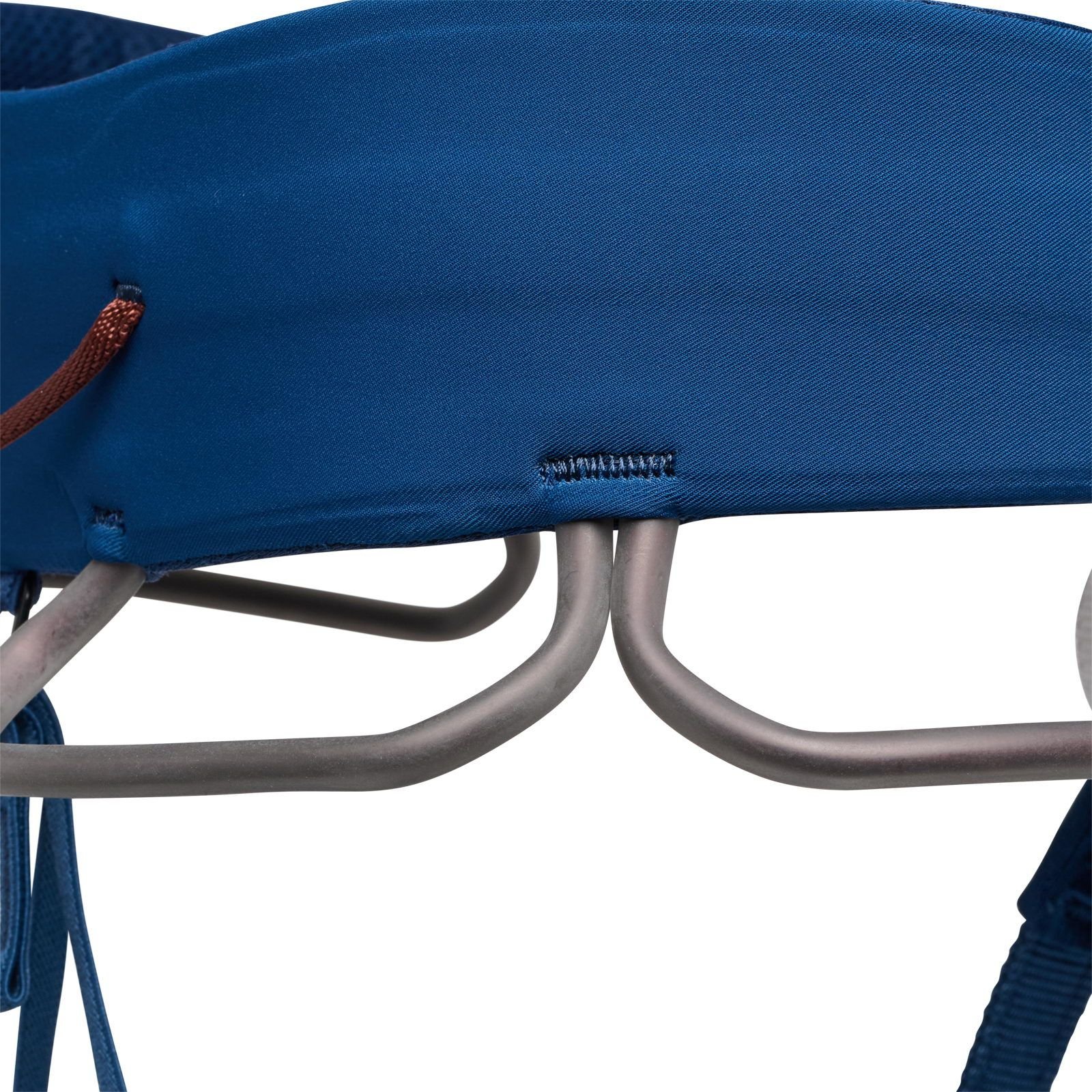
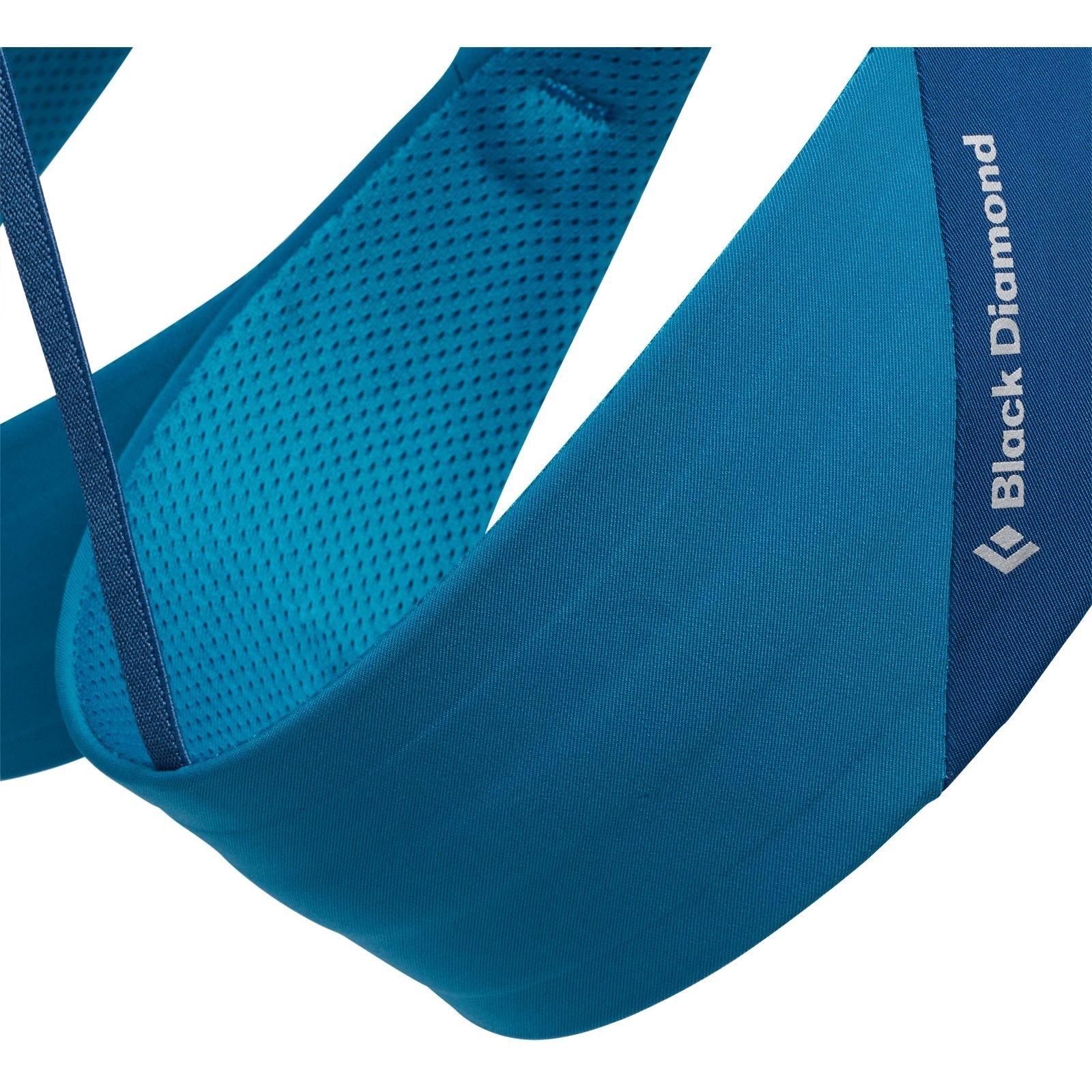
The Black Diamond Solution is the sport climbing harness that has defined the category for the better part of a decade — and with good reason. Fusion Comfort layers webbing bands with an EVA foam insert and soft mesh padding, wrapped in a stretch laminate, so load spreads across a wider surface than the slim profile suggests. Testing it indoors and out for GearJunkie, Nate Mitka reported no pressure points during hangdogging — which is the one thing that matters most when you’re working a sport project.
At 315g it is among the lightest harnesses here, and that is felt on the rock. For climbers whose focus is hard sport redpointing — particularly on steep limestone where you are clipping draws and resting on the rope repeatedly — the reduced weight matters. The four pressure-moulded gear loops stand proud enough that Mitka found racking and unracking easy without reaching awkwardly, and there is a fifth non-weight-rated loop at the back for a chalk bag.
Two caveats before you buy. The fixed leg loops are deliberate — faster to step into between burns, and lighter — but they rule the Solution out for alpine or winter use over bulky trousers, which Mitka flags directly. And it runs small: he found sizing came up tighter than expected, so size up if you’re between sizes, or buy somewhere with free returns.
The four gear loops are functional for sport climbing but limiting for anything beyond a moderate trad rack. For sport-focused climbers this is not a meaningful constraint — you rarely need more than eight to ten quickdraws and a couple of slings. For anyone regularly climbing trad or carrying a full alpine rack, the Mammut Ophir 3 Slide 2.0 or DMM Renegade are better choices.
What It Does Well
- Outstanding hanging comfort for sport redpointing
- Very light at 315g — among the lightest here
- Fusion Comfort technology genuinely works
- Excellent value — premium feel at an accessible price
- Fast to step into with fixed leg loops
- Packable and travel-friendly
Where It Falls Short
- Fixed leg loops — must try on before buying
- Only four gear loops — not ideal for full trad rack
- Not adjustable for wearing over layers
- Small gear loops less practical for big cams
3. DMM Renegade
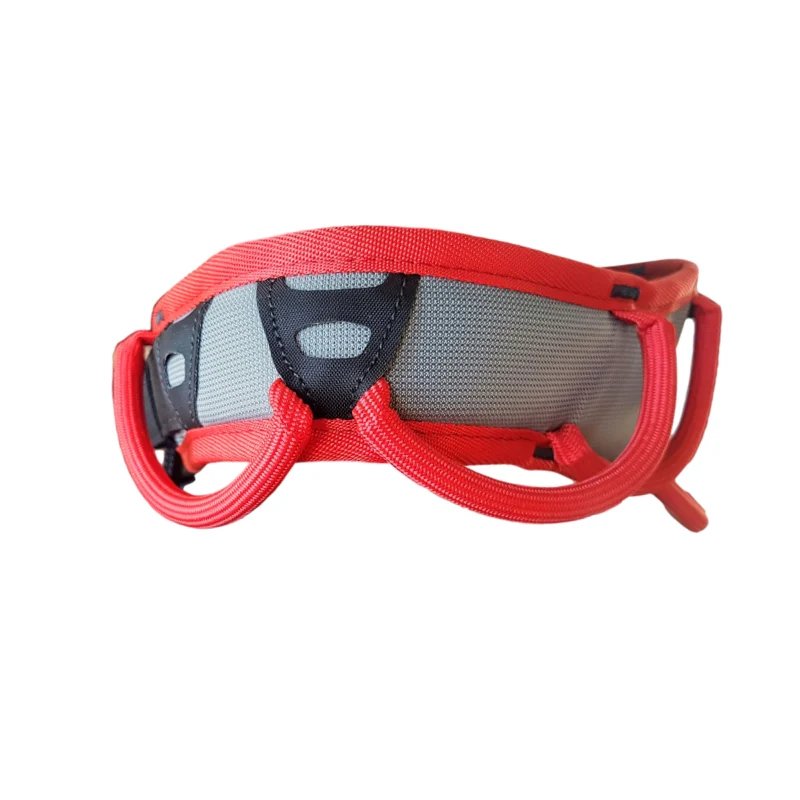
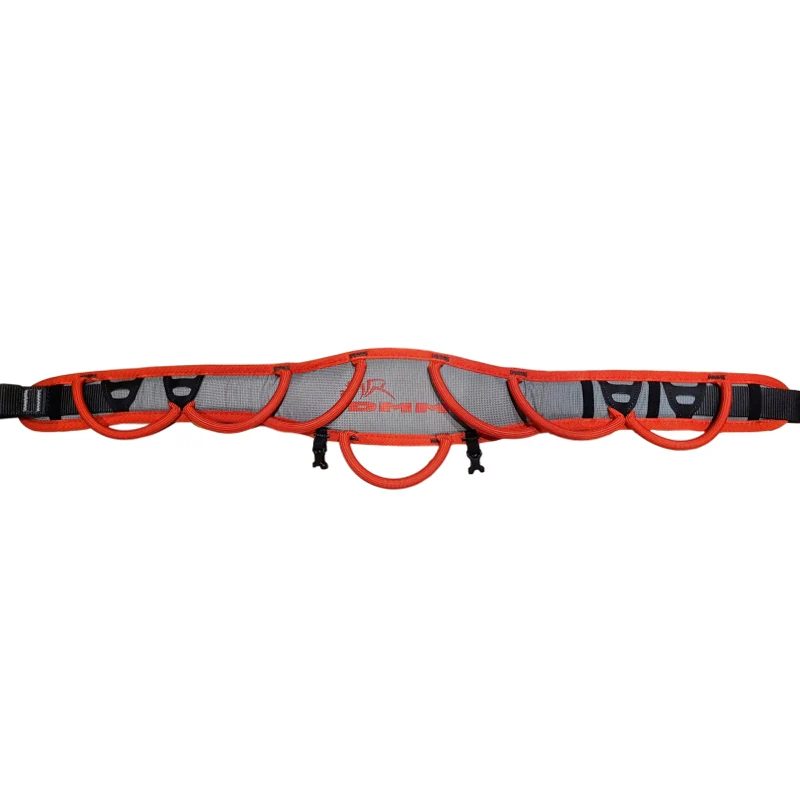
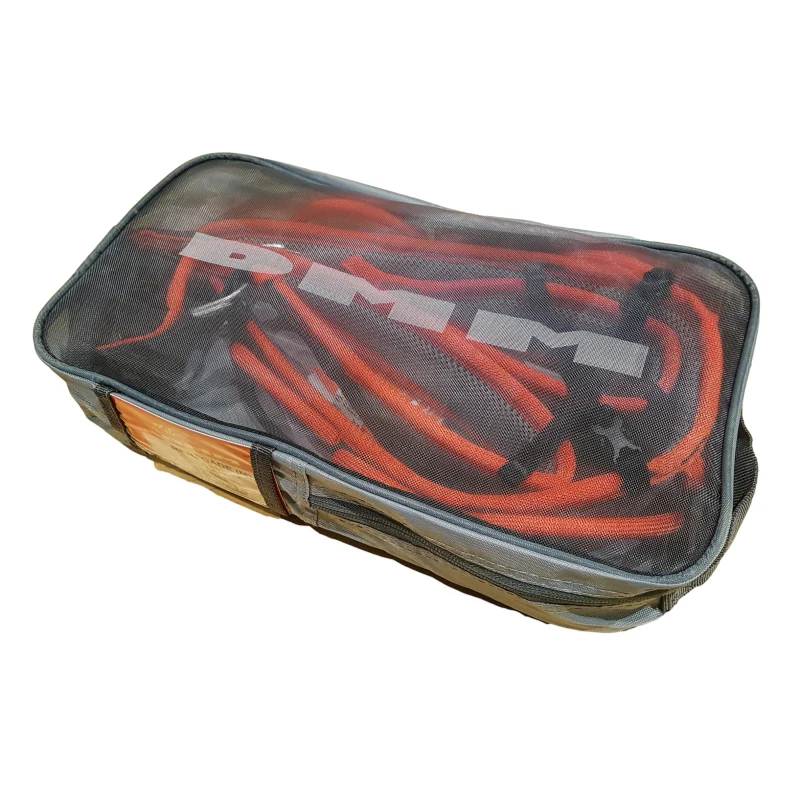
DMM Renegade
Trad-focused, all-day capable. DMM’s flagship harness is built for serious climbers spending long days on complex routes.
⚡ On sale now: Alpinetrek UK £65.56 (was £79.95) or Bergfreunde DE €77.04 (was €93.95)
Score Breakdown
Key Specs
Detailed Review
I’ve climbed on the Renegade for four years, and the most useful thing I can tell you is that there is nothing to report. No fraying, no stiffened webbing, no worn gear loops, nothing I’ve had to keep an eye on. For a harness that lives in a van and gets used hard across European crags, four years of nothing is the whole argument.
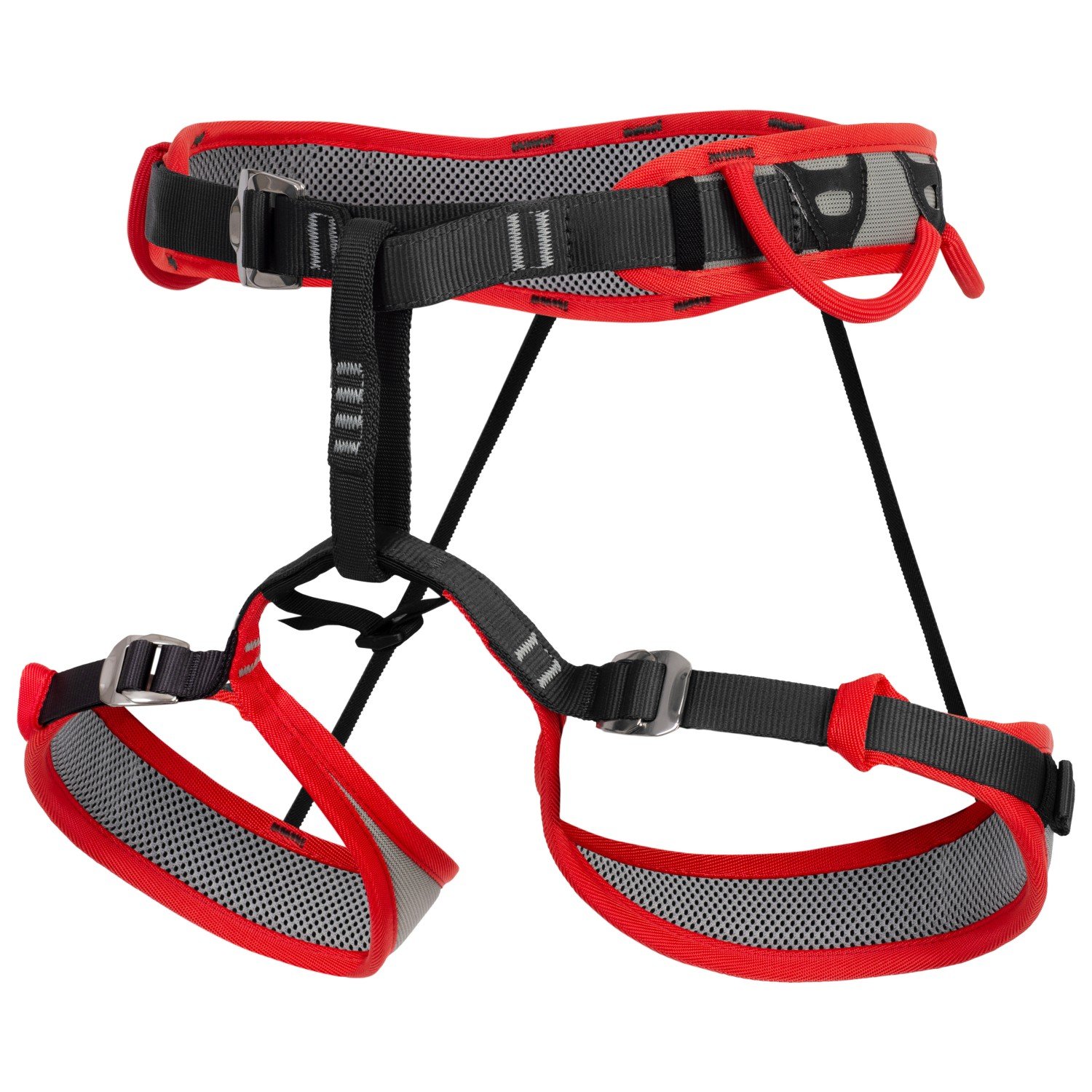
DMM has manufactured in Llanberis since 1986, in the heart of British trad climbing, and that heritage shows. The waist belt is generously padded with shaped foam that moulds to your body over time, distributing load during both active climbing and the long hanging belays that come with serious multi-pitch.
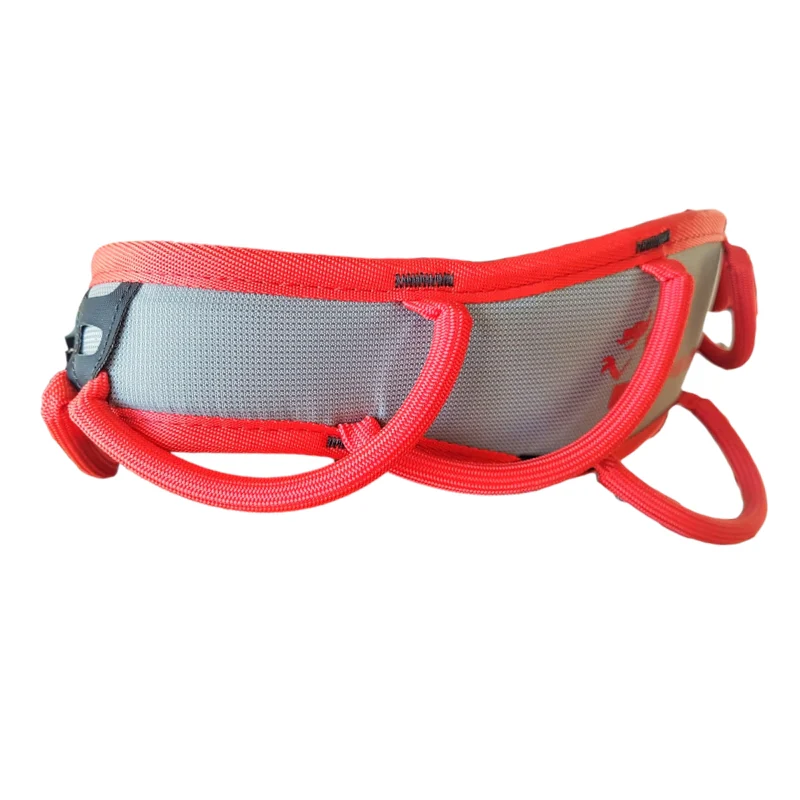
The gear loops are the part I’d point to first. Seven of them, which is more than almost anything else at this price, and the front loops are rigid enough to stop gear rotating while still moving naturally as you climb. What sets the Renegade apart in daily use is the rear racking loop — and not as overflow storage, which is how it usually gets described. I use it to organise carabiners properly. There’s enough space back there that racking becomes genuinely more intuitive, and you stop hunting for the piece you want.
The fully adjustable leg loops matter more in Europe than a spec sheet suggests, and I can confirm this one isn’t a marketing claim: the Renegade genuinely fits over winter layers. British and alpine conditions regularly mean climbing over a base layer, a soft-shell or light waterproofs, and fixed leg loops that are perfect in shorts become impractical over thicker fabric. The Renegade adjusts quickly, which is what you want at a cold stance with gloves on.
Would I buy it again? Without hesitation.
What It Does Well
- Built specifically for trad and all-day climbing
- Rear racking loop makes organising a rack genuinely easier
- Fully adjustable leg loops for layers and varied conditions
- Floating waistbelt keeps padding and gear loops centred
- Shaped foam padding moulds to the wearer over time
- Outstanding durability — four years of hard use, no wear to report
Where It Falls Short
- Heavier than sport-focused harnesses at 395–450g
- More bulk than needed for pure sport climbing
- Less widely available in continental Europe
- Premium price compared to some alternatives
4. Petzl Corax
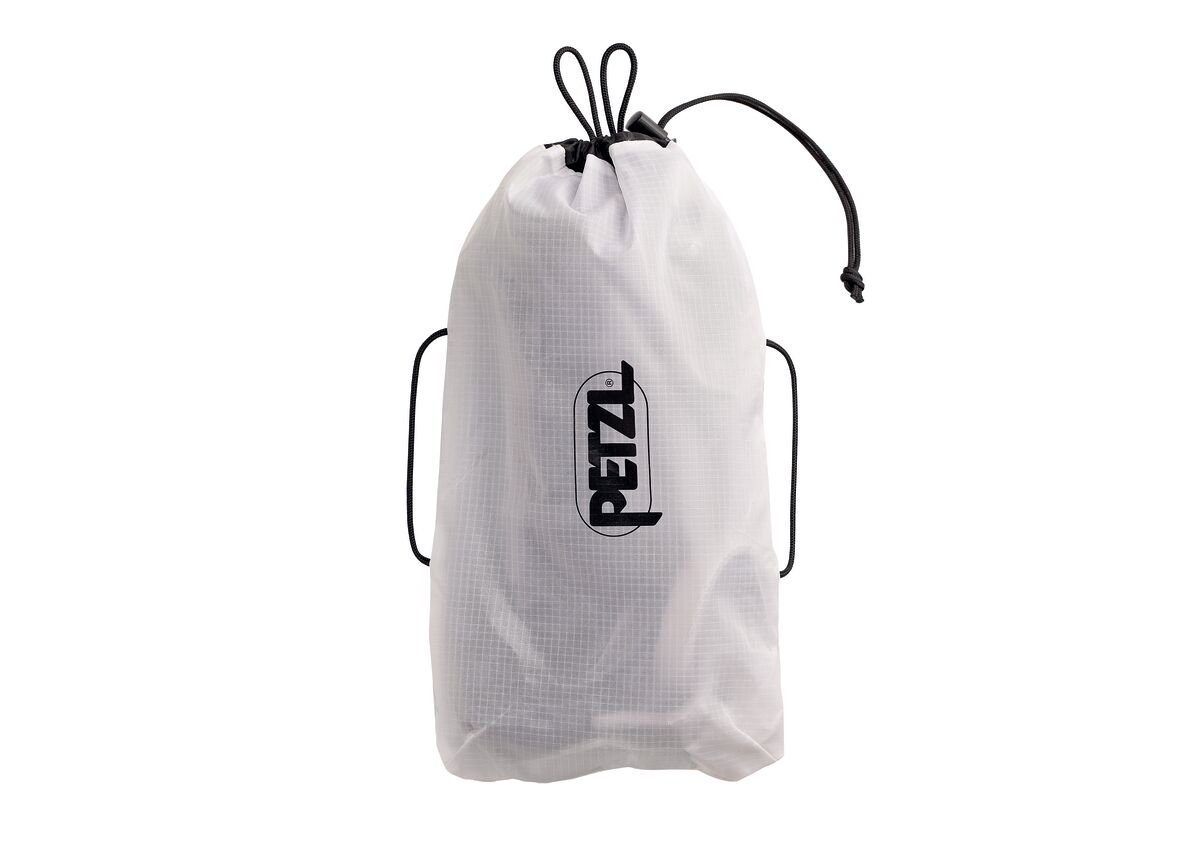
Petzl Corax
The most recommended first harness in Europe — comfortable, adjustable, and genuinely versatile enough to grow with your climbing for years.
⚡ On sale now: Alpinetrek UK £55.15 (was £59.95) or Bergfreunde DE 64.35€ (was €69.95)
Score Breakdown
Key Specs
Detailed Review
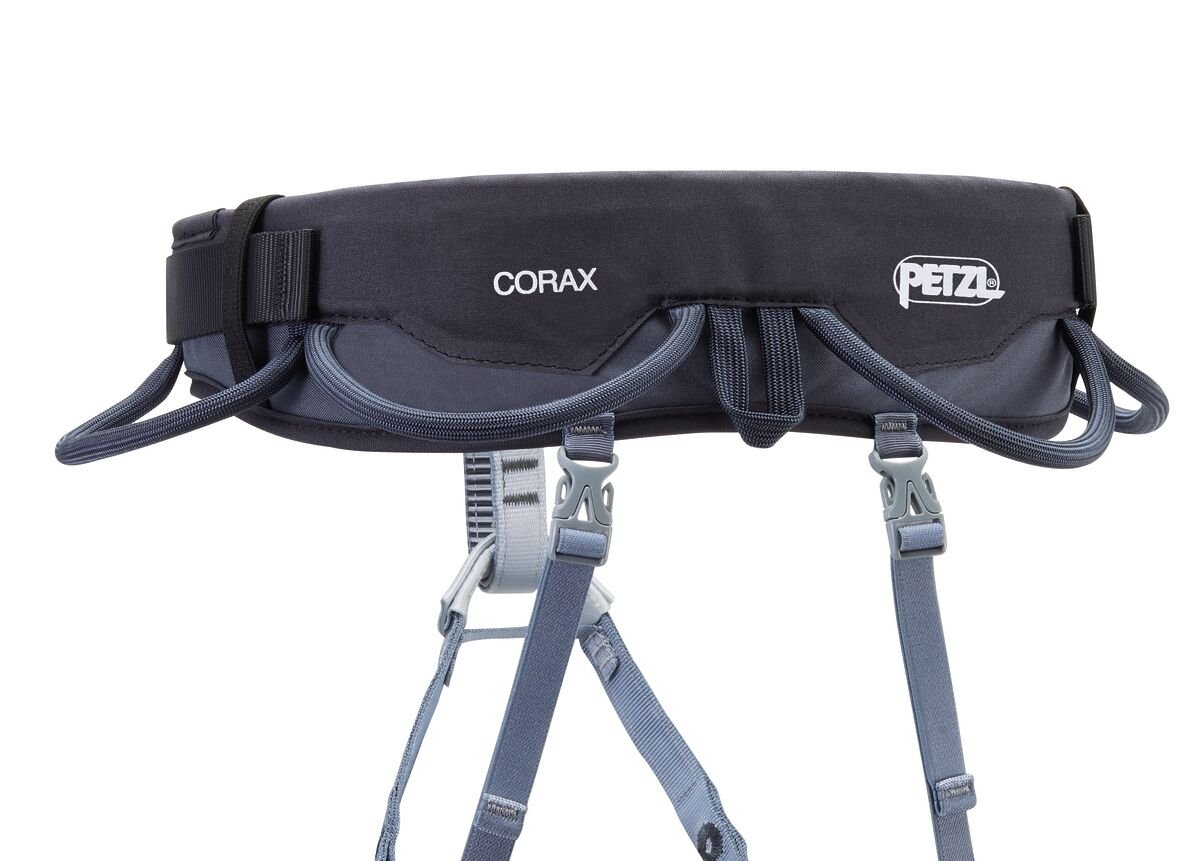
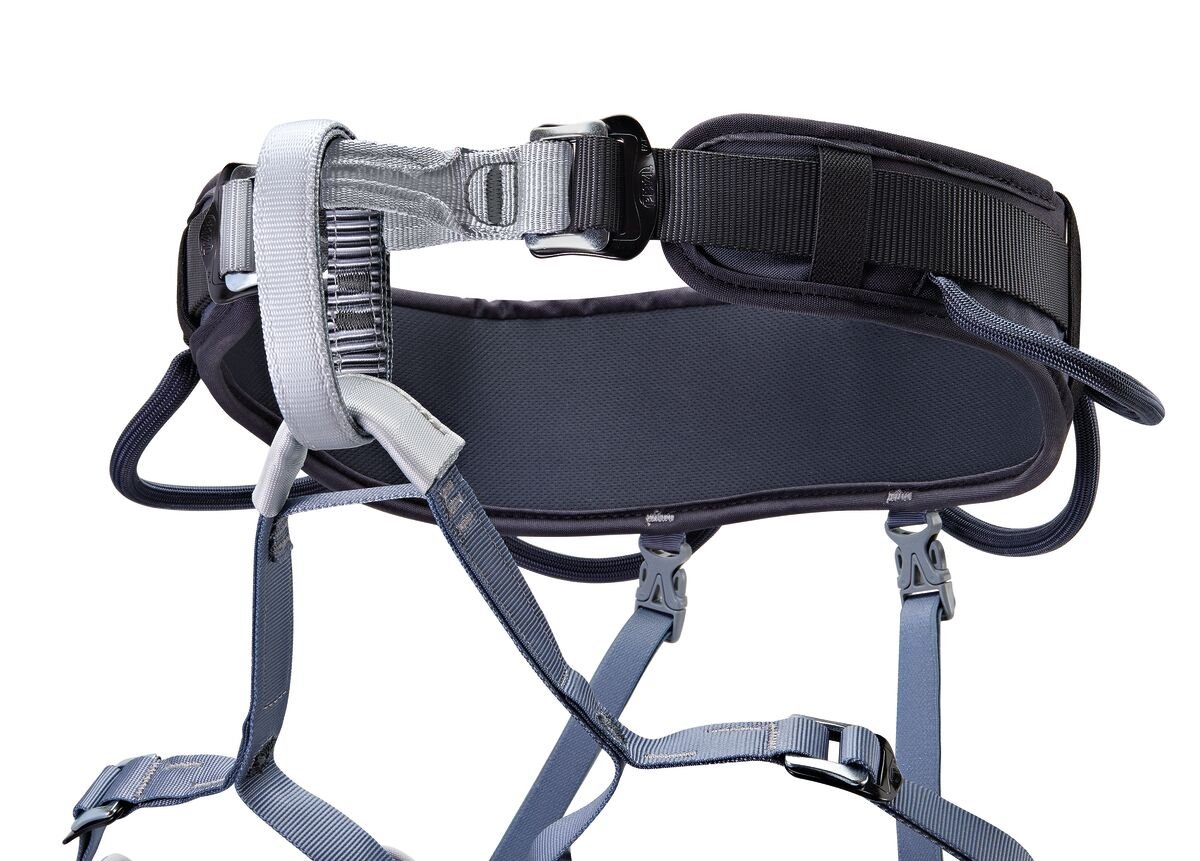
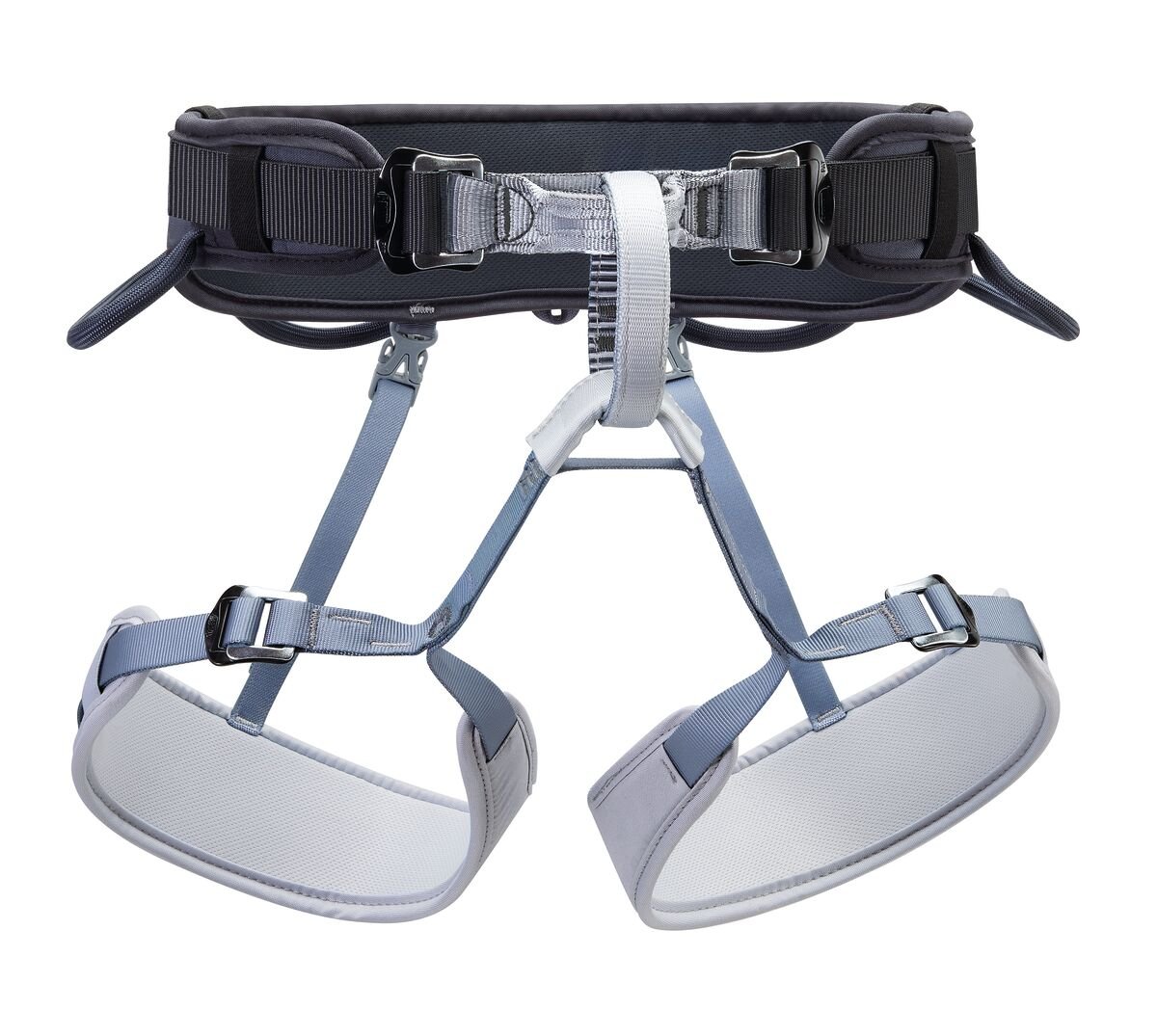
The Petzl Corax is the harness that more European climbing instructors recommend to beginners than any other. The reason is straightforward: it fits an extraordinary range of body shapes through its dual waist buckles and fully adjustable leg loops, meaning a single harness can be shared, borrowed, or grown into without requiring a new purchase.
Petzl’s EndoFrame construction provides comfort that genuinely exceeds what the price suggests. The structural frame within the harness creates a supportive hang without relying purely on padding thickness — which means the Corax is more comfortable during long belay sessions than many comparably-priced rivals.
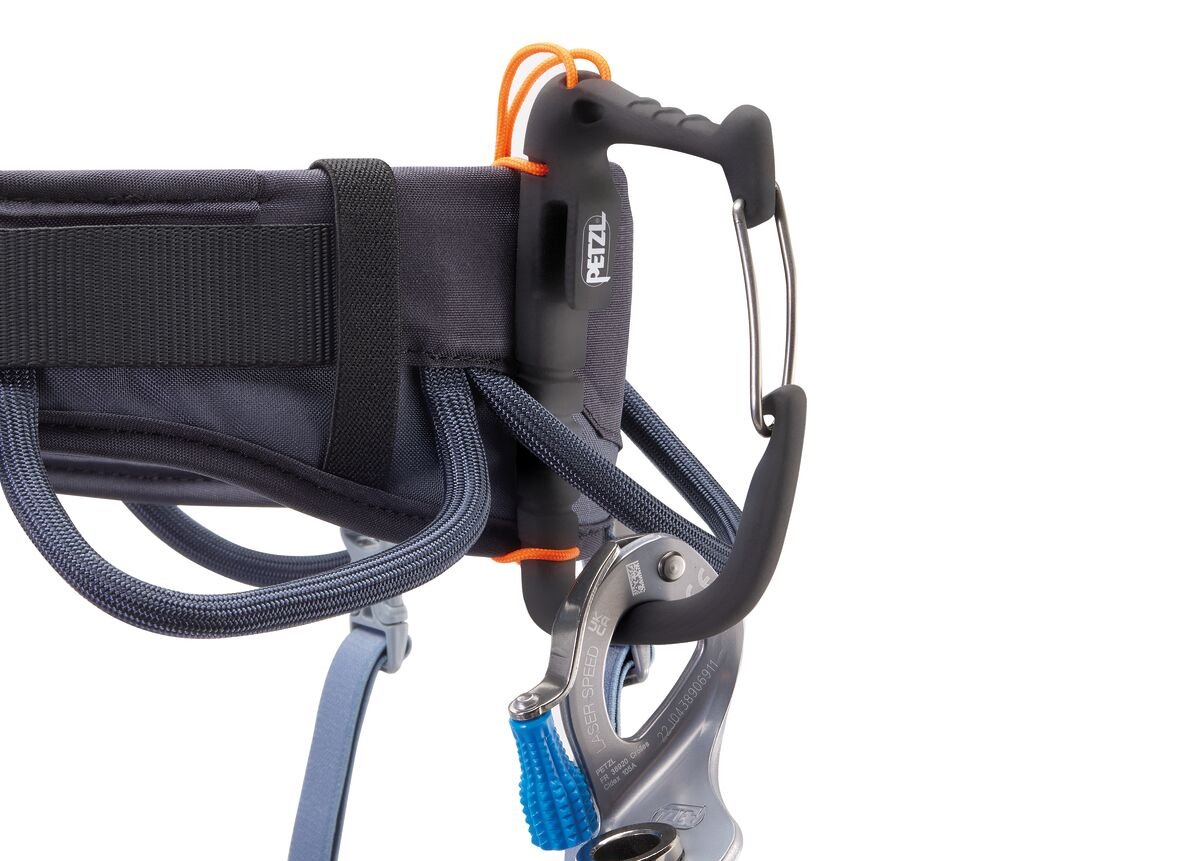
The four gear loops — two rigid at the front, two flexible at the rear — are sufficient for everything up to a moderate trad rack. A beginning trad climber working up to HVS or E1 will find the Corax perfectly adequate.
My partner has climbed on hers for five years and still uses it. That’s worth saying plainly, because the Corax is routinely described as a harness you’ll outgrow in a season or two — in our experience that simply isn’t true. It stays comfortable, it stays adjustable, and it keeps doing the job long past the point where you’d supposedly have moved on.
The honest assessment: it’s the heaviest harness here, and it doesn’t have the performance-oriented hanging comfort of the Mammut Ophir 3 Slide 2.0 or the Black Diamond Solution. If you get to the point of projecting hard sport routes, you’ll feel the difference. But “you’ll outgrow it quickly” is the wrong reason to spend more — five years in, ours hasn’t been outgrown at all.
What It Does Well
- Huge adjustment range — two sizes cover a 65-107cm waist
- Outstanding value at ~€60
- Fully adjustable — easy to share and fit correctly
- Comfortable enough for long belay sessions
- Dual waist buckles make fitting simple and reliable
- Good durability for daily gym and outdoor use
Where It Falls Short
- Heaviest harness in this comparison at 470g
- Bulkier than performance-oriented options
- Less hanging comfort than Mammut Ophir 3 Slide 2.0 or Solution for hard sport
5. Arc’teryx Skaha
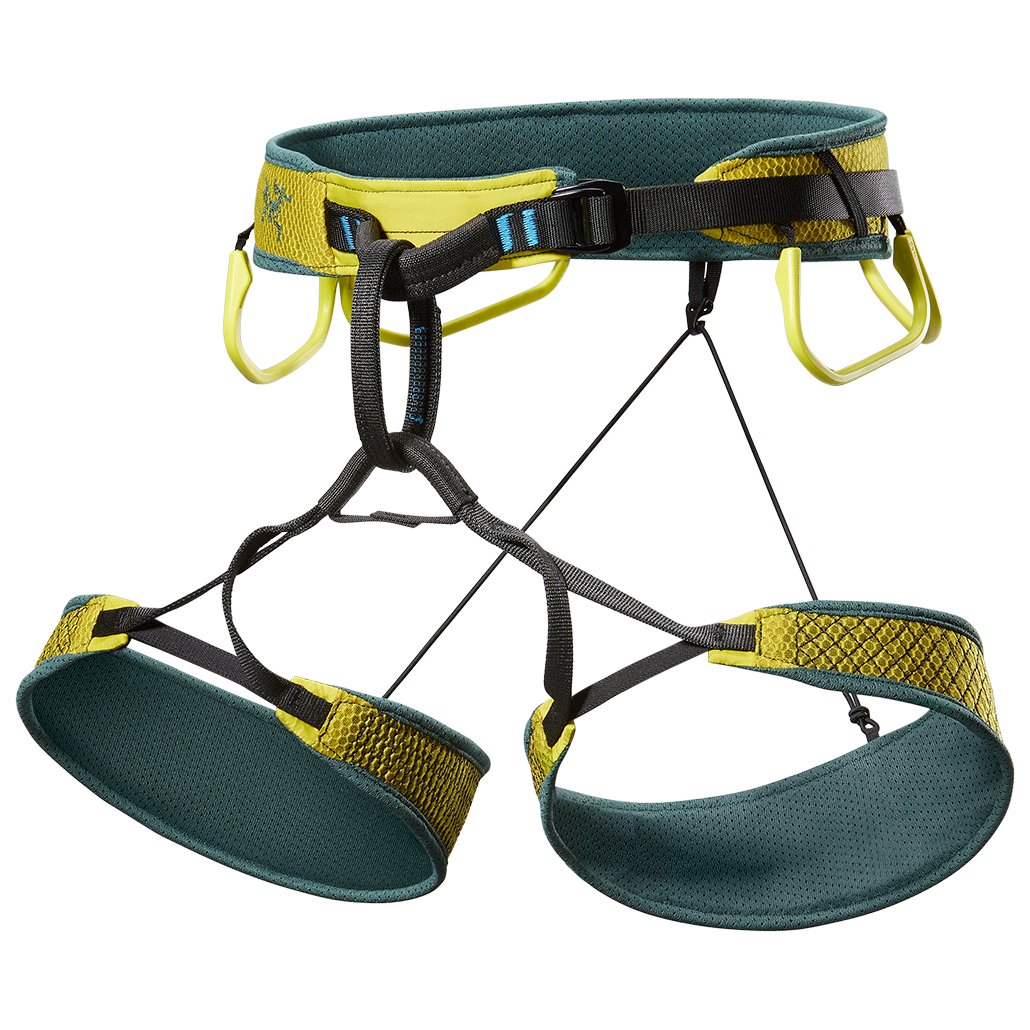
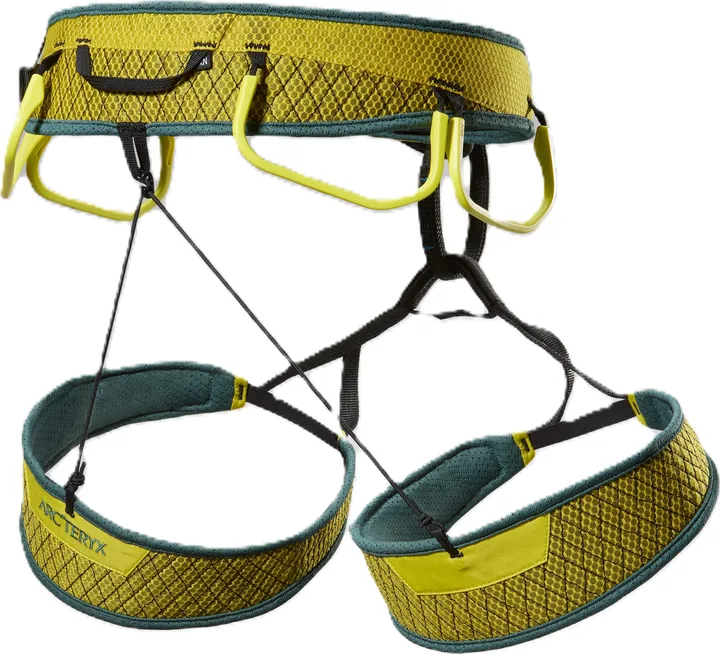
Arc’teryx Skaha
Arc’teryx’s modern sport harness — Warp Strength Technology in a lighter, more breathable package. Honeycomb mono-mesh waist belt for hot Mediterranean projects.
⚡ On sale now: Alpinetrek UK £143.96 (was £159.95) or Bergfreunde DE €161.96 (was €179.95)
Score Breakdown
Key Specs
Detailed Review
The Arc’teryx Skaha is what happens when a company with three decades of harness R&D decides to build the ultimate modern sport climbing harness. It uses the same Warp Strength Technology that made the AR-395a legendary — high-strength HMPE fibres woven across the full width of the waist belt, distributing load across a broader surface than the strap dimensions suggest — but wraps it in a lighter, more breathable package specifically engineered for the projecting mindset.
The standout feature is the 150D honeycomb mono-mesh waist belt with Spacermesh liner. This construction delivers Warp Strength comfort with genuine airflow, which matters enormously when you’re red-pointing hard limestone at 30°C in Kalymnos, Costa Blanca, or Leonidio. Traditional foam-and-webbing harnesses trap heat against your body during long belay sessions — the Skaha genuinely breathes.
At around 300g the Skaha is a full 95g lighter than the AR-395a, and you feel it. For sport projecting where you’re clipping draws, hanging on the rope, and repeating burns for hours, that weight reduction translates directly into less fatigue. The four ergonomically shaped gear loops are finished with rigid plastic that helps with fast deployment — a small but genuinely useful detail when you’re pumped and need to grab the right draw fast.
The fixed leg loops are a deliberate choice — like the Black Diamond Solution, this makes the harness faster to step into and out of between burns, and lighter, at the cost of adjustability. Arc’teryx compensates with elasticated rear risers that provide some accommodation for movement without the weight penalty of full adjustment buckles. The rear elastic risers also feature quick-release hooks that some testers find fiddly at first, but become second nature within a session or two.
The rear fifth gear loop is a thoughtful add — big enough to clip a chalk bag, or if you (like the reviewer at Climbing Gear Reviews) prefer your chalk bag on tat, it’s the perfect spot for prussik loops, a knife, or a maillon on multi-pitch routes.
The honest caveat is the price. At €161.96–€179.95 the Skaha is roughly three times the cost of the Black Diamond Solution, and unless you’re spending long days hanging on the rope, the Solution delivers 85% of the experience at a fraction of the price. This harness is genuinely worth it for the serious sport projector who prioritises airflow, weight reduction, and the WST comfort standard — for most recreational climbers, it’s overkill.
What It Does Well
- Best breathability of any harness in this comparison
- Warp Strength Technology distributes load exceptionally well
- Ultralight at ~300g — barely noticeable on the wall
- Rigid plastic-finished gear loops for fast deployment
- Rear fifth loop for chalk bag or multi-pitch kit
- Dedicated men’s and women’s cuts
- Modern sport design from a genuine climbing brand
Where It Falls Short
- Premium price — significant investment
- Fixed leg loops — must fit correctly out of the box
- Quick-release rear hooks take practice to master
- Not built for winter or alpine use — no ice clipper slots
- Overkill for gym-only or occasional climbers
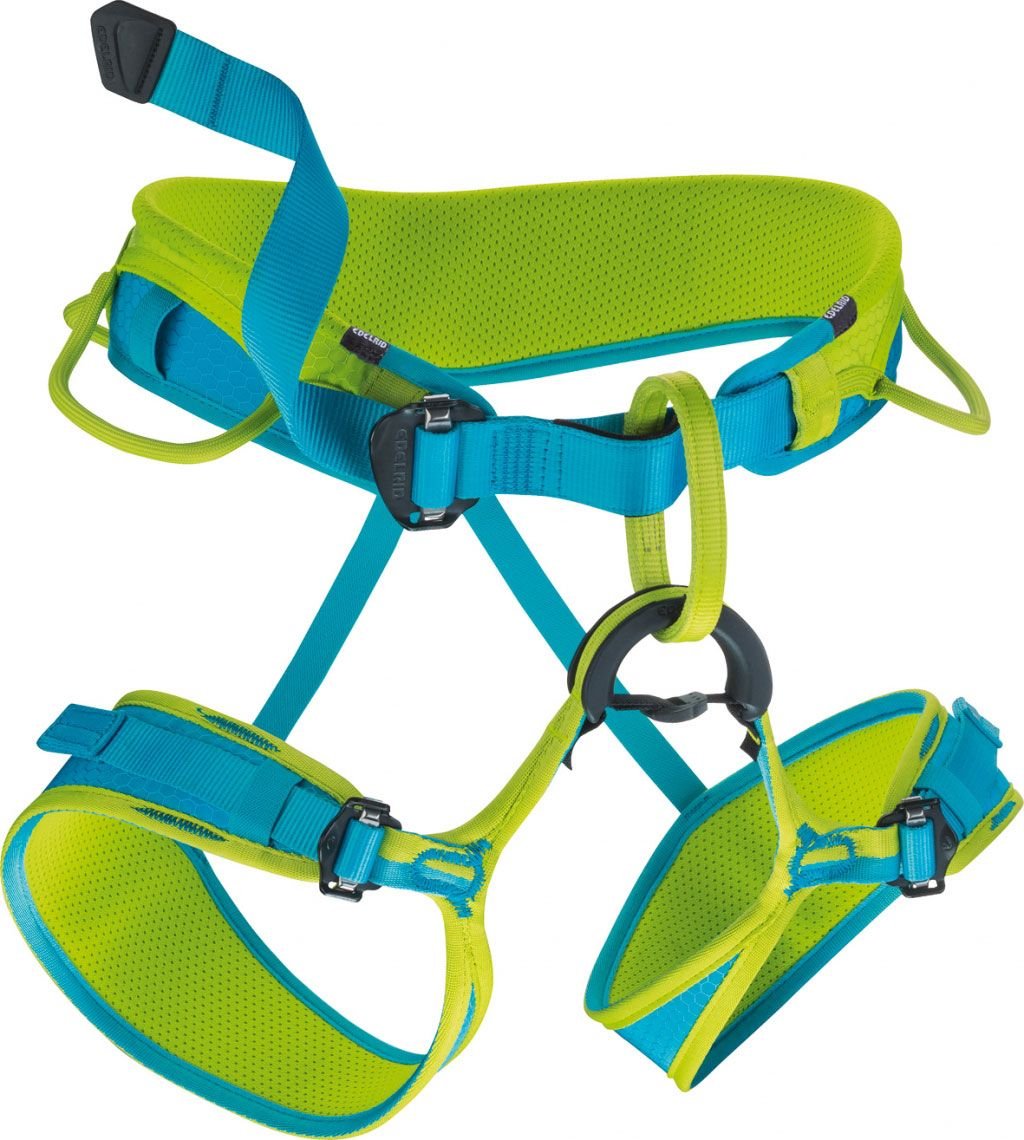
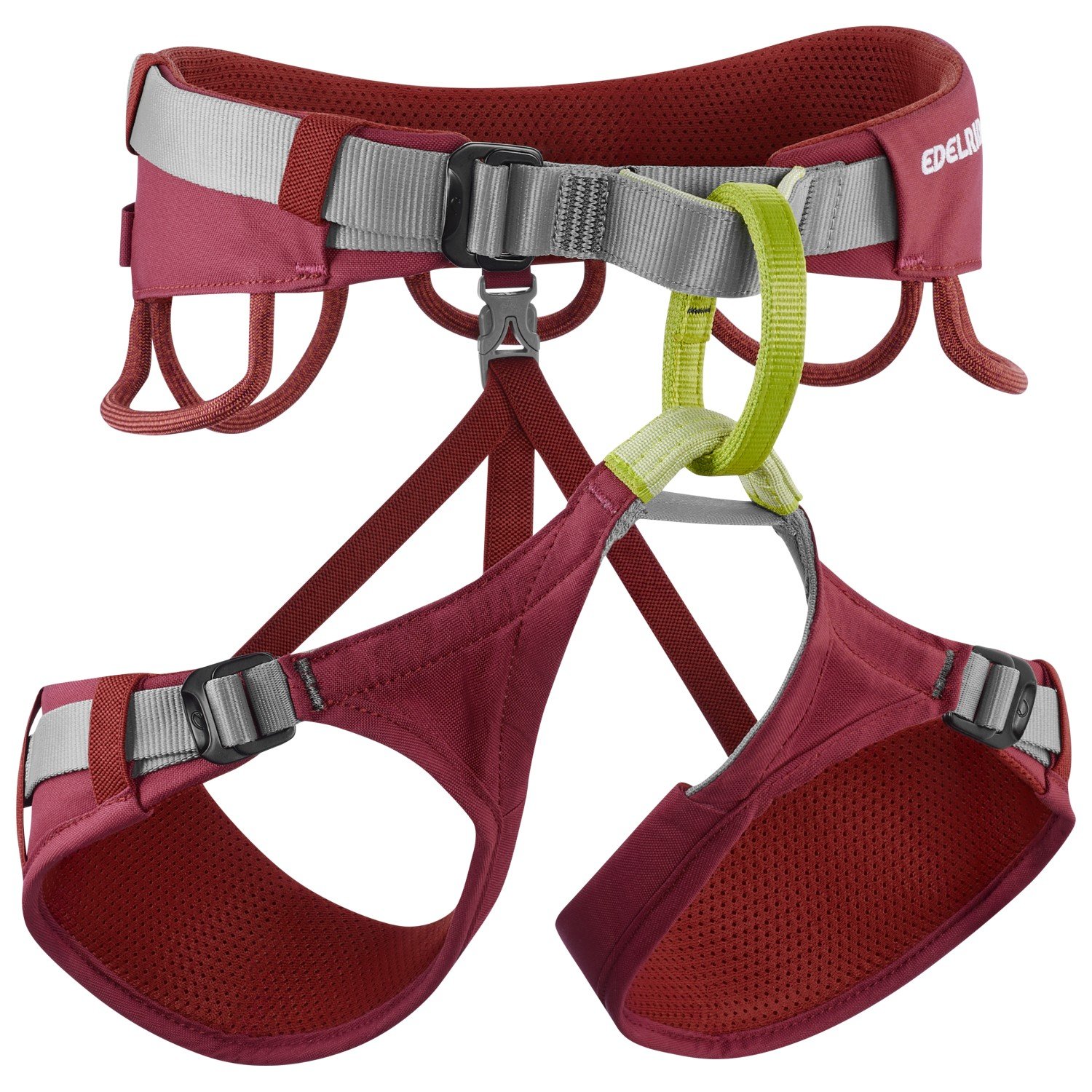
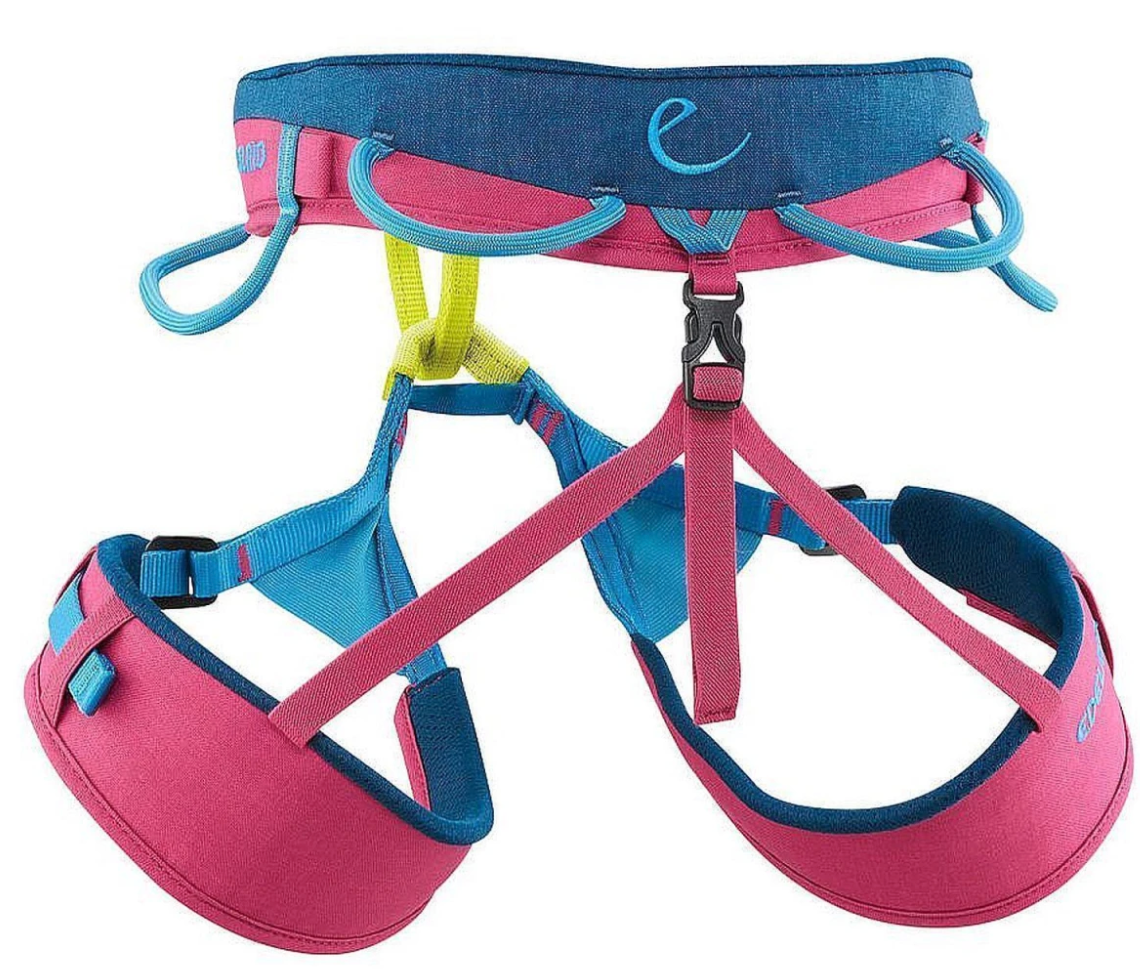
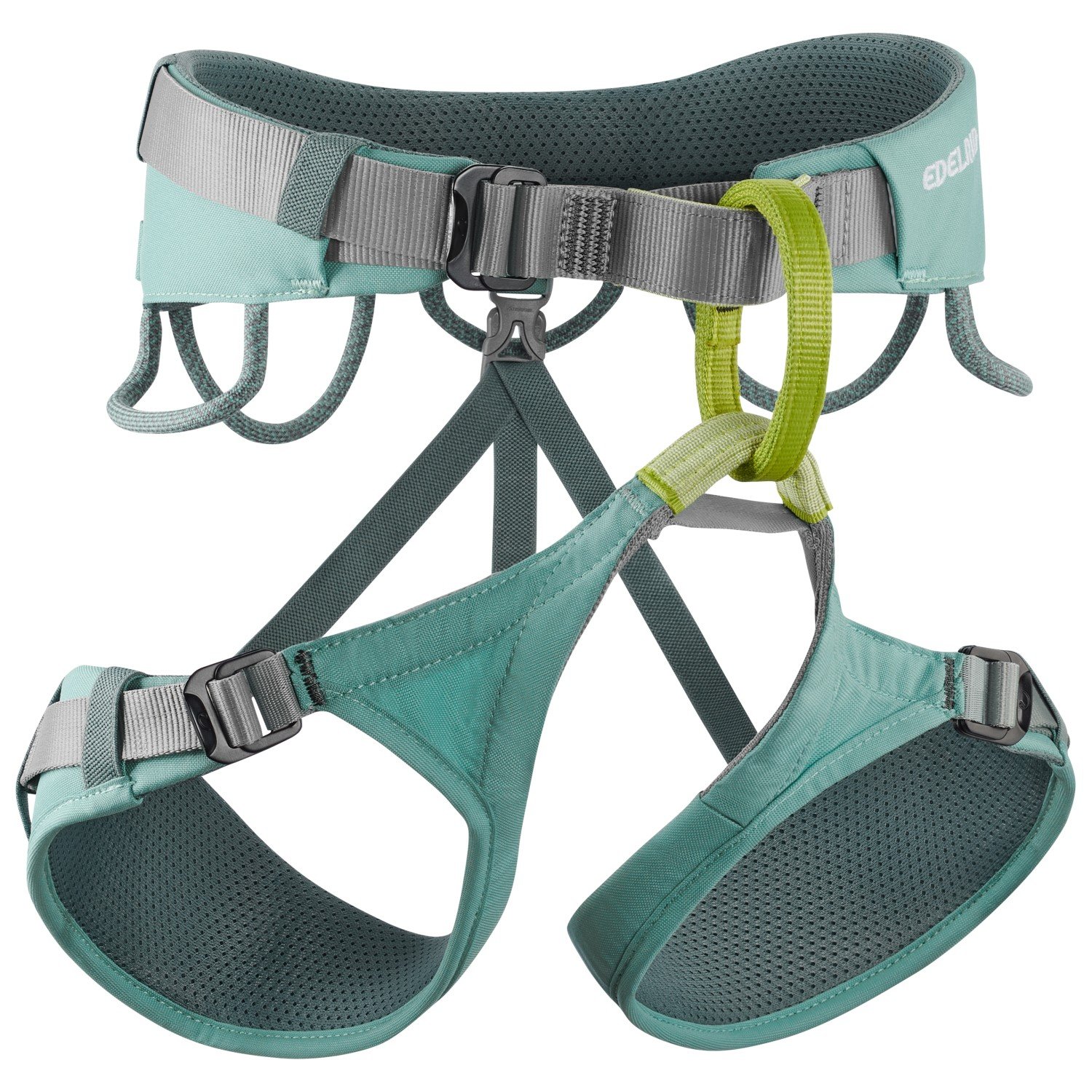
6. Edelrid Jay / Jayne
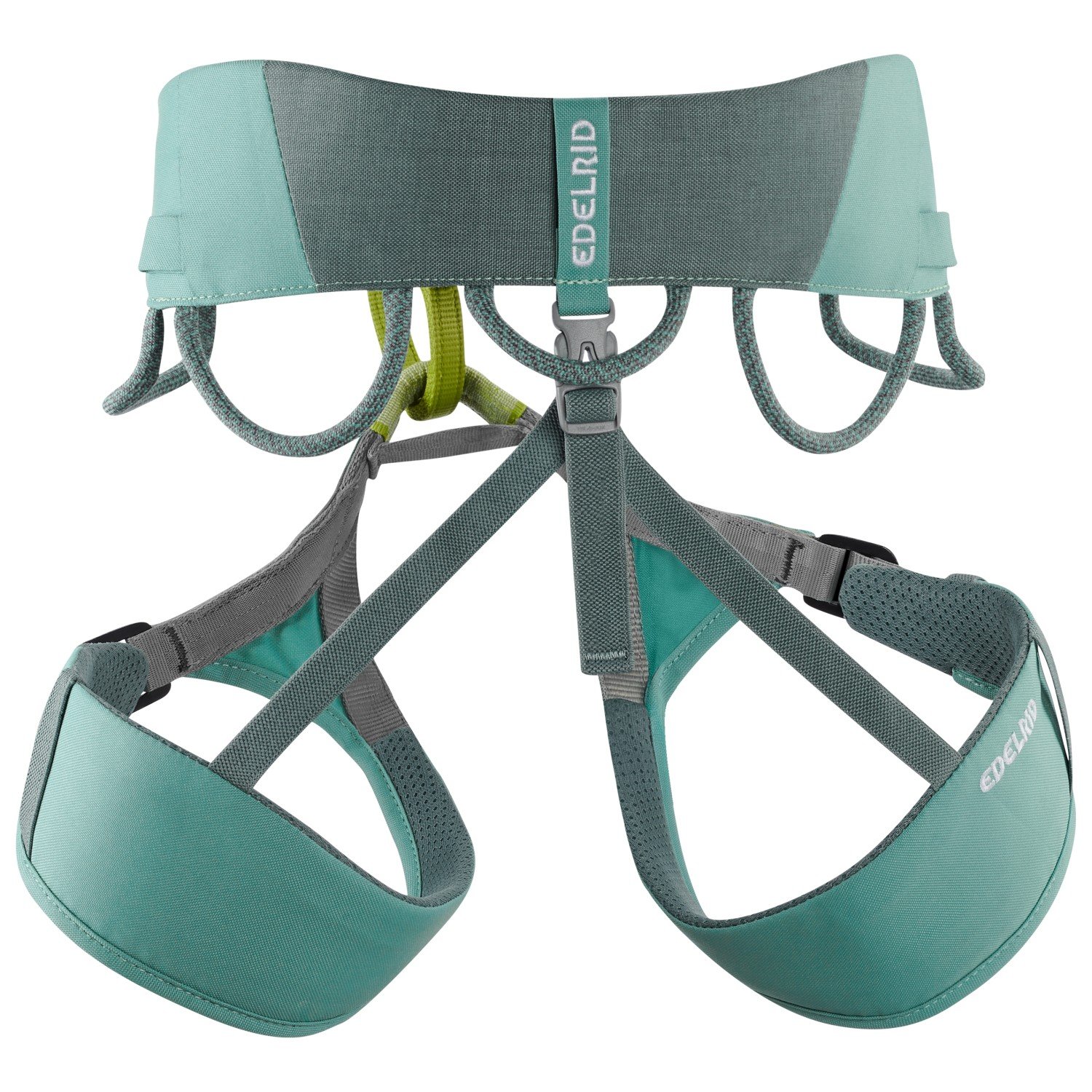
Edelrid Jay / Jayne
The climbing industry’s sustainability benchmark — bluesign® certified materials, built-in wear indicators, and a design that rivals the Petzl Corax in every practical respect.
⚡ On sale now: Alpinetrek UK £50.96 (was £59.95) or Bergfreunde DE €55.21 (was €64.95)
Score Breakdown
Key Specs
Why Is This the Sustainable Pick?
Most brands treat sustainability as a marketing layer on top of conventional manufacturing. Edelrid treats it as an engineering constraint — they often invent the standards that the rest of the climbing industry eventually follows. The Jay and Jayne are built to those standards from the ground up, not retrofitted to meet them.
Edelrid’s sustainability credentials are specific and verifiable, not vague. In 2009 they became the first rope manufacturer in the world to meet bluesign® system standards — a certification that strictly regulates chemical use, water waste, and energy consumption throughout production. Most of their harness range, including the Jay and Jayne, uses bluesign® certified materials throughout. They were also the first to produce a PFC-free climbing rope that still passed UIAA water-repellency standards, removing so-called “forever chemicals” from their production line entirely.
Their flagship sustainability harness — the MOE 3R — takes this further still. It is the first sport climbing harness on the market made almost entirely from recycled materials. The Jay and Jayne sit one step below the MOE 3R in Edelrid’s range, but share the same bluesign® certified material base and the same design philosophy.
The practical standout feature is the wear indicator. Red threads are woven into the webbing at critical points on the harness — the tie-in points and belay loop — and become visible if the harness has been subjected to dangerous levels of wear or impact loading. It is a simple, clever solution to a real safety problem: most climbers retire harnesses by guesswork. Edelrid removes the guesswork.
The Center Fit waist design — a sliding waist belt that keeps the tie-in point and gear loops centred regardless of how many clothing layers you are wearing — makes the Jay and Jayne directly comparable to the Petzl Corax for beginners and all-round use.
The Jay is the men’s cut; the Jayne is the women’s cut with a shorter rise and narrower waist belt geometry. Both are functionally identical in terms of features, gear loops, and safety certification — the difference is purely in how the harness is shaped to fit the body. Try both in a shop if you are between sizes or between cuts.
What It Does Well
- bluesign® certified materials — the industry’s strictest standard
- Built-in red thread wear indicator — unique safety feature
- Center Fit waist keeps tie-in point centred over layers
- PFC-free construction throughout
- Dedicated men’s (Jay) and women’s (Jayne) cuts
- Competitive price — directly rivals the Petzl Corax
Where It Falls Short
- Less widely stocked in continental Europe than Petzl
- Slightly heavier than performance sport harnesses
- Four gear loops only — not ideal for large trad racks
- Center Fit system takes a little getting used to
🏭 The 5 Best Climbing Harness Brands
These are the five brands whose harnesses consistently earn the trust of serious European climbers — from beginners to professional guides.
🎯 Climbing Harness Fit Guide — What to Look For Before You Buy
Choosing a climbing harness is one of the most personal equipment decisions you will make. Unlike a rope or a carabiner, a harness interacts directly with your body — and the right fit for one climber may be genuinely uncomfortable for another. Here is what actually matters.
🔧 Waist Belt Fit
The waist belt must sit on your hips, not your waist. When buckled correctly, you should be able to fit two fingers flat between the belt and your body — no more, no less. Too loose and the harness will shift during a fall. Too tight and it will restrict breathing. The belt should not ride up above your hip bones when you hang.
🦵 Leg Loop Sizing
Leg loops should be snug but not restrictive — you should be able to slide two fingers between the loop and your thigh when standing. If they are too loose, you can slip out in an inverted fall. If too tight, they restrict blood flow during long hanging sessions. Adjustable leg loops are strongly recommended for beginners.
🔗 Belay Loop Inspection
The belay loop is the single most critical point on the harness. Check it before every session for fraying, cuts, and wear. Most harnesses have a wear indicator or a colour change that signals retirement. Never climb on a harness with a damaged belay loop.
🗂️ Gear Loop Placement
For sport climbing, four gear loops and a sensible front placement is sufficient. For trad, look for rigid front loops, flexible rear loops, and a rear accessory loop. Five loops make a meaningful difference on a full rack.
⚖️ Weight vs Comfort Trade-off
Lighter harnesses (300–350g) are optimised for performance sport climbing. Heavier harnesses (380–440g) typically offer better hanging comfort and gear capacity. For all-day wear and trad climbing, prioritise comfort over weight. For hard sport redpointing, prioritise weight.
📅 Harness Lifespan
CE certification requires harnesses to be retired after 10 years from manufacture regardless of use — and sooner if the harness has taken significant falls or shows visible wear. Always check the manufacture date on the label inside the harness. When in doubt, retire it.
Harness fit is genuinely personal — a harness that is perfect for one body shape may be uncomfortable for another even in the same size. Try the harness on in the shop, buckle it correctly, and hang in it if possible. Many good climbing shops have a harness test point. If buying online, check the returns policy before purchasing.
🎯 Our Recommendation in One Sentence
Sport climber: Black Diamond Solution. Trad climber: DMM Renegade. All-rounder / vanlifer: Mammut Ophir 3 Slide 2.0. Beginner: Petzl Corax. Maximum comfort, no budget limit: Arc’teryx Skaha.
📚 Related Rock Vanlife Guides
Complete your climbing setup with our other tested gear guides.
🧗 Complete Your Van Life Climbing Setup
Harness sorted — now make sure the rest of your rack is ready.
❓ Frequently Asked Questions
How do I know if my climbing harness fits correctly?
A correctly fitted climbing harness sits with the waist belt on your hips — not your waist — with the belay loop hanging level with your navel. You should be able to slide two fingers flat between the waist belt and your body when buckled. The leg loops should be snug but allow two fingers between the loop and your thigh. Critically: buckle the harness, hang your weight on it, and check that the waist belt does not ride up above your hip bones and that your legs do not feel restricted or numb within a few minutes. If either happens, the size is wrong.
How long does a climbing harness last?
CE standards require retirement after 10 years from manufacture regardless of condition — and sooner if the harness has taken significant falls, shows any visible wear, cuts, or fraying on the waist belt, leg loops, tie-in points, or belay loop, or has been stored in damp, UV-exposed, or chemically contaminated conditions. Check the manufacture date on the label inside the harness. For climbers who climb regularly (more than 50 days per year), most manufacturers recommend retiring after 5–7 years of active use. When in doubt, retire it.
What is the difference between a sport and trad climbing harness?
Sport harnesses prioritise low weight and hanging comfort for repeated falls on a single pitch. They often have fixed leg loops, minimal padding, and four gear loops. Trad harnesses prioritise gear capacity, adjustability, and comfort during long multi-pitch days. They typically have more gear loops, fully adjustable leg loops for wearing over layers, and heavier padding for extended belay sessions. All-round harnesses like the Mammut Ophir 3 Slide 2.0 aim to cover both disciplines adequately.
Do I need adjustable leg loops?
It depends on how and where you climb. Fixed leg loops are lighter and faster to step into — ideal for sport climbing. Adjustable leg loops are essential if you plan to wear the harness over varying clothing layers, which is common on trad routes in British and alpine conditions. For beginners, adjustable leg loops are strongly recommended as they allow the harness to be fitted correctly regardless of clothing and body changes as fitness develops.
How many gear loops do I need for trad climbing?
A standard trad rack for routes up to E3/6a typically consists of a full set of wires, a set of cams, slings, quickdraws, and a belay device. Fitting this on four gear loops is possible but tight; more loops or a rear racking loop give meaningful breathing room. The DMM Renegade carries seven, which is why it’s our trad pick — the Mammut Ophir 3 Slide 2.0 and Petzl Corax give you four. If you are starting trad climbing and building your rack gradually, four good gear loops are sufficient for the first year or two.
Can I use the same harness for sport and trad climbing?
Yes — and for most climbing vanlifers, that is exactly the right approach. An all-round harness like the Mammut Ophir 3 Slide 2.0 handles both disciplines well. The only scenario where separate harnesses make sense is if your sport climbing is at a high performance level where weight becomes meaningful, or if you regularly carry a very large trad rack. For recreational to intermediate-level European climbers who do both, one good all-round harness is the practical answer.
What makes DMM harnesses special for trad climbing?
DMM has manufactured in Llanberis, at the foot of Yr Wyddfa (Snowdon), since 1986 — one of the most active trad climbing areas in Europe, and the company is now the only manufacturer of climbing hardware left in the UK. Their harnesses are designed and tested by people who climb technical Welsh rock regularly, which means the design priorities reflect real trad climbing needs: durability on sharp rock, adjustability for layered clothing in mountain conditions, gear loop configuration for large rack sizes, and construction quality that holds up to years of hard use.
Is it worth spending more on a premium harness like the Arc’teryx Skaha?
For most recreational climbers, the honest answer is no — the Mammut Ophir 3 Slide 2.0 delivers 90% of the comfort at roughly a third of the price. The Arc’teryx Skaha justifies its premium for climbers who spend a very high proportion of their climbing time hanging on the rope. If hanging comfort is your primary constraint, the Warp Strength Technology makes a noticeable difference. If you climb mostly moderate routes, save the money and put it towards a day on the crag.
🔍 Semantic & Keyword Index
Primary: best climbing harnesses 2026 • best climbing harness Europe • climbing harness review Europe • climbing harness all-day comfort • best climbing harness UK & DE • Secondary: Mammut Ophir 3 Slide review • Black Diamond Solution harness • DMM Renegade harness review • Petzl Corax beginner harness • Arc’teryx Skaha review • Edelrid Jay Jayne review • best sport climbing harness • best trad climbing harness • sustainable climbing harness • bluesign certified harness • adjustable leg loops climbing harness • Warp Strength Technology harness • Long-tail: best climbing harness for van life Europe • best harness for beginner climber Europe • Mammut Ophir vs Petzl Corax • DMM Renegade vs Black Diamond Solution • Arc’teryx Skaha vs AR-395a • how long does a climbing harness last • climbing harness sport vs trad differences • how to choose a climbing harness Europe • best climbing harness Alpinetrek Bergfreunde • sustainable climbing harness bluesign PFC-free • best climbing harness for multi-pitch trad • climbing harness fit guide women men • how many gear loops for trad climbing • harness wear indicators safety
🧗 Explore Our Climbing Guides
Detailed crag guides from our van life climbing adventures across Europe