Le Rocchette Climbing Guide (Tuscany)
171 Routes in Tuscan Beech Forest — Lucca’s Hidden Gem
📋 In This Guide
Le Rocchette is Tuscany’s best-kept climbing secret. Whilst international climbers flock to Finale Ligure and the Dolomites, Le Rocchette sits quietly in the Garfagnana mountains above Lucca, offering 171 sport routes (5.7–5.13b / French 5c–8b+) on beautiful limestone towers surrounded by beech forest at 1050m altitude.
This is proper Tuscan climbing: medieval towns, cypress trees, excellent wine, incredible food — and brilliant limestone sport routes with almost nobody on them. The crag has multiple sectors spread across three distinct rock towers, with routes ranging from slabs to vertical walls to steep overhangs.
Why we love it: You can park right at an overhanging cave with routes, or walk 5–10 minutes to the main sectors. The beech trees provide shade on hot days. The views stretch across the Garfagnana valley to the Apuan Alps. And after climbing, you’re an hour from Lucca — one of Italy’s most beautiful medieval cities. This is the climbing trip you didn’t know you needed.
| 📍 Location | Garfagnana region, above Gallicano, ~1hr north of Lucca. Three limestone towers at 1050m altitude. GPS: 44.0892° N, 10.4458° E |
| 🅿️ Parking | Le Rocchette Grotta (cave with 8 routes) or Piglionico (larger area, 5-10 min walk). €3 parking fee. Van parking possible. |
| 🧗 Total Routes | 171 bolted sport routes across Prima Torre, Seconda Torre, Terza Torre. 15–35m length, all single-pitch. |
| 📈 Grade Range | 5.7–5.13b (YDS) / French 5c–8b+. Good spread: beginners (5c–6a), intermediates (6a–7a), hard projects (7c+–8b+) |
| 🪨 Rock Type | Compact limestone. Similar to British limestone—technical, requires good footwork. Pockets, edges, crimps. Generally safe bolting. |
| 🥾 Approach | 5–10 minutes, easy trails. Well-marked via trail #134. Approach shoes fine. |
| 🏘️ Nearest Towns | Lucca (50km, 1hr) – medieval city, full facilities • Gallicano (15km, 20min) – basic supplies • Castelnuovo di Garfagnana (20km) |
| 🎒 Essential Gear | 12–14 quickdraws • 60m rope (some sectors need 70m) • Helmet recommended • Warm layers (altitude) |
| ☀️ Best Seasons | March–November. ⭐⭐⭐⭐⭐ Spring/Autumn (15–25°C) • ⭐⭐⭐⭐ Summer (stays cool at altitude) • ⭐⭐⭐ Winter (snow dependent) |
| 🚐 Van Parking | ⭐⭐⭐⭐ Good. Piglionico or cave parking accessible. Camping a’Zania nearby (~€20–30/night). Wild camping possible with discretion. |
| 👶 Beginner-Friendly? | ⭐⭐⭐ Moderate. Has beginner routes but compact rock requires technique. Better for intermediates (6a+ upward) improving limestone skills. |
| 👥 Crowds | ⭐⭐⭐⭐⭐ VERY QUIET. Little known even in Italy. Expect sectors to yourself, especially weekdays. Tuscany’s best-kept secret. |
| 📶 Cell Coverage | ⭐⭐⭐ Variable. Mountain location—coverage can be patchy. Italian networks (TIM, Vodafone) generally work. Download topos beforehand. |
| 💰 Daily Budget | €30–50/day (van cooking, wild camping). Parking €3. Lucca meals €12–20. Budget-friendly! |
Why Climb at Le Rocchette?
Tuscany isn’t famous for sport climbing. When climbers think “Italy,” they think Dolomites, Finale Ligure, Arco. Tuscany means wine, Renaissance art, hilltop towns — not limestone sport crags.
Which is exactly why Le Rocchette is brilliant.
The Hidden Gem Appeal
Le Rocchette is genuinely undiscovered. Trip reports describe locals being “quite surprised to see strangers here” and “pleased that some foreign people come and try their routes.” This is rare in modern European climbing.
What this means in practice:
Zero Crowds
You’ll have sectors to yourself. Even on summer weekends.
Peaceful Climbing
Just you, the rock, the beech forest, and birdsong.
Local Feel
A crag Italian climbers use, not an international circus.
Discovery Vibe
Feels like you’ve found something special (because you have).
If you’re tired of queuing for routes, this is your antidote.
Proper Quality Climbing
171 routes is a lot. Le Rocchette isn’t just “a few routes on a nice crag” — it’s a destination-worthy venue with enough climbing for multiple days.
The rock is described as similar to UK limestone: compact, technical, requiring good footwork. This isn’t juggy sport climbing where you just power through. You need to read the rock, find footholds, move efficiently. It’s proper climbing that makes you better.
The variety is excellent:
- Slabs — technical face climbing
- Vertical walls — pockets, edges, crimps
- Overhangs — steep routes for power endurance
- Multi-directional faces — different sectors face different directions, giving options for sun/shade
And the grade range (5.7–5.13b / 5c–8b+) means there’s progression: warm up on easier routes, work your projects on the hard ones, finish on moderate classics.
The Tuscan Experience
Let’s be honest: the climbing is brilliant, but Tuscany is the real reason you’re here.
Le Rocchette lets you combine:
- Morning climbing in beautiful beech forest at 1050m
- Afternoon in Lucca — walk the medieval walls, eat pasta, drink wine
- Evening in your van surrounded by Tuscan hills
This is the climbing trip where your non-climbing partner/friends can actually enjoy themselves. Lucca is stunning. The Garfagnana region is beautiful. The food is incredible. And you can still climb your backside off.
Compare this to, say, the Dolomites (amazing climbing, tourist-trap rifugios, €30 pasta) or Finale Ligure (climbing paradise, but that’s ALL there is). Le Rocchette gives you climbing + culture + cuisine in one package.
Van-Friendly & Affordable
Tuscany is surprisingly budget-friendly outside the main tourist zones (Florence, Pisa, Siena). In the Garfagnana:
- Parking at crag: €3
- Wild camping possible with discretion
- Official camping (Camping a’Zania): ~€20–30/night
- Groceries in Gallicano: affordable
- Restaurants in Lucca: €12–20/meal (not bad for Italy)
You can do a week-long Tuscany climbing trip on a reasonable budget. That’s rare in Italy.
The solitude. Having three limestone towers with 171 routes almost entirely to ourselves was surreal. We climbed 15 routes in a day and saw 2 other climbers. In modern European climbing, that’s magic.
The setting. Beech forest, mountain views, autumn colours (if you go Sept–Oct), that specific quality of light you only get in Tuscany. Climbing here feels different to alpine crags or sea cliffs. It’s gentler, warmer, more intimate.
The Lucca factor. Driving down from the crag, grabbing aperitivo in Lucca’s Piazza dell’Anfiteatro, then cooking dinner in our van with local wine and cheese. That’s the trip.
The Climbing — Sector Breakdown
Le Rocchette has three main limestone towers (Prima Torre, Seconda Torre, Terza Torre) with routes on multiple faces. Different sectors offer different styles and aspects.
La Grotta (The Cave)
~8 routes • Immediate access
Overhanging cave routes right at parking. Climb the moment you arrive. Quick sessions or warm-ups.
Prima Torre (First Tower)
Multiple routes • Fork left from col
First of the main towers. Variety of styles. Good mix of grades. Bring guidebook for navigation.
Spigolo del Vento (Wind Edge)
Arête climbing • Fork right from col
Named sector with exposed climbing. Classic Tuscan limestone ridge routes. More airy than face routes.
Bivacco (The Bivouac)
Bulk of routes • Smoke-blackened walls
Routes spread across Seconda and Terza Torre. Full day exploration. Navigate with guidebook.
Route Style & Character
Rock type: Compact grey limestone. Requires good footwork and technique rather than raw power. UK climbers compare it to British limestone — not juggy, not easy, but brilliant for improving your skills.
Route lengths: 15–35m. Mostly single-pitch, though some longer pitches (14 quickdraws needed for longest routes). 60m rope covers most routes.
Bolting: Generally safe. This is sport climbing, all routes are bolted. Some older routes may have more spaced bolts (typical Italian style) — check guidebook for notes. Bring enough quickdraws (12–14 for safety).
Anchors: Standard two-bolt sport anchors. Bring quickdraws for lowering.
Climbing style: Technical face climbing dominates. Pockets, crimps, edges. Footwork crucial. Slabs to vertical to overhanging. Not the modern steep tufa-pulling style — this is classic limestone technique climbing.
- Bring the guidebook. With three towers and multiple sectors, route-finding is complex. “Tuscany and Isola d’Elba” guidebook has topos and descriptions.
- Trail markers. Follow trail #134 and pay attention to fork points. Watch for cairns.
- Up to 14 quickdraws needed for longer routes. Bring extras.
- Weather changes. You’re at 1050m in mountains. Storms possible. Check forecast.
- No facilities at crag. No water, no toilets (unless you hike 1hr+ to Rifugio Rossi). Bring everything.
- Helmet recommended. Multiple sectors mean climbers could be above you.
Practical Information
Getting There — Driving to Le Rocchette
From Lucca (50km, 1hr):
- Take SS12 north signposted “Abetone” or “Castelnuovo Garfagnana”
- At Gallicano, take SP20 then SP41 toward Molazzana
- Before Molazzana village, turn LEFT following signs for “Rifugio Rossi“
- Continue through 4 forks/junctions (follow Rifugio Rossi signs) until reaching Le Rocchette towers — paved road ends here, dirt road begins
- Parking option 1: Cave parking (La Grotta) — small area on left with overhanging cave. Park here for immediate climbing.
- Parking option 2: Continue on dirt road ~500–600m to Piglionico (1142m) — end of road, larger parking area
Total distance from Gallicano to Piglionico: ~15km (last section is dirt road but standard width, no 4×4 needed).
Parking fee: €3 per vehicle (automated machine ~2km before crag, 2024 price).
From Florence/Pisa: Drive to Lucca first (easy motorway access), then follow directions above.
Nearest airports: Pisa (Galileo Galilei Airport) — ~80km, 1.5hrs. Florence (Peretola Airport) — ~100km, 1.5hrs.
Where to Stay
Van Parking:
- Piglionico parking (end of road) — Flat area, quiet at night, free (just €3 for access). Technically wild camping but discreet overnight stays likely tolerated. No facilities.
- Cave parking (La Grotta) — Smaller area, may fit 1–2 vans if quiet. Same €3 access fee.
- Wild camping in area — Garfagnana has many forest roads. Be discreet, leave no trace.
Official Camping:
- Camping a’Zania (Molazzana, ~10km from crag) — Small campsite in forest. Le Rocchette mentioned as attraction (“10-min drive or 1hr walk away”). Facilities include toilets, showers, laundry. ~€20–30/night for vans. Electric car charging available. Check Pitchup.com for booking.
- Other Garfagnana campsites — Castelnuovo di Garfagnana area has several options.
Accommodation in Lucca:
- Hotels, B&Bs, Airbnb widely available. Lucca is tourist-friendly.
- Search Airbnb Lucca or Booking.com Lucca
- Expect €60–100/night for decent accommodation in Lucca
- Much cheaper in Garfagnana villages (Gallicano, Castelnuovo)
Where to Eat & Drink
At the crag: Bring everything. No facilities. Nearest rifugio Rifugio Rossi (1609m) is 1hr+ hike from Piglionico — has restaurant/beds but call ahead (+39 0583 710386) to confirm it’s open.
Gallicano: Small town, basic restaurants, pizzerias. Affordable local food.
Castelnuovo di Garfagnana: Larger town with more restaurant options. Worth visiting for supplies and meals.
Lucca: THIS IS WHY YOU’RE HERE. Incredible restaurants, trattorias, osterias. Must-try dishes:
- Tordelli Lucchesi (meat-filled pasta typical to Lucca)
- Garmugia (spring vegetable soup)
- Buccellato (sweet bread with raisins and anise)
- Farro soup (Garfagnana speciality)
- Local wine — Montecarlo DOC, Colline Lucchesi
💰 Lucca Budget
€12–20/meal (trattorias) • €8–12 pizza • €3–5 gelato (mandatory)
Approach Times
From cave parking: ~100m walk along trail #134 to col, then fork left for Prima Torre or right for Spigolo del Vento (2-5 mins).
From Piglionico parking: Walk back down dirt road/trail #134 for 5–10 mins to access sectors.
To Bivacco sectors: Follow trail #134 downward from col, then take faint path up right to arrive at smoke-blackened bivouac area. Other sectors stretch leftward from here on two more distinct towers (5-10 mins total).
Road conditions: Paved roads to Gallicano/Molazzana. Final ~15km to Piglionico is dirt road but standard width, no 4×4 required, accessible by regular vans. Road ends at Piglionico (parking). Check conditions after heavy rain or snow — dirt road can get muddy/icy.
Guidebooks & Resources
Essential: Tuscany and Isola d’Elba Climbing Guidebook
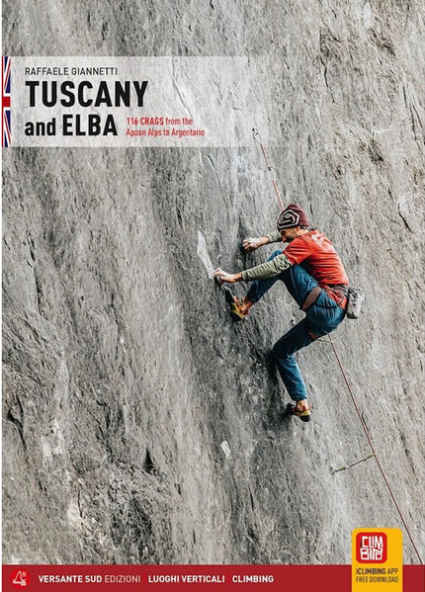
Tuscany and Isola d’Elba Rock Climbing Guidebook
Comprehensive coverage of Tuscan climbing including Le Rocchette’s three towers, Prima Torre, Seconda Torre, and Terza Torre. Essential for navigation with multiple sectors.
Buy from Climb EuropeWhere else to buy:
- Local climbing shops in Lucca/Pisa/Florence may stock copies
- Online: Amazon UK (search “Tuscany climbing guidebook”)
Why the guidebook is essential: With three towers and multiple sectors spread across different faces, navigation is complex. Online resources (TheCrag, Mountain Project) have very limited info — no detailed topos, minimal route descriptions. The guidebook is your map. Don’t go without it.
Online Resources
- TheCrag: Basic route database (limited detail for Le Rocchette)
- Mountain Project: Some user-submitted info
- ToscoClimb.it: Italian resource with approach info
- Italian Climbing Forums: Search “Le Rocchette Garfagnana” for trip reports
Seasons & Weather
Year-Round Climbing
Le Rocchette’s altitude (1050m) provides excellent conditions for extended seasons. Year-round climbing possible due to altitude (stays cooler in summer, milder in winter).
Spring (Mar-May)
⭐⭐⭐⭐⭐ IDEAL. Perfect temps (15–22°C), wildflowers in forest, less crowded, excellent conditions. Road definitely passable (snow melted). Tuscany is stunning in spring.
Summer (Jun-Aug)
⭐⭐⭐⭐ GOOD. Can get hot in Lucca/valleys (30°C+) but Le Rocchette stays pleasant at 1050m (20–28°C). Beech trees provide shade. Climbing possible all day with shade management.
Autumn (Sep-Nov)
⭐⭐⭐⭐⭐ EXCELLENT. Our favourite season. Temps perfect (15–23°C), beech forest turns golden, fewer tourists, stable weather. September is peak climbing season in Tuscany. October adds autumn colours.
Winter (Dec-Feb)
⭐⭐⭐ POSSIBLE BUT RISKY. Depends heavily on snow. Dirt road to Piglionico may be impassable with snow/ice. Lucca valley stays mild but mountains get snow. Check road conditions before driving up. Not reliable.
Verdict: Plan for April–May or September–October for guaranteed good conditions and perfect Tuscan weather.
Budget & Costs
Tuscany is surprisingly budget-friendly outside the main tourist zones. Here’s what you can expect to spend:
💰 Budget Vanlife
€30–50/day (2 people)
Parking €3 • Groceries €15–20 • Fuel €5–10 • Gelato €3–5
🏕️ Mid-Range
€50–70/day
Camping a’Zania €20–30 • Meal out €15–20 • Groceries €10
🏨 Comfortable
€100–150/day
Hotel Lucca €60–100 • Meals €30–40 • Parking/fuel €10
Compared to Europe: Tuscany is genuinely budget-friendly. Compared to Dolomites (expensive rifugios, tourist prices) or Finale Ligure (limited food options), Tuscany offers world-class climbing + incredible food + culture at reasonable prices. You can do a week-long Tuscany climbing trip on a reasonable budget — that’s rare in Italy.
Sample Weekly Budget (Vanlife)
| 🚗 Parking (7 days) | €21 (€3/day at crag) |
| 🛒 Groceries | €105–140 (cooking in van) |
| ⛽ Fuel | €35–70 (crag drives + exploring) |
| 🍕 Meals Out | €50–80 (2-3 meals in Lucca) |
| 🍦 Gelato | €20–35 (daily essential) |
| Total | €231–346 / week (2 people) |
💡 Money-Saving Tips: Shop at Conad/Esselunga in Lucca before heading to Garfagnana • Cook breakfast/lunch in van, eat dinner out in Lucca • Wild camp at Piglionico (free) instead of paid camping • Fill water at petrol stations (free) • Visit Lucca on rest days (cheaper parking than climbing days)
Access, Ethics & Community
Italian climbing access is generally excellent. Le Rocchette has no major restrictions and remains open year-round.
Critical: The Italian climbing community has worked hard to maintain good relationships with local landowners and authorities. Help preserve access by being respectful, following rules, packing out all rubbish, and representing climbers positively.
Best Practices
🗑️ Leave No Trace
Pack out everything. No rubbish left at crag, parking areas, or campsites. Zero trace policy.
🚪 Respect Property
Some approach trails cross private land. Close gates, stay on trails, be courteous to landowners.
🏕️ Wild Camping
Arrive evening, leave morning. No obvious setup (awnings, chairs, tables). Be quiet and discreet.
🚽 Toilet Facilities
None at crag. Use facilities before/after. Emergency: cathole 15cm+ deep, 50m+ from trails/water. Pack out TP.
🔩 Bolting Ethics
Do not add bolts or routes without consulting local climbing organisations. Respect existing development.
🔇 Noise Levels
Keep volumes down at crag and parking. Respect local residents and other climbers seeking solitude.
Meeting Local Climbers
Le Rocchette is genuinely little-known even within Italy. You’re unlikely to meet large groups, but local climbers from Lucca, Pisa, and Florence do visit.
🏪 Climbing Shops in Lucca
Ask at outdoor sports shops in Lucca for beta, guidebooks, and local contacts. Staff often climb and can provide current conditions.
💬 Italian Climbing Forums
Alpinismo.com and ToscoClimb.it have active communities with trip reports and local beta.
Basic Italian Phrases
| 🌅 Good morning/hello | “Buongiorno” (bwon-JOR-noh) |
| 🙏 Thank you | “Grazie” (GRAH-tsee-eh) |
| ✋ Please | “Per favore” (pehr fah-VOH-reh) |
| 📍 Where is…? | “Dove si trova…?” (DOH-veh see TROH-vah) |
| 🧗 Climbing | “Arrampicata” (ah-rahm-pee-KAH-tah) |
| 😅 Excuse me/Sorry | “Scusa” (SKOO-zah) |
Supporting Local Communities
Shop locally: Buy groceries in Gallicano or Castelnuovo rather than stocking up in cities. Eat at local trattorias. Support small businesses.
Visit Lucca: Spend money in the medieval city. Walk the walls, visit cafés, eat at restaurants. This climbing trip works because of the culture — support it.
Respect the solitude: Part of Le Rocchette’s magic is that it’s undiscovered. Share respectfully. Don’t blast it on social media as “Europe’s hidden gem!!!” Let it remain special.
What We Loved (And What You Should Know)
The Brilliant Bits
The crowds (or lack thereof). Having 171 routes with almost nobody there is a luxury in modern European climbing. You can project routes, take your time, not stress about queues. Bliss.
The rock quality. Compact Tuscan limestone that forces you to climb well. We improved our footwork and technique here more than at any “easier” crag. Good climbing makes you better.
The Tuscany lifestyle. Climbing mornings, Lucca afternoons, wine and pasta evenings. This is the trip that balances hard climbing with la dolce vita. Your body gets worked, your soul gets fed.
The beech forest setting. Different vibe to alpine crags or sea cliffs. Gentler, greener, dappled light through trees. Beautiful in an understated way.
The value. Compared to Dolomites (expensive rifugios, tourist prices) or Finale Ligure (limited food options), Tuscany offers world-class climbing + incredible food + culture at reasonable prices.
The Things to Know
Not beginner-friendly like Lagazuoi. The rock is technical, compact, requires good footwork. 5.7s here feel harder than 5.7s on juggy crags. Better for 5.9+/6a+ climbers upward who want to improve technique.
Guidebook essential. With three towers and multiple sectors, you need the “Tuscany and Isola d’Elba” guidebook to navigate and find routes. Online resources are minimal.
Dirt road access. The final ~15km to Piglionico is unpaved. Fine in good weather, potentially muddy/sketchy after rain, impassable with snow. Standard vans can do it, but low-clearance cars might struggle in bad conditions.
No facilities. Unlike rifugio culture in Dolomites, Le Rocchette has nothing at the crag. Bring all water, food, first aid. Plan accordingly.
Limited online info. Most resources are in Italian. TheCrag/MountainProject have basic info but limited detail. You’re relying on the guidebook and your navigation skills.
Frequently Asked Questions
Is Le Rocchette suitable for beginners who can climb 6a in the gym?
Borderline. The rock is compact and technical — gym 6a climbers will likely find outdoor 5.7–5.8 (5c–6a) routes here challenging. But that’s not a bad thing! If you want to improve your technique on real limestone, this is perfect. Just expect the learning curve.
Better beginner option: If you want easier Tuscany climbing, look for crags in Camaiore (Il Camaiorese) near Viareggio — described as “best sport climbing area in Tuscany” with more routes across all grades.
Le Rocchette is ideal for: Intermediate climbers (6a+/6b upward in gym) wanting to transition outdoors and learn proper limestone technique.
Can I actually van camp at Piglionico parking without problems?
Probably yes, but be discreet. Piglionico is the end of a dirt road in the mountains — not a policed area. Overnight parking in vans is common in Italian mountain regions if done respectfully.
Best practices: Arrive evening, leave morning (don’t set up camp for days) • No awnings, tables, chairs outside • Pack out ALL rubbish • Be quiet and respectful
If you want guaranteed legal camping: Camping a’Zania in Molazzana is 10km away, ~€20–30/night.
How does Le Rocchette compare to famous Italian crags like Finale Ligure?
Different experiences:
Finale Ligure: 2000+ routes, international climbing destination, busy, coastal location, established infrastructure. Pure climbing focus.
Le Rocchette: 171 routes, almost unknown internationally, quiet, mountain forest, minimal infrastructure. Climbing + Tuscany culture/food.
Choose Finale if: You want maximum route variety, don’t care about crowds, want pure climbing holiday.
Choose Le Rocchette if: You want quieter climbing, value the Tuscany experience (Lucca, food, wine, culture), prefer solitude, and 171 routes is plenty for your trip length.
What’s the deal with Lucca? Is it worth basing there vs staying at the crag?
Lucca is BRILLIANT and absolutely worth visiting. It’s one of Italy’s most beautiful medieval cities and the 1hr drive to/from Le Rocchette is scenic and easy.
Option 1 — Base in Lucca: Stay in Lucca hotel/Airbnb, drive to crag for climbing days, enjoy city evenings. Best for comfort and culture.
Option 2 — Base at crag: Wild camp at Piglionico or stay at Camping a’Zania, visit Lucca for 1–2 days mid-trip. Best for budget and climbing focus.
Option 3 — Van life: Camp at crag climbing days, drive to Lucca for rest days, best of both worlds.
Our recommendation: If you have a week, split it: 3–4 days camping near crag, 2–3 days based in Lucca exploring the region. You get full Tuscany experience.
Can I climb at Le Rocchette if I don’t have the guidebook?
Not recommended. Online resources (TheCrag, Mountain Project) have very limited info — no detailed topos, minimal route descriptions, confusing sector names.
You need: “Tuscany and Isola d’Elba” rock climbing guidebook (available at Climb Europe). It has proper topos, sector maps, approach details, route descriptions.
Why: With three towers and multiple sectors spread across different faces, navigation is complex. The guidebook is your map. Don’t go without it.
Alternative: If you can’t get the guidebook before your trip, climb at La Grotta (cave parking) where routes are obvious, then buy guidebook in climbing shop in Lucca/Pisa/Florence if available.
What other climbing is nearby if I want to explore more of Tuscany?
Camaiore (Il Camaiorese) — 1hr west toward Viareggio. Described as “best sport climbing area in Tuscany.” Lots of routes, steep tufas, well-developed. Worth visiting.
Apuan Alps multi-pitch — Pizzo d’Uccello, Carrara area. Big alpine routes (100–1000m). Different style to Le Rocchette (trad gear often needed).
Island of Elba — 2hr+ drive + ferry. 8 crags, sea cliff climbing, granite, mid-range grades (F5–F7). Combine climbing with beach holiday.
Muzzerone (Liguria) — 1.5hrs north. Dramatic sea cliff climbing between Sestri Levante and La Spezia. Well-reviewed.
Our take: Le Rocchette + Camaiore makes a great 1-week Tuscany climbing trip. Add Lucca/Pisa/Florence for culture. Perfect combo.
🧗 Exploring More European Climbing?
Le Rocchette is just one of Europe’s incredible climbing destinations. Looking for more hidden gems and classic crags?
📍 Best European Destinations
Discover the top climbing destinations across Europe—from limestone paradises to granite bouldering havens.
Explore Destinations →🗺️ Best Climbing Spots Guide
Comprehensive guide to Europe’s best crags, sectors, and climbing areas—perfect for planning your next trip.
View All Spots →Final Thoughts
Le Rocchette represents something increasingly rare in European climbing: a genuinely undiscovered gem. With 171 routes across three limestone towers, proper technical climbing, and the added bonus of Tuscan culture, food, and wine, it’s difficult to imagine a better destination for climbers who value quality over quantity and solitude over crowds.
The crag works for intermediates to advanced climbers looking to improve technique on compact limestone. Beginners will find it challenging but rewarding. The real magic is the combination: world-class climbing in the morning, medieval Lucca in the afternoon, Tuscan wine in the evening.
Perfect for: Intermediate+ climbers seeking technical limestone • Vanlifers wanting budget-friendly Italy • Anyone combining climbing with cultural tourism • Climbers tired of crowds • People who appreciate proper Tuscan food and wine
Final recommendation: Allocate at least 3–4 days for climbing, add 2–3 days exploring Lucca and the region. Buy the guidebook. Go in spring or autumn. Be discreet with wild camping. Support local businesses in Lucca. Enjoy the solitude.
Share Your Le Rocchette Experience
Have you climbed at Le Rocchette? Which sectors did you love? Any hidden gems or beta to share? Drop your experiences in the comments below to help keep this gem alive for the community.
Le Rocchette Crag Context & Beta
Keywords: Tuscany Limestone Sport Climbing • Garfagnana Hidden Crags • Lucca Climbing Base • Prima Torre Seconda Torre Terza Torre • Compact Technical Limestone • Italian 5c-8b+ Routes • Beech Forest Climbing Italy • Budget Tuscany Climbing • Van Life Garfagnana • Piglionico Parking
🧗 Explore Our Climbing Guides
Detailed crag guides from our van life climbing adventures across Europe