Climbing Chalk Bags 2026: Types, Reviews & The Complete Chalk Guide
Everything you ever wanted to know about climbing chalk — and the bag you carry it in. From magnesia to liquid chalk, hip bags to bouldering buckets, and why a chalk bag makes the perfect climbing gift.
A chalk bag is probably the last piece of climbing gear most people think about — and also the one that gets the most compliments at the crag. It gets sat on, stuffed in the bottom of a pack, knocked over on dirty rock, and generally treated with complete indifference. And yet, more than almost any other piece of kit, it is the one where climbers develop genuine preferences & attachments.
This guide covers two things: Whayt actually “chalk” is? The difference between types, what it does to your skin and the environment, and why you need it. Which ones are the best climbing chalk bags 2026 by types with three bag recommendations per category, all available on both Alpinetrek UK and Vertical Extreme DE.
And if you are reading this because you want a gift idea for the climber in your life — keep reading. A chalk bag is genuinely one of the best climbing presents you can give.
Your local climbing shop funds bolt replacement programmes and keeps the climbing community alive. These retailer links are for reference — always try your local specialist first.
View the 2026 Starter Pack →
🤍 What Is Climbing Chalk?
Climbing chalk is not the same chalk you used on a blackboard at school (which is Calcium Carbonate). Climbing chalk is magnesium carbonate (MgCO₃) — a naturally occurring mineral salt that’s a proper powerhouse at absorbing moisture. The name is something of a misnomer that has stuck because both are white powders used to coat your hands, but they are chemically distinct and behave very differently.
Note for the geeks: You might occasionally see Magnesium Hydroxide Carbonate listed on the back of liquid chalk bottles (like Petzl). While it’s a closely related “cousin” used to help the liquid consistency, it’s not the same as pure Magnesium Hydroxide (the stuff in antacids). For the best grip, you’re always looking for high-purity Magnesium Carbonate as the main event.
Magnesium carbonate is a powerful desiccant — it absorbs moisture. When you coat your fingers and palms with chalk before a hard move, it draws sweat away from the surface of your skin, temporarily increasing the friction between your skin and the rock or plastic hold.
The substance has been used in gymnastics and weightlifting for well over a century, and it entered climbing in the 1950s and 60s when American climber John Gill — a gymnast — introduced it to the sport. It is now ubiquitous in sport climbing, bouldering, and indoor climbing worldwide, though its use remains controversial in some outdoor trad climbing communities and is actively banned at certain crags where it visually marks the rock.
Several peer-reviewed studies have produced contradictory results on whether chalk actually improves grip. Some research suggests the chalk layer can create a fine lubricating dust between skin and rock that slightly reduces friction. Most climbers use it regardless — habit, placebo, and the psychological comfort of a familiar ritual are all real performance factors, even if the friction physics are contested.
⚗️ Chalk vs Magnesia — What’s the Difference?
Nothing — they are the same substance. “Magnesia” is simply the older and more technically correct name for magnesium carbonate (MgCO₃), derived from the Greek region of Magnesia where magnesite deposits were first described in antiquity. In climbing, the two terms are used completely interchangeably. If you see a product labelled “magnesia” at a climbing shop in Germany or Spain, it is the same white powder in your chalk bag.
The confusion sometimes arises because in French, climbing chalk is called magnésie, while English speakers call it chalk. In Germany and across continental Europe you will often see Magnesia on product labels. Same thing. One caveat: gymnastic chalk and lifting chalk sometimes contain talcum powder (magnesium silicate) as an additive, which actually reduces friction — the opposite of what climbers want. Always buy chalk specifically formulated for climbing or bouldering to avoid this issue.
🧪 Types of Chalk: Loose, Liquid, Block & Ball
Walk into any climbing shop and you will find chalk in four distinct formats, each with a different application method, texture, and use case. Understanding the differences helps you choose the right format for your climbing style and environment.
The classic format — finely ground magnesium carbonate that you scoop from your chalk bag directly onto your hands. It comes in textures from ultra-fine dust to coarser “chunky” chalk with larger fragments.
- Most common format worldwide
- Fine = more coverage, more dust
- Chunky = less dusty, easier to control
- Works in any chalk bag type
- Reapply frequently on hard climbing
Best for: Sport climbing, bouldering, all-round outdoor use
Magnesium carbonate suspended in isopropyl alcohol. You apply it directly to your hands from a squeeze bottle — the alcohol evaporates in seconds. Deep water soloing — once your hands are pretty much dry, you can make use of it.
- Longer-lasting base coat than loose chalk
- Almost zero airborne dust
- Alcohol content can be very drying
- Nice for Deep Water as easy to carry and apply once your hands are dry
Best for: Indoor gyms, competition climbing, humid conditions
Compressed magnesium carbonate in solid block form. You break or grind it yourself before use, giving you control over the final texture. Breaks down into loose powder with minimal airborne dust in the process.
- Less dusty to transport than loose chalk
- Very economical — often cheaper per gram
- Grind to your preferred texture
- Slightly more effort to prepare
- Less mess in your bag and pack
Best for: Trad climbers, travellers, anyone who wants less mess
Loose chalk sealed inside a porous fabric sock or mesh ball. You squeeze and pat it onto your hands through the fabric, dispensing a controlled amount of chalk with almost no airborne dust cloud.
- Minimal dust — ideal for gym climbing
- Consistent, controlled application
- Goes inside your chalk bag — not standalone
- Refillable versions available
- Less effective in very sweaty conditions
Best for: Indoor gyms, beginners, anywhere dust is restricted
At Fontainebleau in France, regular chalk is banned to protect the delicate sandstone. The local alternative is colophony (rosin), a pine tree resin sold as a sticky powder that improves friction without leaving white marks. You will also see it added to some liquid chalk formulas as a bonding agent. Pure colophony is gentler on the rock visually, though some argue it is harder to clean off holds over time. If you are climbing at Font or any crag with a chalk ban, check what local climbers use or prepare with Rosin Liquid Chalk on AlpineTrek.
🖐️ What Chalk Does to Your Skin
Chalk’s primary mechanism — absorbing moisture — works on your skin in the same way it works on the rock. This is both its benefit and its main drawback. Used in moderation, chalk keeps your hands dry enough to grip effectively. Used excessively, it strips the natural moisture and oils from your skin faster than your body can replenish them, leading to dryness, cracking, and flappers.
Climbers who chalk up obsessively between every move — a common anxiety habit rather than a performance strategy — often have chronically dry, cracked fingertips that actually reduce grip quality. The goal is dry but not desiccated.
⚠️ Signs You Are Over-Chalking
Skin that cracks at the fingertip creases, flappers that happen repeatedly at the same spots, fingertips that feel rough and scratchy rather than smooth, and white chalk residue that builds up into thick layers between sessions. Over-chalking is extremely common and almost always counterproductive.
✅ Skin Care After Climbing
Wash your hands thoroughly after every session to remove chalk residue. Apply a good hand cream while skin is still slightly damp — the classic among European climbers is Joshua Tree Climbing Salve or any simple unscented moisturiser. Moisturising consistently between sessions is how you keep skin healthy.
Liquid chalk contains isopropyl alcohol, which has been a bit of a double-edged sword for me personally. The isopropyl alcohol is noticeably more aggressive on skin than loose chalk — it evaporates fast but takes moisture with it, and if your skin is already on the dry side (mine is), you’ll feel it. The fix I’ve found: look for liquid chalk brands that add skin conditioners to the formula — a few of the better ones do, and the difference is real.
Chalk additives in some commercial formulas — particularly desiccants like silica or colophony — can also irritate sensitive skin. If you react badly to one brand of chalk, try a purer magnesium carbonate formula without additives. Brands like FrictionLabs and 8B+ market explicitly additive-free, skin-friendly options that are worth trying if standard chalk causes problems.
🌍 Chalk & the Environment
This is a topic the climbing community has been slow to engage with, but the environmental case is real and worth understanding. Climbing chalk has two distinct environmental impacts: the production impact and the crag impact.
The majority of the world’s magnesium carbonate is produced in China, where open-pit mining is the standard extraction method. The process is generally considered energy-intensive and can produce significant dust pollution affecting local communities. Depending on the quality of processing, some industry sources suggest trace contaminants may be present in the final product, though this varies considerably by brand and origin. Some brands have looked at alternative sourcing — notably Black Diamond with their Eco Gold chalk, which is documented as using magnesium carbonate derived from seawater desalination byproducts, significantly lowering the process impact. It’s one of the more interesting sustainability stories in climbing gear, though the broader industry is still largely dependent on conventional mining.
White chalk marks on dark rock are visually disruptive and can affect the experience at a crag, particularly at sandstone areas where chalk absorption into the rock can be permanent. Some crags ban chalk entirely — Fontainebleau being the most famous example. Beyond aesthetics, research on whether chalk residue affects rock surface texture is ongoing and inconclusive. What is clear is that excess chalk builds up on popular holds over time, and regular brushing with a stiff brush helps maintain hold condition for everyone. Leave your chalk brush in your bag and use it.
Practical steps you can take: use block chalk or chalk balls to minimise airborne dust; brush excess chalk off holds when you are done; check crag-specific rules before visiting new venues; and consider chalk brands that use cleaner sourcing if environmental impact matters to you.
❓ Do You Actually Need Chalk?
For most climbers, yes — in practice. If you climb sport or boulder at any meaningful intensity, sweaty hands are a genuine limiting factor, and chalk addresses it directly even if the science is nuanced. The ritual of chalking up also has a real psychological anchoring effect — it marks the transition from resting to trying, and that mental cue has value.
You do not need chalk for: top-roping as a complete beginner, indoor gym climbing at easy grades, or any climbing where the routes are well within your ability. Some climbers never use chalk and climb very well — particularly those with naturally dry hands. But if you are leading outdoors, projecting anything at your limit, or climbing on humid days, chalk will almost certainly help. The question is not whether to use it but how much — and the answer is almost always less than you think.
👜 Types of Chalk Bag
Chalk bags come in three main formats, each suited to different climbing contexts. The differences are practical rather than aesthetic — though with the extraordinary variety of designs, shapes, and materials now available, the aesthetic element is increasingly part of the appeal.
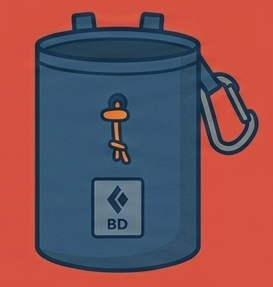
Hip Bag (Standard Chalk Bag)
The standard chalk bag for roped climbing — sport, trad, and multi-pitch. Cylindrical or tapered shape, worn on a waist belt clipped to your harness. Typically 12–16cm tall with a drawcord closure and a fleece-lined interior to hold chalk. You chalk up one-handed while on the wall.
Most hip bags include a stiff wire rim or moldable opening that holds its shape so you can reach in easily mid-climb. A small exterior zip pocket for a key, blister pack, or headtorch is a useful bonus on longer routes.

Bouldering Bucket
A large-format chalk bag designed to sit on the ground at the base of a boulder problem. Much wider and deeper than a hip bag — you plunge both hands in between attempts and coat them thoroughly. Not worn during climbing.
Buckets often include exterior pockets for a phone, snacks, and tape, plus brush holders for your toothbrush. The best ones have a stiff base so they stand upright on uneven ground. Some have a zip closure to prevent spillage in your pack.

Fun & Character Bags
The chalk bag has become a genuinely expressive piece of kit. Shaped like animals, fruit, cacti, classic climbing icons, or made from beautiful hand-dyed fabrics and unusual materials — there is now a chalk bag for every personality and aesthetic.
Functionally identical to a standard hip bag, these designs are popular gifts, a way to stand out at the crag, and a small act of self-expression in a sport where most gear is fairly uniform. Nobody loses a chalk bag shaped like a cactus.
🎯 Hip Bags — 3 Recommendations
These are the bags that live on your harness for every roped climbing session. The priorities are a clean opening that stays rigid mid-climb, a secure drawcord closure, and a good fleece liner that distributes chalk evenly without clumping.
Our Hip Bag Picks
The go-to sport climbing hip bag — stiff wire rim holds its shape for one-handed access on the wall, quality fleece liner, simple drawcord. No fuss, works perfectly, won’t let you down on a hard clip. The benchmark hip bag at an honest price.
Alpinetrek UK → | Vertical Extreme DE →Built specifically for long routes and multi-pitch — two zippered exterior pockets, a brush holder, and a deep fleece-lined interior that holds plenty of chalk for a full day on the rock. The extra organisation is genuinely useful on trad and alpine days.
Alpinetrek UK → | Vertical Extreme DE →Petzl’s clever answer to harness organisation — a chalk bag with an integrated front zippered pocket large enough for your phone, tape, and essentials. Reduces the need for a separate gear pouch on sport climbing days. Clean design, reliable closure, comfortable on the harness.
Alpinetrek UK → | Vertical Extreme DE →🪣 Bouldering Buckets — 3 Recommendations
Bouldering buckets live on the ground. The priorities are a wide opening for two-handed access, a stable self-standing base, exterior pockets for phone and tape, and brush holders. Capacity matters — a good bucket holds enough chalk for a full session without needing to be topped up.
Our Bouldering Bucket Picks
DMM’s bouldering bucket is generously sized — holds mountains of chalk, four brushes, tape, sandpaper, and whatever else you need for a full session. Soft pile lining makes chalking up easy, and the wide opening is comfortable for both hands at once. A proper workhorse bucket from a brand that knows its hardware.
Alpinetrek UK → | Vertical Extreme DE →Moon’s bucket uses a dry-bag style closure — hook and loop, roll, and buckle — which keeps chalk genuinely sealed when you’re moving between problems or throwing it in a bag. Cuff the top open and it sits upright as a chalk pot at the wall. Mesh pocket on the outside for the essentials. A smart, well-thought-out design.
Alpinetrek UK → | Vertical Extreme DE →Mammut’s bouldering bucket with a dust-tight roll closure system, a zip pocket for your phone, and a mesh pocket for tape and brushes. Folds flat when empty so it takes no space in your pack. Practical carry handle for moving between boulders. Clean, no-nonsense design that does everything you need without overcomplicating it.
Alpinetrek UK → | Vertical Extreme DE →🎁 Fun & Gift Bags — 3 Recommendations
This is where things actually get a bit of personality. The market for novelty chalk bags and proper artisan gear has absolutely exploded lately — cheers to bouldering culture and climbing becoming a bit more trendy. Honestly, they do exactly the same job as a basic bag, but they’re heaps better to look at.
Our Fun Bag Picks
8BPlus is the market leader in character chalk bags — they make bags shaped like animals, food, monsters, and everything in between. The build quality is genuinely good: stiff opening, quality fleece, reliable drawcord. Available in a huge range of designs. Very popular as gifts.
Alpinetrek UK → | Vertical Extreme DE →YY Vertical do some cracking chalk bags — from sleek, minimalist gear to their “animal” range, which are more like cool, textured bits of art than your average plushie. Built solid, too — proper sturdy rims that don’t collapse when you’re digging for chalk, decent liners, and they’ll clip onto any belt no worries.
Alpinetrek UK → | Vertical Extreme DE →Italian climbing brand E9 makes chalk bags the same way they make their clothing — with genuine design attention and quality materials. Understated but distinctively stylish, their bags are popular with climbers who want something that looks good without shouting about it. The kind of gift a climber actually appreciates.
Alpinetrek UK → | Vertical Extreme DE →🎁 Chalk Bags as Gifts — Why They Work
I have never bought a chalk bag for myself. Every one I have ever climbed with came from a gym lost-and-found — forgotten by someone who had presumably upgraded to something nicer, or just left it there on a distracted Tuesday evening and never came back. I suspect a significant proportion of climbers share this experience. The chalk bag occupies a strange category in the gear hierarchy: you know you need one, you use one every session, and yet it somehow never quite rises to the level of a conscious purchase.
Which is exactly why it makes such a good gift. A climber who would never quite justify spending money on a chalk bag they actually liked — rather than the battered thing they found — will genuinely appreciate receiving one. Particularly because the chalk bag is the most personal and visible piece of kit on the harness. It is the first thing other climbers see when you rack up. It sits at eye level when you are belaying someone. It gets handled dozens of times per session.
A chalk bag without chalk is only half a present. A 100g or 200g bag of good loose chalk — Mammut, Black Diamond, or FrictionLabs if you want to splash out — makes the gift complete and immediately usable. Add a chalk ball if the recipient primarily climbs indoors. Total cost still comes in well under most gear purchases and is significantly more memorable than another pair of climbing socks.
The Chalk Bag Bottom Line
For roped climbing, the Black Diamond Mojo is the reliable workhorse. For multi-pitch and trad days, the Mammut Alpine gives you the organisation you need. For bouldering, any of the bucket picks will serve you well for years. And if you are buying for someone else — or finally treating yourself to something better than what you found in the gym lost-and-found — go for a character bag from 8Bplus.
You use your chalk bag every session. It might as well make you smile.
Frequently Asked Questions
Can I use climbing chalk for weightlifting or gymnastics?
Yes — climbing chalk (magnesium carbonate) is the same substance used in gymnastics and weightlifting. The difference is formulation: some gym chalk products contain talcum powder additives to reduce friction in gymnastics, which is the opposite of what you want for climbing grip. Always use chalk specifically labelled for climbing or bouldering to ensure you are getting pure magnesium carbonate without friction-reducing additives.
Is liquid chalk better than loose chalk?
Neither is categorically better — they serve different purposes. Liquid chalk creates a longer-lasting base coat and produces almost no airborne dust, making it mandatory in many indoor gyms. Loose chalk is faster to reapply and gives you more control over coverage. Many serious climbers use liquid chalk as a base before a hard attempt, then top up with loose chalk as needed. Liquid chalk is harder on skin due to the alcohol content, so moisturise consistently if you use it regularly.
Why is chalk banned at some crags?
White chalk marks on dark or coloured rock are visually disruptive and, at some crags, the chalk residue can be absorbed permanently into the rock surface — particularly sandstone. Fontainebleau in France is the most famous chalk-banned venue; climbers there use colophony (rosin) instead. Some UK gritstone and sandstone crags also discourage or ban chalk. Always check the local crag ethics before visiting a new venue, and brush off excess chalk from holds as a courtesy regardless of whether it is required.
How often should I fill my chalk bag?
For a standard hip bag, a 30–50g fill is sufficient for most sport climbing sessions. For bouldering in a bucket, 100–200g allows a full day without worrying about running low. Block chalk is economical for refilling — break off what you need and grind it into the bag. Keep a spare bag of chalk in the van or climbing pack so you are never caught short at the crag. Store chalk in a sealed bag or container away from moisture — it absorbs humidity and clumps if left open.
Can I wash my chalk bag?
Most chalk bags can be hand-washed in lukewarm water. Empty them fully first — including tipping them inside out to shake out residual chalk — then wash gently with mild soap, rinse thoroughly, and air-dry completely before refilling. Machine washing is generally not recommended as it can damage the wire rim, fleece liner, and drawcord mechanism. Check the specific manufacturer guidance for your bag. Character bags and novelty designs with special fabrics may need extra care.
Do I need both a hip bag and a bouldering bucket?
Not necessarily. Most hip bags can technically be used for bouldering by removing the waist belt and leaving the bag on the ground — the opening is just smaller than a dedicated bucket. That said, if you boulder regularly, a dedicated bucket makes the experience noticeably better. A hip bag for roped climbing and a bucket for bouldering is the ideal setup, but a single hip bag handles both adequately if budget or space is a constraint.
Is climbing chalk bad for the environment?
There are two distinct concerns. First, most magnesium carbonate is mined from open-pit operations in China — energy-intensive and locally polluting. Black Diamond’s Eco Gold chalk uses magnesium sourced from seawater desalination byproducts, which is a significantly cleaner alternative. Second, chalk residue on rock faces is visually disruptive and at sandstone crags can be absorbed into the rock semi-permanently. Using block chalk or chalk balls reduces airborne dust, brushing holds after climbing removes excess residue, and respecting local chalk restrictions are the practical steps that make the most difference.
🔍 Semantic & Keyword Index
Primary: best climbing chalk bags 2026 • climbing chalk bag guide • which chalk bag to buy climbing • Secondary: hip chalk bag sport climbing • bouldering bucket chalk bag • chalk bag gift climber • Black Diamond Mojo chalk bag review • Mammut Alpine chalk bag • Petzl Sakapoche review • DMM Edge boulder bag • Moon bouldering chalk bag • 8BPlus character chalk bag • what is climbing chalk • magnesium carbonate climbing • liquid chalk vs loose chalk • Long-tail: best chalk bag for sport climbing • best bouldering bucket chalk bag • chalk bag as climbing gift • difference between chalk bag types • loose chalk vs chalk ball climbing • is liquid chalk better than loose chalk • how to choose a chalk bag climbing • best chalk bag for trad climbing • funny climbing chalk bag gift idea • dyneema vs nylon chalk bag • chalk bag fleece liner • chalk bag with zip pocket • best bouldering chalk bag outdoor • climbing chalk skin care tips • does chalk actually improve grip climbing
🧗 Explore Our Climbing Guides
Detailed crag guides from our van life climbing adventures across Europe