Climbing Grade Conversion:
France, USA, UK & Beyond
Every grading system explained — what the numbers actually mean, why they differ, and how to convert between them without getting out of your depth.
🎒 Next up in your gear journey
Got your grade sorted? Now the pack that carries the rest.
Six European climbing backpacks tested — from ultralight sport crag packs to Chamonix-built alpine haulers. Real testing, current UK & DE sale prices.
📊 Master Grade Conversion Chart
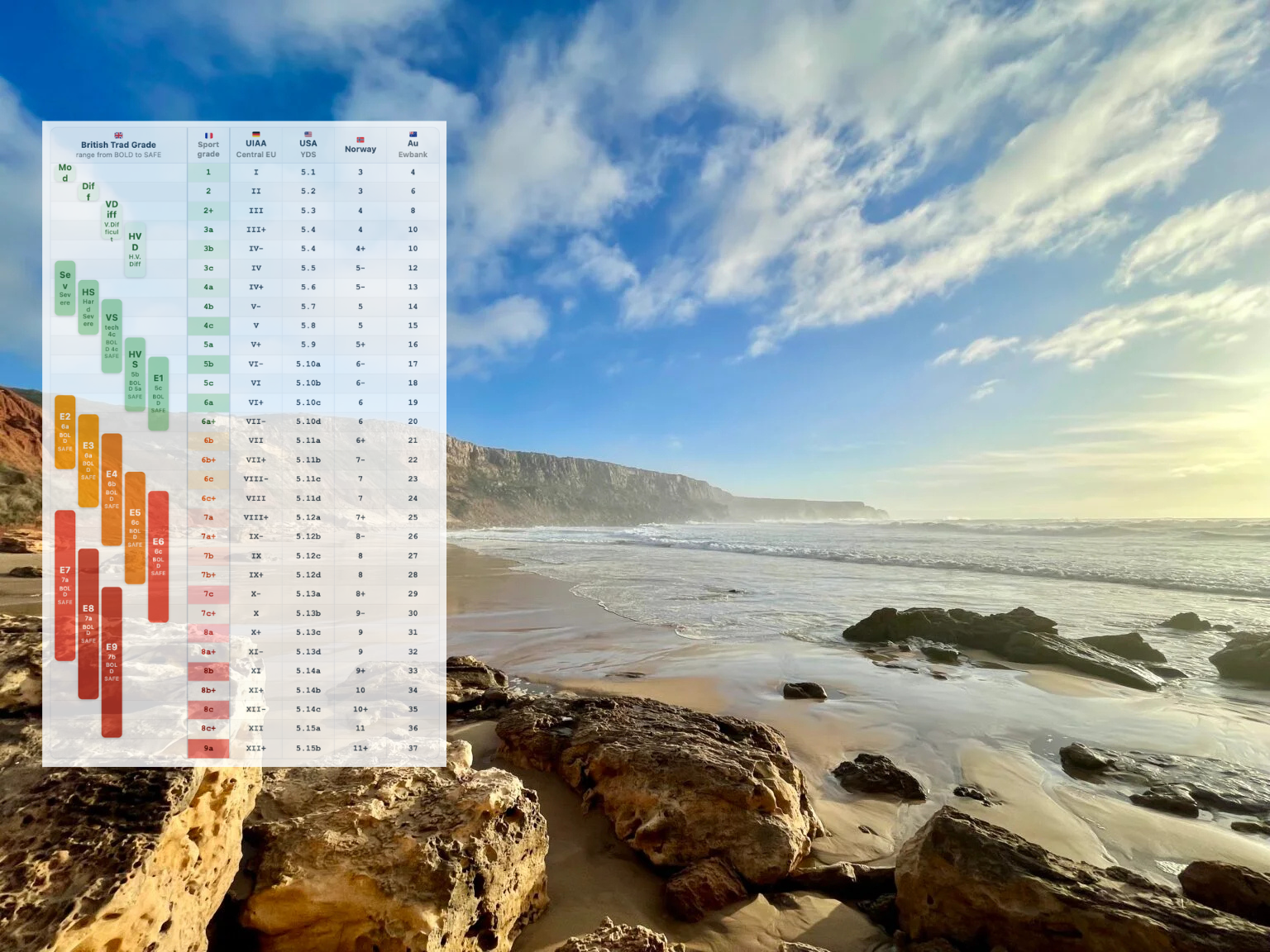
The following table is the most comprehensive conversion reference for European climbers. All conversions are approximate — grading systems measure different things, community grade cultures vary by area, and individual routes may feel harder or easier than their grade for your specific strengths and style. Use this as a planning guide, not a precise scientific equivalence.
The left-hand column shows a difficulty band label to give context. The table covers the practical sport climbing range — from first-route territory up to world-class performance.
British Trad blocks show the range each grade covers (top = BOLD/harder, bottom = SAFE) • All conversions approximate • rockvanlife.com
⚠️ All conversions are approximate. Grade equivalence varies by area, rock type, and community. Use as a planning guide only.
View the 2026 Starter Pack →
🌍 Why Grades Differ Around the World
This climbing grade conversion chart is the complete reference for European climbers — covering the French sport system, UK Trad adjectival grades, UIAA, Yosemite Decimal, and Ewbank, explaining what each one means and how to convert between them. Climbing grades were not invented by a single committee that sat down and decided on a universal standard. They evolved organically, country by country, crag by crag — each system reflecting the type of climbing that was most common there, the culture of the local community, and the era in which the routes were first ascended.
The French system developed around the limestone sport climbing of the Verdon and Fontainebleau in the 1970s and 80s, where bolted protection made objective safety less relevant and the grade could focus purely on technical difficulty. The UK system evolved around traditional sandstone and gritstone climbing where the consequences of falling — runout, poor gear, serious injury — are part of the grade’s meaning. The UIAA system emerged from Central European alpine traditions, where routes were long, committing, and graded by German and Austrian climbers who had their own conventions.
None of these systems is objectively correct. They each measure different things, which is precisely why conversion tables between them are always approximate rather than exact. A French 6c and an American 5.11b describe roughly the same technical difficulty — but one carries no information about protection or consequence, whilst the other may.
Grades describe technical difficulty. They do not describe danger, commitment, or how frightening a route is. Two routes with the same grade can be separated by a world of difference in terms of how scary they are to climb. This distinction — between technical difficulty and overall seriousness — is the heart of why the UK trad system uses two grades, and why it takes European climbers time to adjust when they first visit British crags.
There is also a practical problem that every travelling climber encounters: the guidebook for your Spanish crag uses French grades, but you learned to climb in the US and think in Yosemite Decimal System. Your German climbing partner uses UIAA. The British climber you meet at the campsite describes routes in adjectival grades. Understanding all of these systems — and how they translate — is one of the more genuinely useful skills a vanlifer can develop.
🇫🇷 The French Grade System
The Global Standard for Sport Climbing
The French numerical system is the dominant grading system for sport climbing worldwide, and certainly across all of Europe. If you climb sport routes in Spain, France, Portugal, Italy, Greece, or most of southern and central Europe, you are dealing with French grades. Understanding this system thoroughly is the single most useful investment a European climbing vanlifer can make. For the most current route grades across Europe, 27Crags and Rockfax are the definitive references.
The system runs from 1 to 9+, with each number subdivided by letters a, b, c — and each of those can be modified with a + to indicate the upper end of that subdivision. In practice, grades below 4 are rarely used in published guidebooks as they represent very easy scrambling. The meaningful sport climbing range begins around 5a and currently extends to 9c, which represents the absolute cutting edge of human climbing performance.
How the Letter Subdivisions Work
Within each number, the letters a, b, and c progress from easier to harder. A plus sign appended to any of these — 6a+, 6b+, 6c+ — indicates the upper portion of that subdivision, essentially bridging the gap between two letters. In practice this gives each number six distinct grades: 6a / 6a+ / 6b / 6b+ / 6c / 6c+. At the higher end of climbing, this granularity matters enormously: the difference between 8b and 8c represents hundreds of training hours.
The Benchmark Grades to Know
- 5a–5c — Accessible for beginners with some experience. Most people at a climbing wall can work towards this range.
- 6a–6b — The busy middle ground. Most leisure sport climbers climb in this range. A solid 6a on-sight is a reasonable measure of a competent recreational climber.
- 6c–7a — Moving into the performance range. Routes become more sustained, demanding footwork, technique, and specific strength.
- 7b–7c — Enthusiastic amateur territory. Requires dedicated training, good technique, and significant climbing experience.
- 8a — A milestone grade that represents a serious, trained athlete. Roughly 1–2% of sport climbers reach this level.
- 8c+/9a — World-class. Fewer than 200 people have climbed 9a.
Whether you’re in the Gorges du Verdon in France, Siurana in Spain, Arco in Italy, Kalymnos in Greece, or Sagres in Portugal — the grades on the bolted routes will be French. This system is the one to learn first and learn thoroughly. Everything else is a conversion from here.
🇬🇧 UK Trad: The Two-Part Grading System
The Most Complex and Most Informative System
The UK traditional grading system is the most sophisticated — and initially confusing — grading system in common use. It communicates information that no other system does: not just technical difficulty, but overall seriousness and commitment. This is why British climbers often struggle to translate their grades for continental climbing partners, and why European climbers visiting the UK for the first time find the grades mystifying.
A UK grade has two components: an adjectival grade (describing overall seriousness) and a technical grade (describing the hardest single move). Reading both together gives a picture of the route that a French grade simply cannot provide.
| Adjectival Grade | Abbreviation | What It Means |
|---|---|---|
| Moderate | M | Easy scrambling territory. Rarely roped. No technical crux. |
| Difficult | D | Requires a rope. Easy climbing, well-protected. Good introduction grade. |
| Very Difficult | VD | Stepping up from Difficult. Still manageable protection. |
| Severe | S or HS | Noticeably harder. Requires competent gear placement. Hard Severe is a step up. |
| Very Severe | VS | The entry to serious climbing. Technical moves, less-than-perfect gear possible. |
| Hard Very Severe | HVS | Demanding. Often well-protected but moves are difficult. The last “accessible” grade for many climbers. |
| Extremely Severe | E1–E11 | The open-ended modern scale. E1 is serious but manageable; E9+ is the current cutting edge of traditional climbing. |
The Technical Grade — The Second Number
Alongside the adjectival grade sits a technical grade: 4a, 4b, 4c, 5a, 5b, 5c, 6a, 6b, 6c, 7a, 7b. This describes the hardest single move on the route, independent of protection or consequence. A route graded HVS 5a has an adjectival seriousness of Hard Very Severe and a hardest move of 5a. A route graded E1 5b has a slightly more serious overall character but a slightly harder crux move.
How to Read Both Grades Together
VS 4c — Fairly technical overall seriousness, moves of 4c. Reasonable protection.
HVS 4c — Same move difficulty as the VS, but scarier overall — perhaps longer runouts or worse gear. The moves aren’t harder, but falling off has more consequence.
E2 5c — Hard moves AND serious consequence. A route where the crux is technical AND poorly protected.
E3 5c — Same move difficulty as the E2, but the route is more serious still — possibly a more significant fall potential or harder-to-place gear elsewhere on the pitch.
This two-part system means a visiting European sport climber who red-points 7a in France can comfortably climb the technical moves of most VS routes — but may find the overall commitment of a runout E1 on gritstone an entirely different psychological experience.
A French 6b and a UK E1 5b have roughly equivalent crux difficulty — but the E1 carries information about protection, consequences, and commitment that the French grade completely ignores. Never assume a grade conversion gives you the full picture when moving between sport and trad systems.
🇩🇪 UIAA: Central Europe’s Mountain Grade
Germany, Austria, Switzerland, Eastern Europe
The UIAA (Union Internationale des Associations d’Alpinisme) system was developed in Europe and uses Roman numerals running from I to XII, with plus and minus modifiers at each level. Originally conceived as a 6-grade system, it was extended upwards as climbing standards improved. Today the UIAA scale is used primarily in German-speaking countries (Germany, Austria, Switzerland), as well as much of central and eastern Europe — Czech Republic, Poland, Slovakia, Hungary, and parts of the Balkans.
The UIAA system was historically used across much of Europe before the French system’s dominance in sport climbing. In alpine contexts — particularly in the Alps, the Tatras, and the Dolomites — UIAA grades are still commonly encountered. A key point: UIAA V+ corresponds roughly to French 6a, which is a useful anchor grade for conversions. The systems track closely through the middle grades but diverge slightly at the extreme end, where French grades offer finer granularity.
🇦🇺 Ewbank: Australia & South Africa
Clean, Simple, Logically Consistent
The Ewbank system — developed in Australia by John Ewbank in the 1960s — is an open-ended numerical scale starting from 1, with no theoretical upper limit. It uses only whole numbers, with no letter or symbol modifiers. The current hardest routes are graded around 35–36. It is the standard system across Australia and is also used in South Africa.
The Ewbank system’s simplicity is its strength — each number represents a meaningful step up in difficulty, and the scale extends naturally without the awkward gaps and historical accidents of the YDS. Grade 20 is roughly equivalent to French 6a; grade 25 to roughly 7a.
🇺🇸 USA: The Yosemite Decimal System (YDS)
Worth Knowing, Not Worth Memorising
You will not encounter YDS grades on any European crag — the French system is universal here. It’s worth knowing the scale exists so you can follow American climbing content and communicate with North American partners, but it is not something you need to internalise as a European climber.
The system runs 5.0 to 5.15d, with letters a–d added from 5.10 upwards. One notable quirk: the jump from 5.9 to 5.10a is disproportionately large — a historical accident when the scale was extended beyond its original ceiling. See the conversion table above for French equivalents.
📍 Used in: USA and Canada. Not used anywhere in Europe.
⚙️ Sport vs Trad: Why the Grade Means Different Things
This is the distinction that most confuses climbers moving between disciplines, and between European and British crags in particular. A grade in sport climbing and a grade in traditional climbing communicate fundamentally different information, even when the number looks the same.
🔩 Sport Climbing
Routes protected by pre-placed, permanent bolt anchors drilled into the rock. The grade describes technical difficulty only. A fall at any point on a sport route is — in principle — safe: the bolt is there, the quickdraw catches the rope, you lower off.
- French grading system used universally
- Grade = technical difficulty of the hardest move or sustained section
- Protection quality is consistent and does not affect the grade
- Falling is a normal part of the process — encouraged for progression
- No rack of traditional gear required; quickdraws only
- Grades are relatively consistent between crags within the same country
🪨 Traditional Climbing
Routes where the leader places and removes their own protection — nuts, cams, hexes — in natural features of the rock. The grade communicates both technical difficulty AND the overall seriousness of the undertaking.
- UK adjectival + technical grade system used in Britain
- UIAA or local grades used for trad in continental Europe
- Grade accounts for: move difficulty, protection quality, runout sections, crux position relative to gear
- Falling is sometimes acceptable but sometimes catastrophic depending on grade and position
- Requires a rack: nuts, cams, slings to suit the crack systems
- Grade comparison between crags can be more variable
The Critical Difference in Practice
Consider a French 6c sport route and an E2 5c trad route in the UK. Both have a hardest move of roughly equivalent difficulty — around 5c in technical terms. But the sport climber has bolts every 2–3 metres and a clean fall onto their last clip. The trad climber may be 5 or 6 metres above a questionable wire placement, on rock where a fall would be serious.
This is why experienced trad climbers say that a French 7a sport climber cannot simply walk onto an E4 trad route. The technical ability is there. The mental skills, the gear placement experience, and the comfort with consequence are entirely separate competencies that require separate development.
Conversely, a strong UK trad climber visiting a sport crag in Spain for the first time may find their grades feel slightly sandbagged — not because the routes are harder, but because trad climbers often climb conservatively below their technical ceiling. A solid HVS trad climber may be technically capable of 6b or 6c sport routes, but will need a few sessions to adjust.
Experienced climbers often suggest that a competent climber’s trad lead grade × 1.5 levels gives their approximate sport on-sight level. So a confident HVS/E1 trad climber can typically on-sight around 6b/6c sport with a short adjustment period. This is approximate — body type, style, and specific strengths all affect it.
🪨 Bouldering Grades: Font Scale, V-Scale & Beyond
Bouldering uses completely separate grading systems from roped climbing, and for good reason: bouldering problems are short, unroped, and graded on difficulty of the individual moves with no consideration of height, protection, or consequence beyond a relatively low fall.
🪨 What Bouldering Grades Measure
A bouldering grade describes the difficulty of a short sequence of moves — typically 3 to 15 moves. It says nothing about height (most boulder problems are 3–6 metres), protection (no ropes, just crash pads), or commitment. The grade is determined by the hardest single move or the difficulty of linking several hard moves together.
- No rope, no gear — crash pads and spotters only
- Problems are short but can be extremely intense
- Grades determined by consensus from repeat ascents
- Two main systems: Fontainebleau (Font/FB) and Hueco (V-scale)
The Fontainebleau (Font) Scale — European Standard
Named after the legendary bouldering forest south of Paris, the Fontainebleau scale is the standard bouldering grade across Europe. It uses a similar numerical structure to the French sport grade — numbers from 1 to 9, with letter subdivisions a, b, c and plus modifiers — but the two scales are not the same and should not be conflated. A Font 6B is not equivalent to a French 6b sport route.
In practice, bouldering grades in Europe always use capitalised letters — 6B, 6B+, 6C — to distinguish them from sport grades (6b, 6b+, 6c). This typographic convention is important when reading topos and guidebooks.
The V-Scale — American Standard
Developed by John Sherman at Hueco Tanks in Texas, the V-scale (or Hueco scale) runs from VB (basic) through V0 to V17, which represents the current hardest boulder problems in the world. It is used universally in the USA and is familiar to most climbers globally due to the dominance of American climbing media and competition climbing.
Bouldering and sport grades are not directly comparable — bouldering trains explosive power on short sequences, while sport climbing requires endurance over longer distances. That said, experienced climbers often note rough equivalences:
Font 6A ≈ French 6a/6a+ sport · Font 6B ≈ 6b+/6c sport · Font 7A ≈ 7a/7a+ sport · Font 7B ≈ 7c sport · Font 8A ≈ 8b+ sport
A boulderer who climbs Font 7A does not automatically sport climb 7a — they may lack the endurance capacity. These equivalences are conversation starters, not predictions.
🗺️ European Climbing Grade System Map
Different countries across Europe use different grading systems for their climbing. The map below shows which system is dominant for sport and trad climbing in each major European climbing nation.
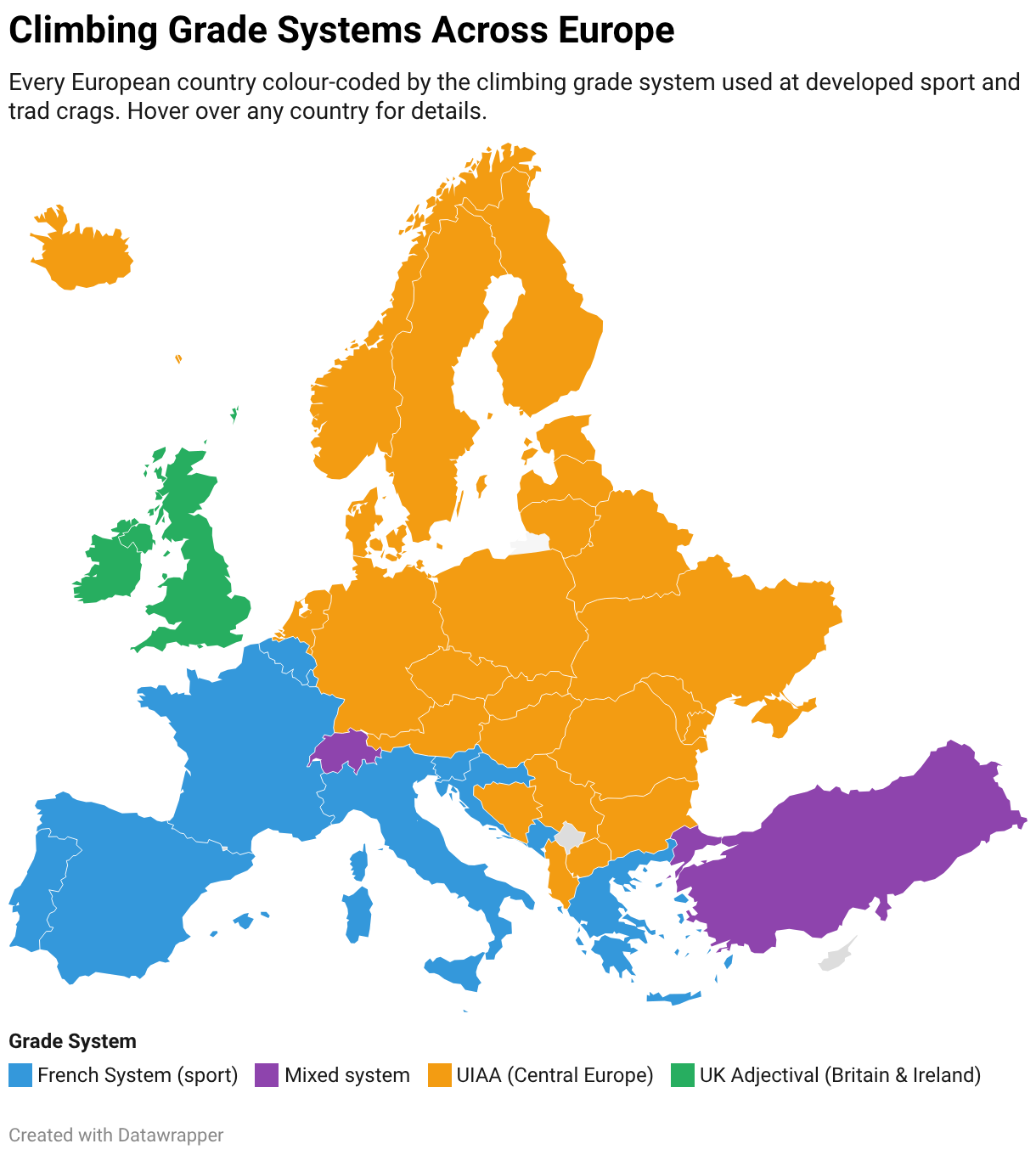
🖱️ Hover over any country to see which grading system is used. On mobile, tap a country. Data reflects the dominant system at developed sport climbing crags — alpine and trad routes within the same country may use different grades.
🧂 Sandbagging, Soft Grades & Regional Culture
No discussion of climbing grades is complete without addressing the elephant in the room: grades are not objective scientific measurements. They are community opinions, set by the first ascentionist and refined (sometimes) by subsequent ascents. This means that grading cultures vary enormously by country, by crag, and by era.
Which Countries Are Known for Which Grade Culture?
France — Generally considered to have the most internationally consistent sport grades, particularly at iconic crags like Céüse and Verdon. French grades at well-visited limestone sport crags are widely trusted as a benchmark.
Spain — Spanish grades have historically been considered slightly stiff (harder than the French grade suggests) at some crags, particularly in the Costa Blanca and older Andalusian areas. Newer routes at major crags like Siurana and Margalef are more calibrated to French standards. A Spanish 6c+ may feel like a French 7a to many visiting climbers.
UK — UK grades are famously harsh by continental standards. British climbers train on hard, poor-gear gritstone and sandstone, producing climbers who are technically strong but who grade conservatively. A UK E3 climber visiting French limestone sport crags typically finds they can climb routes several grades above their UK level. This is normal and expected — the systems measure different things.
Greece (Kalymnos) — The grading at Kalymnos has historically been considered slightly generous — particularly on technical difficulty — because the style (long, juggy, pumpy tufa climbing) suits certain body types very well. A powerful boulderer may find Kalymnos grades harder than expected; a tall, endurance-oriented climber may find them easier.
Italy — Italian grades at Arco and Finale Ligure are generally considered consistent with French standards. Older routes in Sicily and southern Italy may be slightly stiffer.
When arriving at a new crag or climbing in a new country for the first time, always begin two full grades below your usual level. This accounts for style differences, rock type, local grade culture, and the physical process of calibrating to a new crag. Pride is the number one cause of unnecessary struggle on new rock.
📚 Related Guides on Rock Vanlife
Planning where to use these grades? Our destination and tool guides have you covered.
🧗 Complete Your Van Life Climbing Setup
Grades understood — now get the right gear and planning tools in place.
❓ Frequently Asked Questions
What is the most common grading system in Europe?
The French numerical system (4a, 5a, 6b, 7c etc.) is the dominant grading system for sport climbing across Europe. From Portugal and Spain through France, Italy, Slovenia, Croatia, and Greece, all bolted sport routes use French grades. The UIAA Roman numeral system (III, V, VII+) is common in German-speaking countries and central and eastern Europe, particularly for trad and alpine climbing. The UK uses its own unique two-part adjectival system for trad routes, though sport crags in the UK often publish French grades alongside.
Is French 7a hard? What does it mean in real terms?
French 7a is a significant milestone in sport climbing — it represents the upper boundary of what most leisure climbers achieve, and the lower boundary of what could reasonably be called performance-level climbing. In practical terms, it requires solid technique, good strength-to-weight ratio, and deliberate training. Most estimates suggest that 5–10% of people who regularly climb outdoors reach 7a. In terms of conversions, French 7a corresponds approximately to American 5.11d, UIAA VIII−, Ewbank 24, and UK E3 5c/6a (technical difficulty).
How do UK trad grades compare to French sport grades?
The technical grade component of the UK system (4a, 4c, 5a, 5c, 6a etc.) maps reasonably well to the French system up to about 6b. The adjectival grade (the E-number) adds information about overall seriousness that has no direct French equivalent. A rough conversion for technical difficulty: VS ≈ French 5b/5c, HVS ≈ 6a, E1 ≈ 6b, E2 ≈ 6c, E3 ≈ 7a, E4 ≈ 7b, E5 ≈ 7c. However, these conversions are for technical move difficulty only — an E3 may feel far harder overall than a French 7a sport route because of protection, exposure, and commitment.
What is the difference between Font and V-scale bouldering grades?
Both are bouldering-only grade systems that describe difficulty of short, unroped problems. Font (Fontainebleau) is the European standard, using numbers with letters and plus signs: 6A, 6B, 6C, 7A, 7B etc. V-scale (or Hueco scale) is the American standard, running VB, V0, V1 … V17. They track each other closely: V0 ≈ Font 5, V3 ≈ Font 6A+, V6 ≈ Font 7A, V10 ≈ Font 7C+, V16 ≈ Font 8C+. In Europe you will almost always see Font grades. The important typographic note: Font bouldering grades use capital letters (6B, 7A) to distinguish them from French sport grades (6b, 7a).
Can I use my French sport grade to estimate what boulder problems I should try?
Yes, with important caveats. The rough equivalence most climbers use is Font ≈ French minus about one grade or subdivision: a French 6c sport climber might start on Font 6B boulders. However, bouldering tests power and short-term strength on specific movement styles, while sport climbing tests sustained endurance. A climber who is strong on long pumpy routes may find bouldering significantly harder than their sport grade suggests. Use the conversion as a starting point, not a prediction.
Why are Spanish grades often said to be harder than French?
This is a recognised cultural tendency rather than a universal rule. Historically, some Spanish crags — particularly in the Costa Blanca and older Andalusian areas — were graded by local climbers whose “6c” may correspond to what French climbers would call a “7a”. At major international crags like Siurana, Margalef, and increasingly at El Chorro, grades have been recalibrated towards international French standards through repeated ascents by climbers from across Europe. Always warm up a grade or two below your usual level at any new crag regardless of country.
What grading system does Italy use?
Italy uses French grades for sport climbing throughout the country — at Arco, Finale Ligure, Massone, Muzzerone, Rocchetta Sant’Antonio, and the Sardinian crags. For alpine routes in the Dolomites and the Western Alps, UIAA grades are traditional and widely used. When in doubt, assume French grades at any bolted sport crag and UIAA grades at any alpine or multi-pitch trad route in the mountains.
Does the UIAA system go up to the same level as the French system?
Yes — the UIAA system has been extended to XII and beyond to accommodate modern climbing standards. UIAA XII corresponds approximately to French 9a at the absolute cutting edge. In practice, the UIAA system becomes less useful at extreme grades because it does not offer the same fine granularity as the French system. This is one reason why even UIAA-dominant countries increasingly use French grades at the performance end of sport climbing.
I climb indoors — how do indoor grades relate to outdoor grades?
This varies significantly by climbing wall. Most European walls now publish French grades on their routes, but the calibration is set by the individual routesetter and can be inconsistent. Generally, indoor grades at the entry and intermediate level tend to be slightly generous compared to outdoor grades — a reason why many climbers find their first outdoor sessions harder than expected. The holds are sharper outdoors, the moves require more precise footwork, and there are no bolt-on footholds exactly where you need them. As a rough guide, expect to be one to two full grades lower on your first outdoor visits than your indoor level, and progress from there over several sessions.
🔍 Semantic & Keyword Index
Primary: climbing grade conversion Europe • French climbing grades explained • UK trad grades vs French grades • UIAA grade conversion • bouldering grade conversion Font V-scale • Secondary: Yosemite Decimal System conversion • Ewbank grade chart • climbing grade chart Europe • what is a French 7a • UK adjectival trad grade explained • sport vs trad grade difference • Font scale bouldering explained • European country climbing grade map • Spanish grades sandbagging • Italy climbing grade system • Greece climbing grades Kalymnos • Long-tail: how to convert climbing grades France UK USA • what grade should I climb in Europe • French 6c in American grades • UK E-grade conversion French • is Spanish 7a the same as French 7a • what countries use French climbing grades • UIAA to French grade conversion table
🧗 Explore Our Climbing Guides
Detailed crag guides from our van life climbing adventures across Europe
🇪🇸 Spain
🇫🇷 France
🇵🇹 Portugal
🇬🇧 UK
🇮🇹 Italy
📚 Helpful Climbing Resources
Essential guides, tips, and advice for your climbing adventures
🔧 Gear Lab
View all →
Black Diamond RockLock Review — Our Biggest, Toughest Locker
Read more →
Petzl Attache Review — The Most Versatile First Locker
Read more →🚐 Road Trip Essentials
View all →
10 Underrated European Sport Climbing Destinations (That We Actually Drove To)
Read more →
Van Life Electrical Setup 2026 — Our Exact Power System
Read more →📖 Climber's Handbook
View all →
Beginner Climbing Gear List 2026 – Everything You Need to Start Climbing Outdoors
Read more →